

S t À!
actionðtÞ
‘ hS t þ Dt
ð9Þ
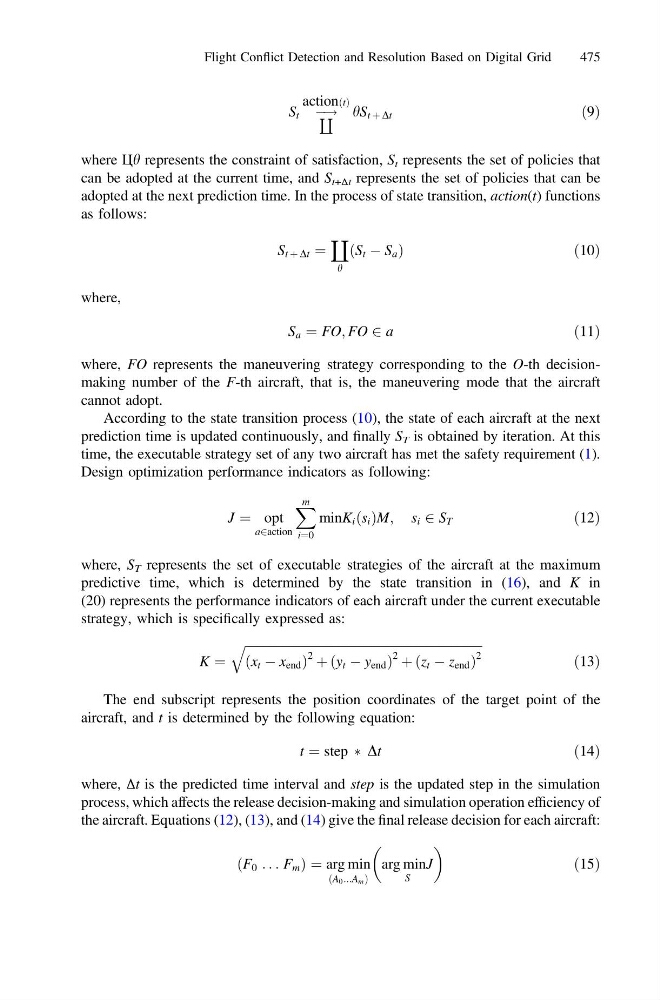
where Цh represents the constraint of satisfaction, S t represents the set of policies that
can be adopted at the current time, and S t+Δt represents the set of policies that can be
adopted at the next prediction time. In the process of state transition, action(t) functions
as follows:
S t þ Dt ¼
a
h
ðS t À S a Þ
ð 10Þ
where,
S a ¼ FO; FO 2 a
ð11Þ
where, FO represents the maneuvering strategy corresponding to the O-th decisionmaking number of the F-th aircraft, that is, the maneuvering mode that the aircraft
cannot adopt.
According to the state transition process (10), the state of each aircraft at the next
prediction time is updated continuously, and finally S T is obtained by iteration. At this
time, the executable strategy set of any two aircraft has met the safety requirement (1).
Design optimization performance indicators as following:
J ¼ opt
a2action
X m
i¼0
minK i ðs i ÞM; s i 2 S T
ð12Þ
where, S T represents the set of executable strategies of the aircraft at the maximum
predictive time, which is determined by the state transition in (16), and K in
(20) represents the performance indicators of each aircraft under the current executable
strategy, which is specifically expressed as:
K ¼
ffiffiffiffiffiffiffiffiffiffiffiffiffiffiffiffiffiffiffiffiffiffiffiffiffiffiffiffiffiffiffiffiffiffiffiffiffiffiffiffiffiffiffiffiffiffiffiffiffiffiffiffiffiffiffiffiffiffiffiffiffiffiffiffiffiffiffiffiffiffiffiffiffiffiffiffi
ðx t À x end Þ
2 þ ðy t À y end Þ
2 þ ðz t À z end Þ
2
q
ð13Þ
The end subscript represents the position coordinates of the target point of the
aircraft, and t is determined by the following equation:
t ¼ step à Dt
ð14Þ
where, Δt is the predicted time interval and step is the updated step in the simulation
process, which affects the release decision-making and simulation operation efficiency of
the aircraft. Equations (12), (13), and (14) give the final release decision for each aircraft:
ðF 0 . . . F m Þ ¼ arg min
ðA 0 ...A m Þ
arg minJ
S
ð15Þ
Flight Conflict Detection and Resolution Based on Digital Grid
475