

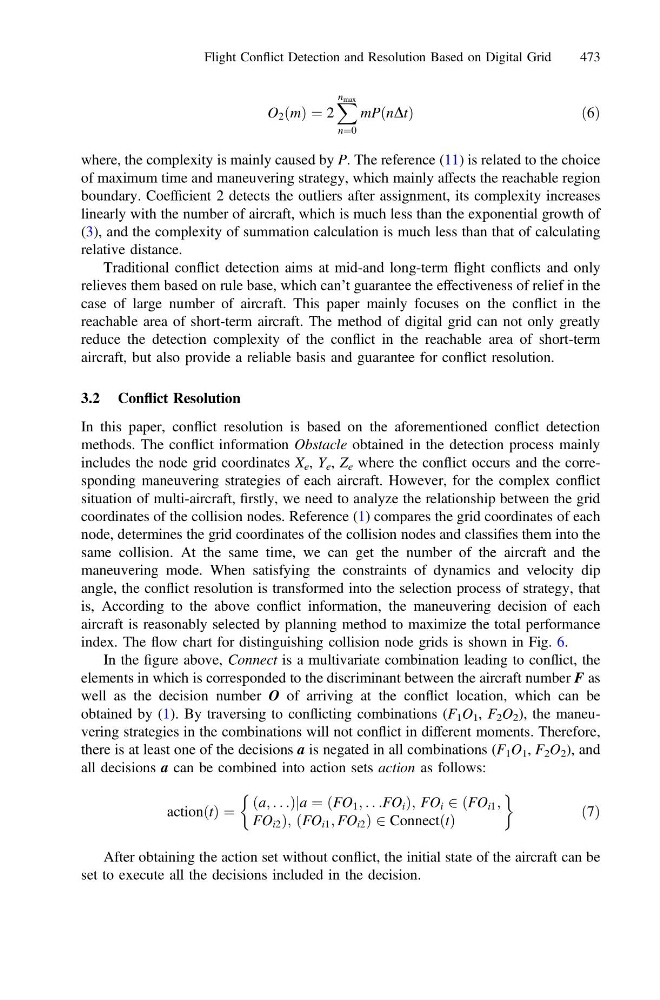
O 2 ðmÞ ¼ 2
X n max
n¼0
mPðnDtÞ
ð 6Þ
where, the complexity is mainly caused by P. The reference (11) is related to the choice
of maximum time and maneuvering strategy, which mainly affects the reachable region
boundary. Coefficient 2 detects the outliers after assignment, its complexity increases
linearly with the number of aircraft, which is much less than the exponential growth of
(3), and the complexity of summation calculation is much less than that of calculating
relative distance.
Traditional conflict detection aims at mid-and long-term flight conflicts and only
relieves them based on rule base, which can’t guarantee the effectiveness of relief in the
case of large number of aircraft. This paper mainly focuses on the conflict in the
reachable area of short-term aircraft. The method of digital grid can not only greatly
reduce the detection complexity of the conflict in the reachable area of short-term
aircraft, but also provide a reliable basis and guarantee for conflict resolution.
3.2 Conflict Resolution
In this paper, conflict resolution is based on the aforementioned conflict detection
methods. The conflict information Obstacle obtained in the detection process mainly
includes the node grid coordinates X e , Y e , Z e where the conflict occurs and the corresponding maneuvering strategies of each aircraft. However, for the complex conflict
situation of multi-aircraft, firstly, we need to analyze the relationship between the grid
coordinates of the collision nodes. Reference (1) compares the grid coordinates of each
node, determines the grid coordinates of the collision nodes and classifies them into the
same collision. At the same time, we can get the number of the aircraft and the
maneuvering mode. When satisfying the constraints of dynamics and velocity dip
angle, the conflict resolution is transformed into the selection process of strategy, that
is, According to the above conflict information, the maneuvering decision of each
aircraft is reasonably selected by planning method to maximize the total performance
index. The flow chart for distinguishing collision node grids is shown in Fig. 6.
In the figure above, Connect is a multivariate combination leading to conflict, the
elements in which is corresponded to the discriminant between the aircraft number F as
well as the decision number O of arriving at the conflict location, which can be
obtained by (1). By traversing to conflicting combinations (F 1 O 1 , F 2 O 2 ), the maneuvering strategies in the combinations will not conflict in different moments. Therefore,
there is at least one of the decisions a is negated in all combinations (F 1 O 1 , F 2 O 2 ), and
all decisions a can be combined into action sets action as follows:
actionðtÞ ¼
ða; . . .Þja ¼ ðFO 1 ; . . .FO i Þ; FO i 2 ðFO i1 ;
FO i2 Þ; ðFO i1 ; FO i2 Þ 2 ConnectðtÞ
ð7Þ
After obtaining the action set without conflict, the initial state of the aircraft can be
set to execute all the decisions included in the decision.
Flight Conflict Detection and Resolution Based on Digital Grid
473