

Chinese Named Entity Recognition with Changed BiLSTM and CRF
405
3.3 Experiment Result
After training our model with, we firstly use a new text to predict whether
our model has the ability to successfully analyze name entities. Here, we use a
sentence
“
”, and the result is
that “B-PRE” + “I-PER”:
“B-LOC” + “I-LOC”:
;
“B-ORG”
+
“I-ORG”:
. We can see that the result is totally
correct.
Table 1. Comparison result of different algorithms.
Model
CRF viterbi accuracy (%)
Embedding + LSTM
95.71
Embedding + CRF
96.57
Embddubg + BiLSTM
96.61
Embddubg + BiLSTM+CRF 97.41
Our model
97.87
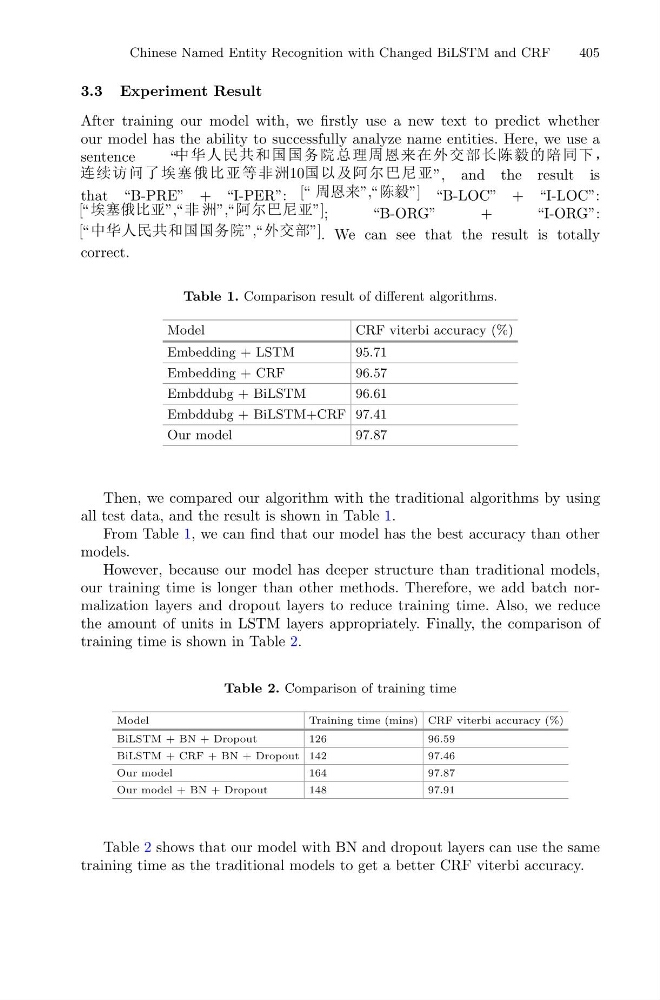
Then, we compared our algorithm with the traditional algorithms by using
all test data, and the result is shown in Table 1.
From Table 1, we can find that our model has the best accuracy than other
models.
However, because our model has deeper structure than traditional models,
our training time is longer than other methods. Therefore, we add batch normalization layers and dropout layers to reduce training time. Also, we reduce
the amount of units in LSTM layers appropriately. Finally, the comparison of
training time is shown in Table 2.
Table 2. Comparison of training time
Model
Training time (mins) CRF viterbi accuracy (%)
BiLSTM + BN + Dropout
126
96.59
BiLSTM + CRF + BN + Dropout 142
97.46
Our model
164
97.87
Our model + BN + Dropout
148
97.91
Table 2 shows that our model with BN and dropout layers can use the same
training time as the traditional models to get a better CRF viterbi accuracy.
405
3.3 Experiment Result
After training our model with, we firstly use a new text to predict whether
our model has the ability to successfully analyze name entities. Here, we use a
sentence
“
”, and the result is
that “B-PRE” + “I-PER”:
“B-LOC” + “I-LOC”:
;
“B-ORG”
+
“I-ORG”:
. We can see that the result is totally
correct.
Table 1. Comparison result of different algorithms.
Model
CRF viterbi accuracy (%)
Embedding + LSTM
95.71
Embedding + CRF
96.57
Embddubg + BiLSTM
96.61
Embddubg + BiLSTM+CRF 97.41
Our model
97.87
Then, we compared our algorithm with the traditional algorithms by using
all test data, and the result is shown in Table 1.
From Table 1, we can find that our model has the best accuracy than other
models.
However, because our model has deeper structure than traditional models,
our training time is longer than other methods. Therefore, we add batch normalization layers and dropout layers to reduce training time. Also, we reduce
the amount of units in LSTM layers appropriately. Finally, the comparison of
training time is shown in Table 2.
Table 2. Comparison of training time
Model
Training time (mins) CRF viterbi accuracy (%)
BiLSTM + BN + Dropout
126
96.59
BiLSTM + CRF + BN + Dropout 142
97.46
Our model
164
97.87
Our model + BN + Dropout
148
97.91
Table 2 shows that our model with BN and dropout layers can use the same
training time as the traditional models to get a better CRF viterbi accuracy.