

Chinese Named Entity Recognition with Changed BiLSTM and CRF
403
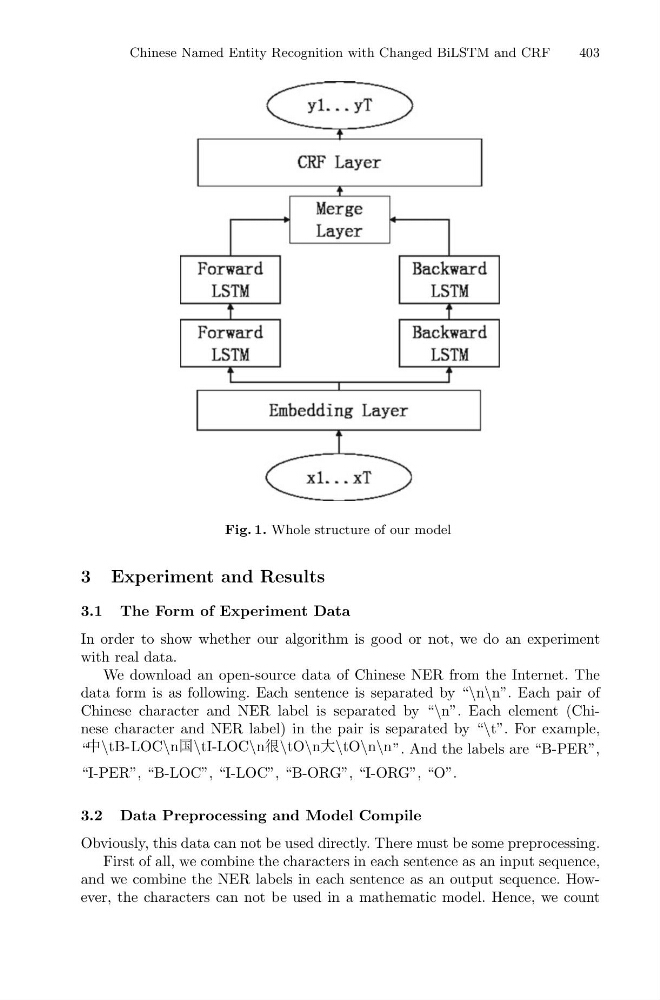
Fig. 1. Whole structure of our model
3 Experiment and Results
3.1 The Form of Experiment Data
In order to show whether our algorithm is good or not, we do an experiment
with real data.
We download an open-source data of Chinese NER from the Internet. The
data form is as following. Each sentence is separated by “\n\n”. Each pair of
Chinese character and NER label is separated by “\n”. Each element (Chinese character and NER label) in the pair is separated by “\t”. For example,
“ \tB-LOC\n \tI-LOC\n \tO\n \tO\n\n ”. And the labels are “B-PER”,
“I-PER”, “B-LOC”, “I-LOC”, “B-ORG”, “I-ORG”, “O”.
3.2 Data Preprocessing and Model Compile
Obviously, this data can not be used directly. There must be some preprocessing.
First of all, we combine the characters in each sentence as an input sequence,
and we combine the NER labels in each sentence as an output sequence. However, the characters can not be used in a mathematic model. Hence, we count
403
Fig. 1. Whole structure of our model
3 Experiment and Results
3.1 The Form of Experiment Data
In order to show whether our algorithm is good or not, we do an experiment
with real data.
We download an open-source data of Chinese NER from the Internet. The
data form is as following. Each sentence is separated by “\n\n”. Each pair of
Chinese character and NER label is separated by “\n”. Each element (Chinese character and NER label) in the pair is separated by “\t”. For example,
“ \tB-LOC\n \tI-LOC\n \tO\n \tO\n\n ”. And the labels are “B-PER”,
“I-PER”, “B-LOC”, “I-LOC”, “B-ORG”, “I-ORG”, “O”.
3.2 Data Preprocessing and Model Compile
Obviously, this data can not be used directly. There must be some preprocessing.
First of all, we combine the characters in each sentence as an input sequence,
and we combine the NER labels in each sentence as an output sequence. However, the characters can not be used in a mathematic model. Hence, we count