

The paper focuses on how to realize interactive learning, obtain knowledge and
improve operation strategies in cluster operation assessment system so as to adapt to
the environment and reach the ideal purpose [14–17]. UAV-borne computer is not
informed of subsequent act, and it can only make judgment by trying every movement.
Remarkably featured by trial-and-error-based search and delayed reward, reinforcement
learning realizes enhancement of optimal actions and optimal movement strategies by
making judgment on the environment’s feedback about actions and instructing subsequent actions based on assessment. In this way, UAV cluster operation can better
adapt to the environment [18].
2 UAV Cluster’s Task Allocation and Modeling
Task allocation in UAV cluster operation aims at confirming UAV cluster’s target and
attack task, designing the path and realizing maximal overall performances and least
cost in cluster attack. This is a multi-target optimization problem with numerous
restrictions. Optimization indicators include: maximal value return of target, maximal
coverage of target, minimal flight distance and least energy consumption. Restrictions
include a certain definition ratio of target surveillance, necessity of target’s location
within UAV platform’s attack diameter, limitations of each prohibition/flight avoidance
zone and a certain number of UAV platforms that surveil the same target (no exceeding
the limit), etc. [19].
Considering the features of multiple goals and restrictions, based on multi-target
optimization theory, the paper sets up an overall multi-target integral planning model
concerning UAV cluster’s automatic task allocation.
Set the number of UAV platforms and targets as N v and N T , respectively. Decisionmaking variable in design is: x i;j 2 0; 1
f g; i ¼ 1; 2; . . .; N T
f
g : 1 means that UAV
platform i targets at j, and it is the opposite in case of 0. Therefore, mathematical model
of task allocation in UAV cluster attack is established.
Target function
(1) Cluster’s least flight time f 1
One important indicator in UAV cluster’s attack task allocation is “least time of UAV
cluster’s task implementation as much as possible,” i.e., realizing shortest path of UAV
platform allocated with a task.
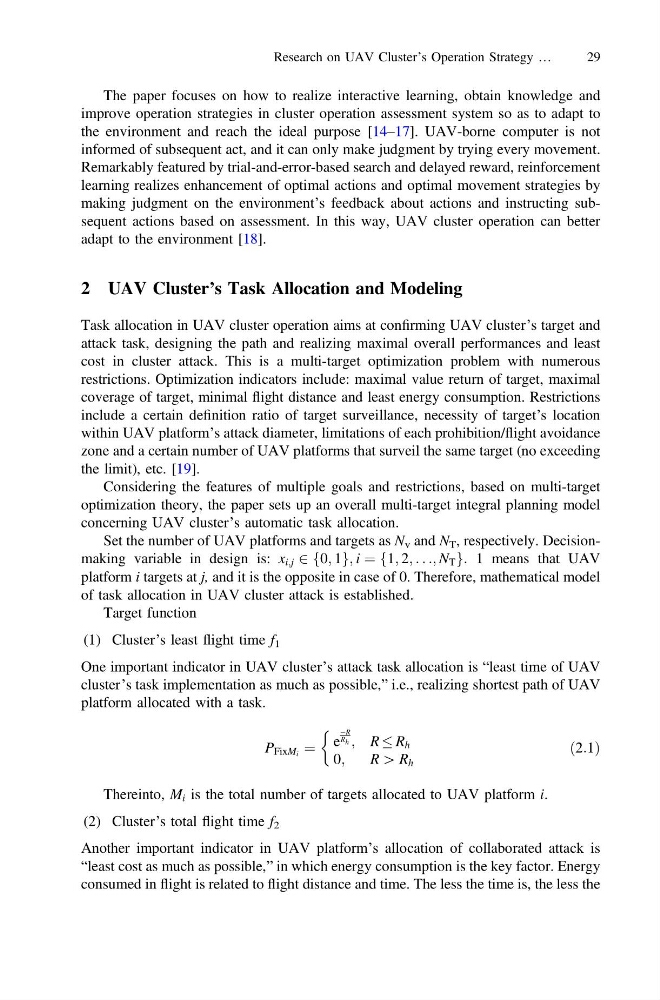
P FixM i ¼ e
ÀR
R h ; R R h
0;
R [ R h
ð2:1Þ
Thereinto, M i is the total number of targets allocated to UAV platform i.
(2) Cluster’s total flight time f 2
Another important indicator in UAV platform’s allocation of collaborated attack is
“least cost as much as possible,” in which energy consumption is the key factor. Energy
consumed in flight is related to flight distance and time. The less the time is, the less the
Research on UAV Cluster’s Operation Strategy …
29
improve operation strategies in cluster operation assessment system so as to adapt to
the environment and reach the ideal purpose [14–17]. UAV-borne computer is not
informed of subsequent act, and it can only make judgment by trying every movement.
Remarkably featured by trial-and-error-based search and delayed reward, reinforcement
learning realizes enhancement of optimal actions and optimal movement strategies by
making judgment on the environment’s feedback about actions and instructing subsequent actions based on assessment. In this way, UAV cluster operation can better
adapt to the environment [18].
2 UAV Cluster’s Task Allocation and Modeling
Task allocation in UAV cluster operation aims at confirming UAV cluster’s target and
attack task, designing the path and realizing maximal overall performances and least
cost in cluster attack. This is a multi-target optimization problem with numerous
restrictions. Optimization indicators include: maximal value return of target, maximal
coverage of target, minimal flight distance and least energy consumption. Restrictions
include a certain definition ratio of target surveillance, necessity of target’s location
within UAV platform’s attack diameter, limitations of each prohibition/flight avoidance
zone and a certain number of UAV platforms that surveil the same target (no exceeding
the limit), etc. [19].
Considering the features of multiple goals and restrictions, based on multi-target
optimization theory, the paper sets up an overall multi-target integral planning model
concerning UAV cluster’s automatic task allocation.
Set the number of UAV platforms and targets as N v and N T , respectively. Decisionmaking variable in design is: x i;j 2 0; 1
f g; i ¼ 1; 2; . . .; N T
f
g : 1 means that UAV
platform i targets at j, and it is the opposite in case of 0. Therefore, mathematical model
of task allocation in UAV cluster attack is established.
Target function
(1) Cluster’s least flight time f 1
One important indicator in UAV cluster’s attack task allocation is “least time of UAV
cluster’s task implementation as much as possible,” i.e., realizing shortest path of UAV
platform allocated with a task.
P FixM i ¼ e
ÀR
R h ; R R h
0;
R [ R h
ð2:1Þ
Thereinto, M i is the total number of targets allocated to UAV platform i.
(2) Cluster’s total flight time f 2
Another important indicator in UAV platform’s allocation of collaborated attack is
“least cost as much as possible,” in which energy consumption is the key factor. Energy
consumed in flight is related to flight distance and time. The less the time is, the less the
Research on UAV Cluster’s Operation Strategy …
29