

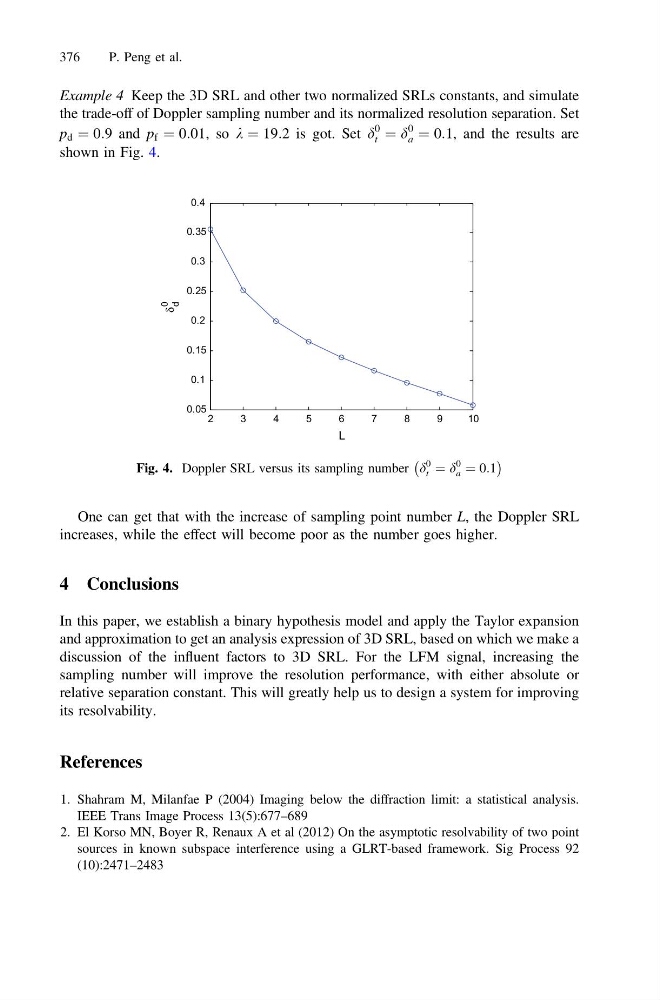
Example 4 Keep the 3D SRL and other two normalized SRLs constants, and simulate
the trade-off of Doppler sampling number and its normalized resolution separation. Set
p d ¼ 0:9 and p f ¼ 0:01, so k ¼ 19:2 is got. Set d
0
t ¼ d
0
a ¼ 0:1, and the results are
shown in Fig. 4.
One can get that with the increase of sampling point number L, the Doppler SRL
increases, while the effect will become poor as the number goes higher.
4 Conclusions
In this paper, we establish a binary hypothesis model and apply the Taylor expansion
and approximation to get an analysis expression of 3D SRL, based on which we make a
discussion of the influent factors to 3D SRL. For the LFM signal, increasing the
sampling number will improve the resolution performance, with either absolute or
relative separation constant. This will greatly help us to design a system for improving
its resolvability.
References
1. Shahram M, Milanfae P (2004) Imaging below the diffraction limit: a statistical analysis.
IEEE Trans Image Process 13(5):677–689
2. El Korso MN, Boyer R, Renaux A et al (2012) On the asymptotic resolvability of two point
sources in known subspace interference using a GLRT-based framework. Sig Process 92
(10):2471–2483
2
3
4
5
6
7
8
9
10
0.05
0.1
0.15
0.2
0.25
0.3
0.35
0.4
L
δ
d
0
Fig. 4. Doppler SRL versus its sampling number d
0
t ¼ d
0
a ¼ 0:1
À
Á
376
P. Peng et al.
the trade-off of Doppler sampling number and its normalized resolution separation. Set
p d ¼ 0:9 and p f ¼ 0:01, so k ¼ 19:2 is got. Set d
0
t ¼ d
0
a ¼ 0:1, and the results are
shown in Fig. 4.
One can get that with the increase of sampling point number L, the Doppler SRL
increases, while the effect will become poor as the number goes higher.
4 Conclusions
In this paper, we establish a binary hypothesis model and apply the Taylor expansion
and approximation to get an analysis expression of 3D SRL, based on which we make a
discussion of the influent factors to 3D SRL. For the LFM signal, increasing the
sampling number will improve the resolution performance, with either absolute or
relative separation constant. This will greatly help us to design a system for improving
its resolvability.
References
1. Shahram M, Milanfae P (2004) Imaging below the diffraction limit: a statistical analysis.
IEEE Trans Image Process 13(5):677–689
2. El Korso MN, Boyer R, Renaux A et al (2012) On the asymptotic resolvability of two point
sources in known subspace interference using a GLRT-based framework. Sig Process 92
(10):2471–2483
2
3
4
5
6
7
8
9
10
0.05
0.1
0.15
0.2
0.25
0.3
0.35
0.4
L
δ
d
0
Fig. 4. Doppler SRL versus its sampling number d
0
t ¼ d
0
a ¼ 0:1
À
Á
376
P. Peng et al.