

The test case is a real-time bi-directional audio stream between node 1 and node 2.
And then node 3, which is configured as the relay node, is inserted between node 1 and
node 2. The audio stream, employing the G.711a code, is sent at 4 ms intervals with the
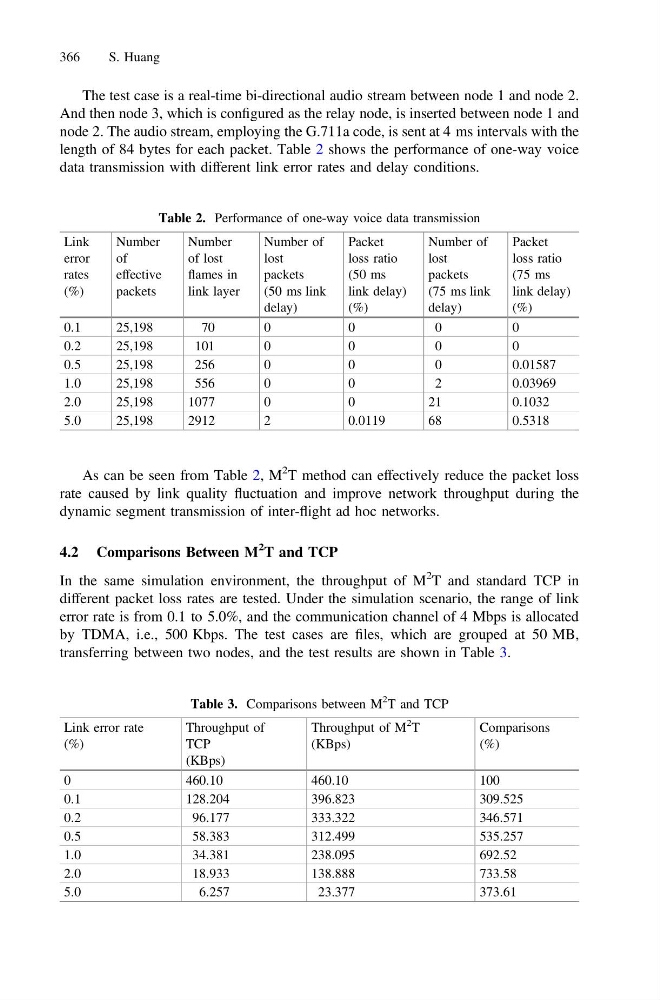
length of 84 bytes for each packet. Table 2 shows the performance of one-way voice
data transmission with different link error rates and delay conditions.
As can be seen from Table 2, M
2 T method can effectively reduce the packet loss
rate caused by link quality fluctuation and improve network throughput during the
dynamic segment transmission of inter-flight ad hoc networks.
4.2 Comparisons Between M
2 T and TCP
In the same simulation environment, the throughput of M
2
T and standard TCP in
different packet loss rates are tested. Under the simulation scenario, the range of link
error rate is from 0.1 to 5.0%, and the communication channel of 4 Mbps is allocated
by TDMA, i.e., 500 Kbps. The test cases are files, which are grouped at 50 MB,
transferring between two nodes, and the test results are shown in Table 3.
Table 2. Performance of one-way voice data transmission
Link
error
rates
(%)
Number
of
effective
packets
Number
of lost
flames in
link layer
Number of
lost
packets
(50 ms link
delay)
Packet
loss ratio
(50 ms
link delay)
(%)
Number of
lost
packets
(75 ms link
delay)
Packet
loss ratio
(75 ms
link delay)
(%)
0.1
25,198
70
0
0
0
0
0.2
25,198
101
0
0
0
0
0.5
25,198
256
0
0
0
0.01587
1.0
25,198
556
0
0
2
0.03969
2.0
25,198
1077
0
0
21
0.1032
5.0
25,198
2912
2
0.0119
68
0.5318
Table 3. Comparisons between M
2 T and TCP
Link error rate
(%)
Throughput of
TCP
(KBps)
Throughput of M
2
T
(KBps)
Comparisons
(%)
0
460.10
460.10
100
0.1
128.204
396.823
309.525
0.2
96.177
333.322
346.571
0.5
58.383
312.499
535.257
1.0
34.381
238.095
692.52
2.0
18.933
138.888
733.58
5.0
6.257
23.377
373.61
366
S. Huang
And then node 3, which is configured as the relay node, is inserted between node 1 and
node 2. The audio stream, employing the G.711a code, is sent at 4 ms intervals with the
length of 84 bytes for each packet. Table 2 shows the performance of one-way voice
data transmission with different link error rates and delay conditions.
As can be seen from Table 2, M
2 T method can effectively reduce the packet loss
rate caused by link quality fluctuation and improve network throughput during the
dynamic segment transmission of inter-flight ad hoc networks.
4.2 Comparisons Between M
2 T and TCP
In the same simulation environment, the throughput of M
2
T and standard TCP in
different packet loss rates are tested. Under the simulation scenario, the range of link
error rate is from 0.1 to 5.0%, and the communication channel of 4 Mbps is allocated
by TDMA, i.e., 500 Kbps. The test cases are files, which are grouped at 50 MB,
transferring between two nodes, and the test results are shown in Table 3.
Table 2. Performance of one-way voice data transmission
Link
error
rates
(%)
Number
of
effective
packets
Number
of lost
flames in
link layer
Number of
lost
packets
(50 ms link
delay)
Packet
loss ratio
(50 ms
link delay)
(%)
Number of
lost
packets
(75 ms link
delay)
Packet
loss ratio
(75 ms
link delay)
(%)
0.1
25,198
70
0
0
0
0
0.2
25,198
101
0
0
0
0
0.5
25,198
256
0
0
0
0.01587
1.0
25,198
556
0
0
2
0.03969
2.0
25,198
1077
0
0
21
0.1032
5.0
25,198
2912
2
0.0119
68
0.5318
Table 3. Comparisons between M
2 T and TCP
Link error rate
(%)
Throughput of
TCP
(KBps)
Throughput of M
2
T
(KBps)
Comparisons
(%)
0
460.10
460.10
100
0.1
128.204
396.823
309.525
0.2
96.177
333.322
346.571
0.5
58.383
312.499
535.257
1.0
34.381
238.095
692.52
2.0
18.933
138.888
733.58
5.0
6.257
23.377
373.61
366
S. Huang