

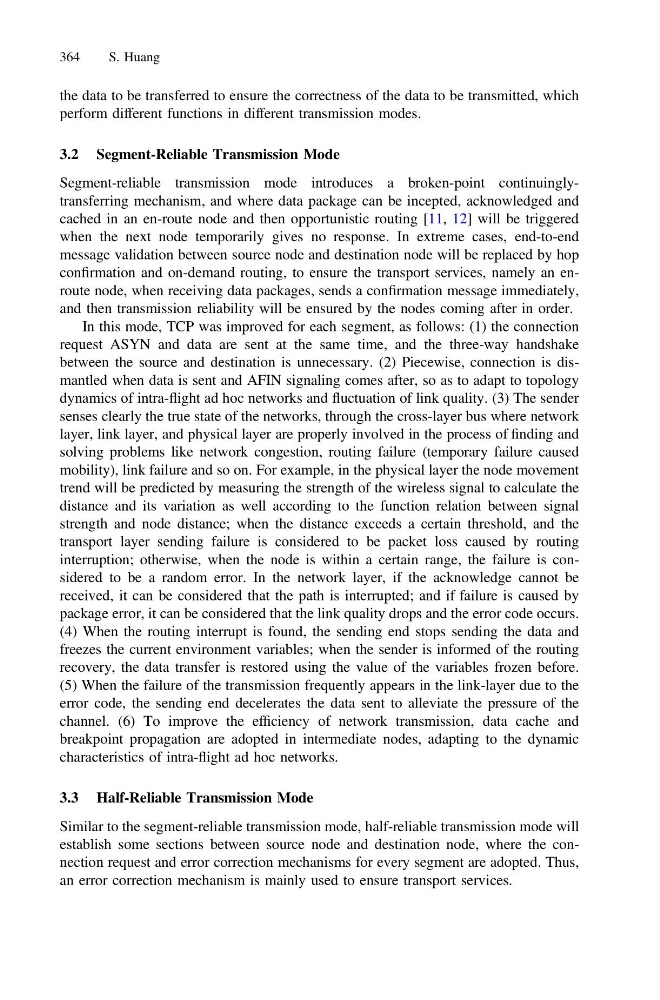
the data to be transferred to ensure the correctness of the data to be transmitted, which
perform different functions in different transmission modes.
3.2 Segment-Reliable Transmission Mode
Segment-reliable transmission mode introduces a broken-point continuinglytransferring mechanism, and where data package can be incepted, acknowledged and
cached in an en-route node and then opportunistic routing [11, 12] will be triggered
when the next node temporarily gives no response. In extreme cases, end-to-end
message validation between source node and destination node will be replaced by hop
confirmation and on-demand routing, to ensure the transport services, namely an enroute node, when receiving data packages, sends a confirmation message immediately,
and then transmission reliability will be ensured by the nodes coming after in order.
In this mode, TCP was improved for each segment, as follows: (1) the connection
request ASYN and data are sent at the same time, and the three-way handshake
between the source and destination is unnecessary. (2) Piecewise, connection is dismantled when data is sent and AFIN signaling comes after, so as to adapt to topology
dynamics of intra-flight ad hoc networks and fluctuation of link quality. (3) The sender
senses clearly the true state of the networks, through the cross-layer bus where network
layer, link layer, and physical layer are properly involved in the process of finding and
solving problems like network congestion, routing failure (temporary failure caused
mobility), link failure and so on. For example, in the physical layer the node movement
trend will be predicted by measuring the strength of the wireless signal to calculate the
distance and its variation as well according to the function relation between signal
strength and node distance; when the distance exceeds a certain threshold, and the
transport layer sending failure is considered to be packet loss caused by routing
interruption; otherwise, when the node is within a certain range, the failure is considered to be a random error. In the network layer, if the acknowledge cannot be
received, it can be considered that the path is interrupted; and if failure is caused by
package error, it can be considered that the link quality drops and the error code occurs.
(4) When the routing interrupt is found, the sending end stops sending the data and
freezes the current environment variables; when the sender is informed of the routing
recovery, the data transfer is restored using the value of the variables frozen before.
(5) When the failure of the transmission frequently appears in the link-layer due to the
error code, the sending end decelerates the data sent to alleviate the pressure of the
channel. (6) To improve the efficiency of network transmission, data cache and
breakpoint propagation are adopted in intermediate nodes, adapting to the dynamic
characteristics of intra-flight ad hoc networks.
3.3 Half-Reliable Transmission Mode
Similar to the segment-reliable transmission mode, half-reliable transmission mode will
establish some sections between source node and destination node, where the connection request and error correction mechanisms for every segment are adopted. Thus,
an error correction mechanism is mainly used to ensure transport services.
364
S. Huang
perform different functions in different transmission modes.
3.2 Segment-Reliable Transmission Mode
Segment-reliable transmission mode introduces a broken-point continuinglytransferring mechanism, and where data package can be incepted, acknowledged and
cached in an en-route node and then opportunistic routing [11, 12] will be triggered
when the next node temporarily gives no response. In extreme cases, end-to-end
message validation between source node and destination node will be replaced by hop
confirmation and on-demand routing, to ensure the transport services, namely an enroute node, when receiving data packages, sends a confirmation message immediately,
and then transmission reliability will be ensured by the nodes coming after in order.
In this mode, TCP was improved for each segment, as follows: (1) the connection
request ASYN and data are sent at the same time, and the three-way handshake
between the source and destination is unnecessary. (2) Piecewise, connection is dismantled when data is sent and AFIN signaling comes after, so as to adapt to topology
dynamics of intra-flight ad hoc networks and fluctuation of link quality. (3) The sender
senses clearly the true state of the networks, through the cross-layer bus where network
layer, link layer, and physical layer are properly involved in the process of finding and
solving problems like network congestion, routing failure (temporary failure caused
mobility), link failure and so on. For example, in the physical layer the node movement
trend will be predicted by measuring the strength of the wireless signal to calculate the
distance and its variation as well according to the function relation between signal
strength and node distance; when the distance exceeds a certain threshold, and the
transport layer sending failure is considered to be packet loss caused by routing
interruption; otherwise, when the node is within a certain range, the failure is considered to be a random error. In the network layer, if the acknowledge cannot be
received, it can be considered that the path is interrupted; and if failure is caused by
package error, it can be considered that the link quality drops and the error code occurs.
(4) When the routing interrupt is found, the sending end stops sending the data and
freezes the current environment variables; when the sender is informed of the routing
recovery, the data transfer is restored using the value of the variables frozen before.
(5) When the failure of the transmission frequently appears in the link-layer due to the
error code, the sending end decelerates the data sent to alleviate the pressure of the
channel. (6) To improve the efficiency of network transmission, data cache and
breakpoint propagation are adopted in intermediate nodes, adapting to the dynamic
characteristics of intra-flight ad hoc networks.
3.3 Half-Reliable Transmission Mode
Similar to the segment-reliable transmission mode, half-reliable transmission mode will
establish some sections between source node and destination node, where the connection request and error correction mechanisms for every segment are adopted. Thus,
an error correction mechanism is mainly used to ensure transport services.
364
S. Huang