

process of slow start. However, these solutions need building the end-to-end connection, and the delay produced cannot be endured for the low latency collaborative
information. Also for high dynamic air environment, it is difficult to guarantee the endto-end connection.
This paper integrates cross-layer perception (requirements of various businesses
and reasons of packet loss), cross-layer and lateral transmission, segmented handshake
for confirmation, error correction, put forwards a variety of transmission mode, like
segment-reliable mode, half reliable mode and efficient mode, and also the method of
adaptive handoff, to satisfy the various requirements of intra-flight ad hoc networks,
such as low latency, high reliability, large capacities and so on.
3 Multi Transmission Modes
According to the link characteristics of intra-flight ad hoc networks and to meet the
transmission requirements of instructions, intelligence, and control information, the
segment-reliable mode, half reliable mode, and efficient mode are proposed by
adopting different handshake and confirmation mechanisms based on segmented
connections at the transport layer.
3.1 Frame Structure of the Transmission Protocol
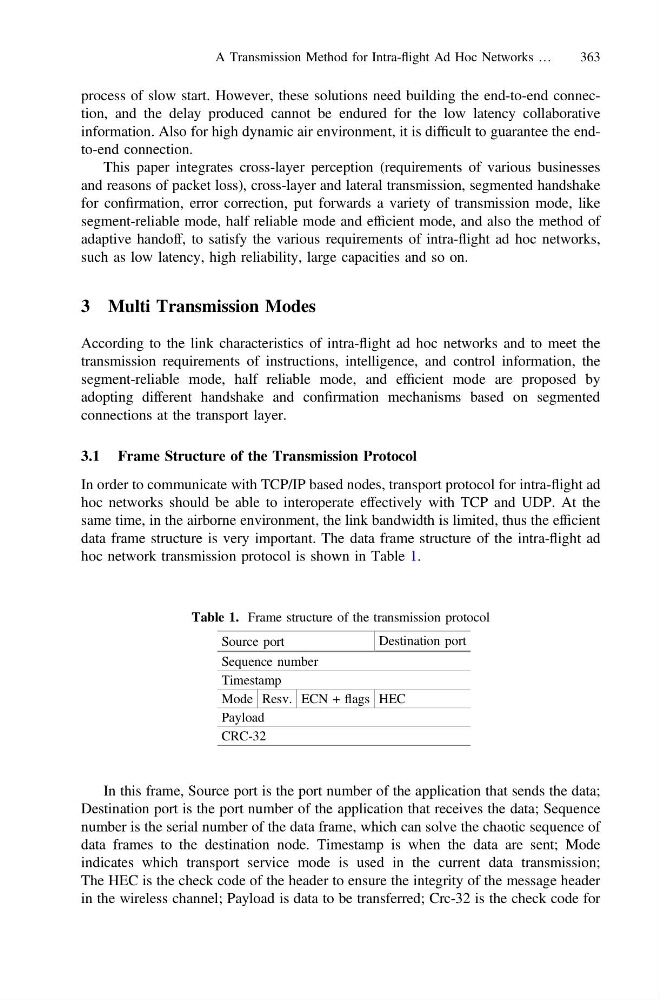
In order to communicate with TCP/IP based nodes, transport protocol for intra-flight ad
hoc networks should be able to interoperate effectively with TCP and UDP. At the
same time, in the airborne environment, the link bandwidth is limited, thus the efficient
data frame structure is very important. The data frame structure of the intra-flight ad
hoc network transmission protocol is shown in Table 1.
In this frame, Source port is the port number of the application that sends the data;
Destination port is the port number of the application that receives the data; Sequence
number is the serial number of the data frame, which can solve the chaotic sequence of
data frames to the destination node. Timestamp is when the data are sent; Mode
indicates which transport service mode is used in the current data transmission;
The HEC is the check code of the header to ensure the integrity of the message header
in the wireless channel; Payload is data to be transferred; Crc-32 is the check code for
Table 1. Frame structure of the transmission protocol
Source port
Destination port
Sequence number
Timestamp
Mode Resv. ECN + flags HEC
Payload
CRC-32
A Transmission Method for Intra-flight Ad Hoc Networks …
363
information. Also for high dynamic air environment, it is difficult to guarantee the endto-end connection.
This paper integrates cross-layer perception (requirements of various businesses
and reasons of packet loss), cross-layer and lateral transmission, segmented handshake
for confirmation, error correction, put forwards a variety of transmission mode, like
segment-reliable mode, half reliable mode and efficient mode, and also the method of
adaptive handoff, to satisfy the various requirements of intra-flight ad hoc networks,
such as low latency, high reliability, large capacities and so on.
3 Multi Transmission Modes
According to the link characteristics of intra-flight ad hoc networks and to meet the
transmission requirements of instructions, intelligence, and control information, the
segment-reliable mode, half reliable mode, and efficient mode are proposed by
adopting different handshake and confirmation mechanisms based on segmented
connections at the transport layer.
3.1 Frame Structure of the Transmission Protocol
In order to communicate with TCP/IP based nodes, transport protocol for intra-flight ad
hoc networks should be able to interoperate effectively with TCP and UDP. At the
same time, in the airborne environment, the link bandwidth is limited, thus the efficient
data frame structure is very important. The data frame structure of the intra-flight ad
hoc network transmission protocol is shown in Table 1.
In this frame, Source port is the port number of the application that sends the data;
Destination port is the port number of the application that receives the data; Sequence
number is the serial number of the data frame, which can solve the chaotic sequence of
data frames to the destination node. Timestamp is when the data are sent; Mode
indicates which transport service mode is used in the current data transmission;
The HEC is the check code of the header to ensure the integrity of the message header
in the wireless channel; Payload is data to be transferred; Crc-32 is the check code for
Table 1. Frame structure of the transmission protocol
Source port
Destination port
Sequence number
Timestamp
Mode Resv. ECN + flags HEC
Payload
CRC-32
A Transmission Method for Intra-flight Ad Hoc Networks …
363