

4 Conclusions
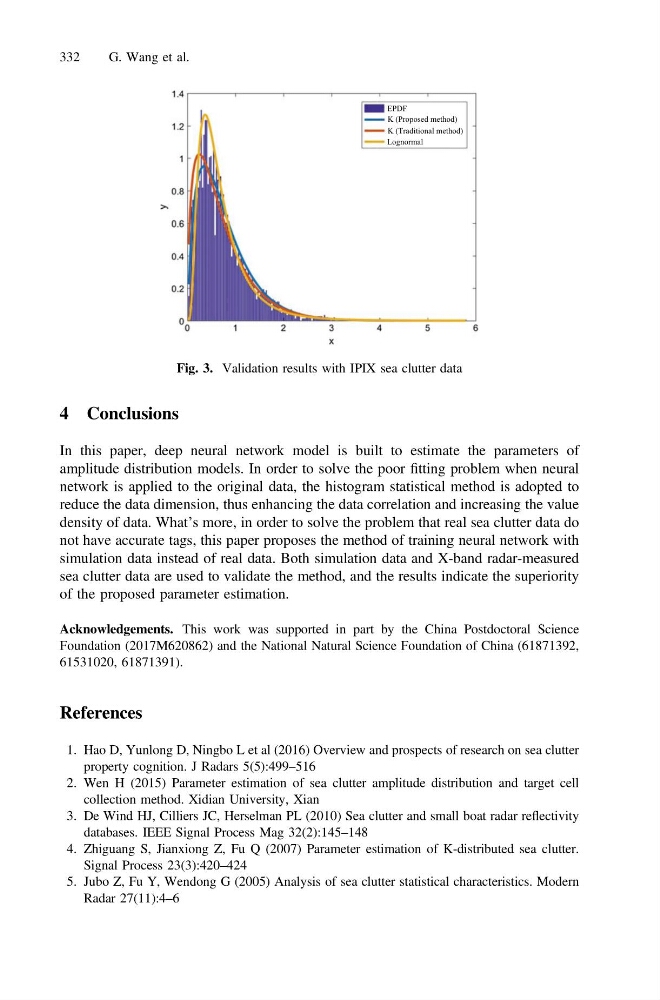
In this paper, deep neural network model is built to estimate the parameters of
amplitude distribution models. In order to solve the poor fitting problem when neural
network is applied to the original data, the histogram statistical method is adopted to
reduce the data dimension, thus enhancing the data correlation and increasing the value
density of data. What’s more, in order to solve the problem that real sea clutter data do
not have accurate tags, this paper proposes the method of training neural network with
simulation data instead of real data. Both simulation data and X-band radar-measured
sea clutter data are used to validate the method, and the results indicate the superiority
of the proposed parameter estimation.
Acknowledgements. This work was supported in part by the China Postdoctoral Science
Foundation (2017M620862) and the National Natural Science Foundation of China (61871392,
61531020, 61871391).
References
1. Hao D, Yunlong D, Ningbo L et al (2016) Overview and prospects of research on sea clutter
property cognition. J Radars 5(5):499–516
2. Wen H (2015) Parameter estimation of sea clutter amplitude distribution and target cell
collection method. Xidian University, Xian
3. De Wind HJ, Cilliers JC, Herselman PL (2010) Sea clutter and small boat radar reflectivity
databases. IEEE Signal Process Mag 32(2):145–148
4. Zhiguang S, Jianxiong Z, Fu Q (2007) Parameter estimation of K-distributed sea clutter.
Signal Process 23(3):420–424
5. Jubo Z, Fu Y, Wendong G (2005) Analysis of sea clutter statistical characteristics. Modern
Radar 27(11):4–6
EPDF
K (Proposed method)
K (Traditional method)
Lognormal
Fig. 3. Validation results with IPIX sea clutter data
332
G. Wang et al.
In this paper, deep neural network model is built to estimate the parameters of
amplitude distribution models. In order to solve the poor fitting problem when neural
network is applied to the original data, the histogram statistical method is adopted to
reduce the data dimension, thus enhancing the data correlation and increasing the value
density of data. What’s more, in order to solve the problem that real sea clutter data do
not have accurate tags, this paper proposes the method of training neural network with
simulation data instead of real data. Both simulation data and X-band radar-measured
sea clutter data are used to validate the method, and the results indicate the superiority
of the proposed parameter estimation.
Acknowledgements. This work was supported in part by the China Postdoctoral Science
Foundation (2017M620862) and the National Natural Science Foundation of China (61871392,
61531020, 61871391).
References
1. Hao D, Yunlong D, Ningbo L et al (2016) Overview and prospects of research on sea clutter
property cognition. J Radars 5(5):499–516
2. Wen H (2015) Parameter estimation of sea clutter amplitude distribution and target cell
collection method. Xidian University, Xian
3. De Wind HJ, Cilliers JC, Herselman PL (2010) Sea clutter and small boat radar reflectivity
databases. IEEE Signal Process Mag 32(2):145–148
4. Zhiguang S, Jianxiong Z, Fu Q (2007) Parameter estimation of K-distributed sea clutter.
Signal Process 23(3):420–424
5. Jubo Z, Fu Y, Wendong G (2005) Analysis of sea clutter statistical characteristics. Modern
Radar 27(11):4–6
EPDF
K (Proposed method)
K (Traditional method)
Lognormal
Fig. 3. Validation results with IPIX sea clutter data
332
G. Wang et al.