

extraction of deep features with higher accuracy [9–12]. However, its application
mainly concentrates on radar target detection or recognition, and in the field of
parameter estimation, it is still a blank. In fact, for a specific theoretical distribution
model, the parameter estimation problem can be abstractly treated as a complex nonlinear optimization problem, and deep learning theory has obvious technical advantages in solving this kind of problem. Based on this consideration, this paper constructs
a deep neural network model with high precision parameter estimation ability. By
selecting a reasonable structure of the deep neural network and training the deep
learning model, the model can be equipped with multi-parameter estimation ability in
the form of autonomous learning. Effectiveness of the estimation method is validated
with simulation data and X-band radar-measured sea clutter data.
2 Sea Clutter Parameter Estimation Based on Deep Learning
Theory
2.1 Deep Neural Network Model
Neural network is a mathematical model that simulates the behavior characteristics of
animal neural network and performs distributed parallel information processing [12].
At present, the multilayer feed-forward neural network is the most widely used. The
learning process of the network is divided into two parts, namely the forward conduction of the signal and the backpropagation of the error, that is, the error output is
carried out in the direction from input to output, and the reverse correction is carried
out in the direction from output to input when the weight is adjusted. In the case of
signal forward transmission, the input information propagates to the hidden layer
through the input layer acting on the weight, and then propagates to the output layer
through the same effect on the weight, calculates the error between the expected output
and the actual output, and then enters the process of error reverse transmission. The
final error is conducted back to the input layer through the hidden layer, and the overall
error is distributed to all nodes in each layer, and then the weight of each unit is
adjusted to make the error drop in the direction of gradient. After repeated learning and
adjustment, the optimal error value is obtained. A four-layer feed-forward neural
network is shown in Fig. 1, which contains input layer, two hidden layers, and output
layer, and the nodes between each layer are fully connected [13].
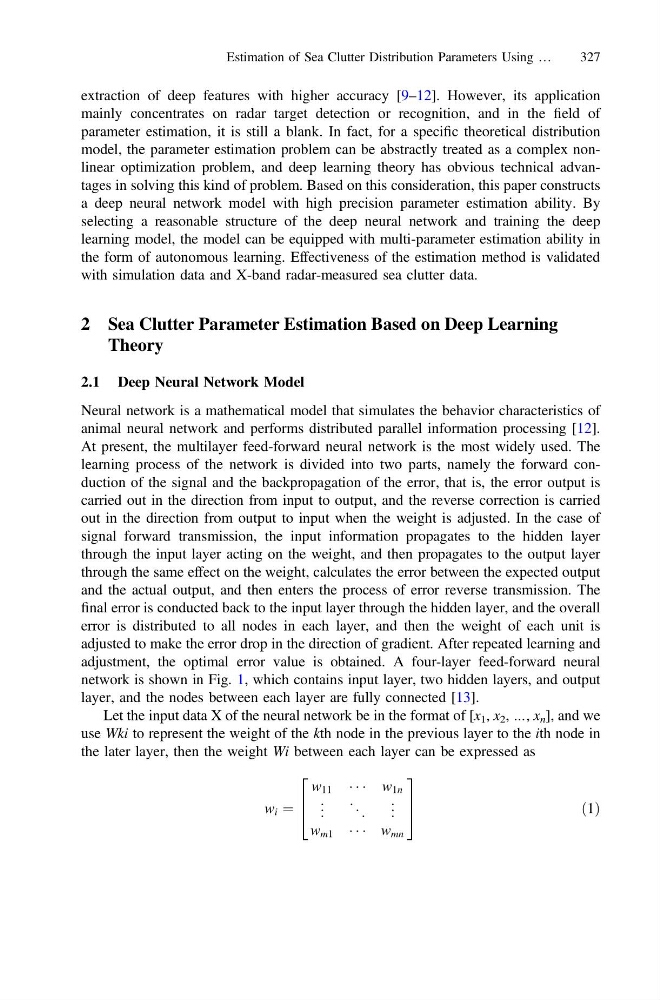
Let the input data X of the neural network be in the format of [x 1 , x 2 , …, x n ], and we
use Wki to represent the weight of the kth node in the previous layer to the ith node in
the later layer, then the weight Wi between each layer can be expressed as
w i ¼
w 11 Á Á Á w 1n
. .
.
. .
.
. .
.
w m1 Á Á Á w mn
2
6
4
3
7
5
ð1Þ
Estimation of Sea Clutter Distribution Parameters Using …
327
mainly concentrates on radar target detection or recognition, and in the field of
parameter estimation, it is still a blank. In fact, for a specific theoretical distribution
model, the parameter estimation problem can be abstractly treated as a complex nonlinear optimization problem, and deep learning theory has obvious technical advantages in solving this kind of problem. Based on this consideration, this paper constructs
a deep neural network model with high precision parameter estimation ability. By
selecting a reasonable structure of the deep neural network and training the deep
learning model, the model can be equipped with multi-parameter estimation ability in
the form of autonomous learning. Effectiveness of the estimation method is validated
with simulation data and X-band radar-measured sea clutter data.
2 Sea Clutter Parameter Estimation Based on Deep Learning
Theory
2.1 Deep Neural Network Model
Neural network is a mathematical model that simulates the behavior characteristics of
animal neural network and performs distributed parallel information processing [12].
At present, the multilayer feed-forward neural network is the most widely used. The
learning process of the network is divided into two parts, namely the forward conduction of the signal and the backpropagation of the error, that is, the error output is
carried out in the direction from input to output, and the reverse correction is carried
out in the direction from output to input when the weight is adjusted. In the case of
signal forward transmission, the input information propagates to the hidden layer
through the input layer acting on the weight, and then propagates to the output layer
through the same effect on the weight, calculates the error between the expected output
and the actual output, and then enters the process of error reverse transmission. The
final error is conducted back to the input layer through the hidden layer, and the overall
error is distributed to all nodes in each layer, and then the weight of each unit is
adjusted to make the error drop in the direction of gradient. After repeated learning and
adjustment, the optimal error value is obtained. A four-layer feed-forward neural
network is shown in Fig. 1, which contains input layer, two hidden layers, and output
layer, and the nodes between each layer are fully connected [13].
Let the input data X of the neural network be in the format of [x 1 , x 2 , …, x n ], and we
use Wki to represent the weight of the kth node in the previous layer to the ith node in
the later layer, then the weight Wi between each layer can be expressed as
w i ¼
w 11 Á Á Á w 1n
. .
.
. .
.
. .
.
w m1 Á Á Á w mn
2
6
4
3
7
5
ð1Þ
Estimation of Sea Clutter Distribution Parameters Using …
327