

3 Block DCT Combined with SPIHT
For the sake of reconstructing the fidelity of the image, the quantization method in
compression does not use the quantization matrix, but uses the planar quantization
method to retain the image details. When SPHIT algorithm is coding, the determined
value of image wavelet coefficient is taken as the initial scanning threshold. In
sequential scanning, the threshold value of each scan is halved on the basis of the
previous one. As the threshold value decreases, the coefficient in the image increases
continuously. However, in practical application, if the cyclic scanning reaches the
threshold value of 1, let the scanning stop. A large amount of scan data will be
generated, but these data are highly redundant, which is not very helpful for image
compression and reconstruction. Therefore, we can flexibly set the termination
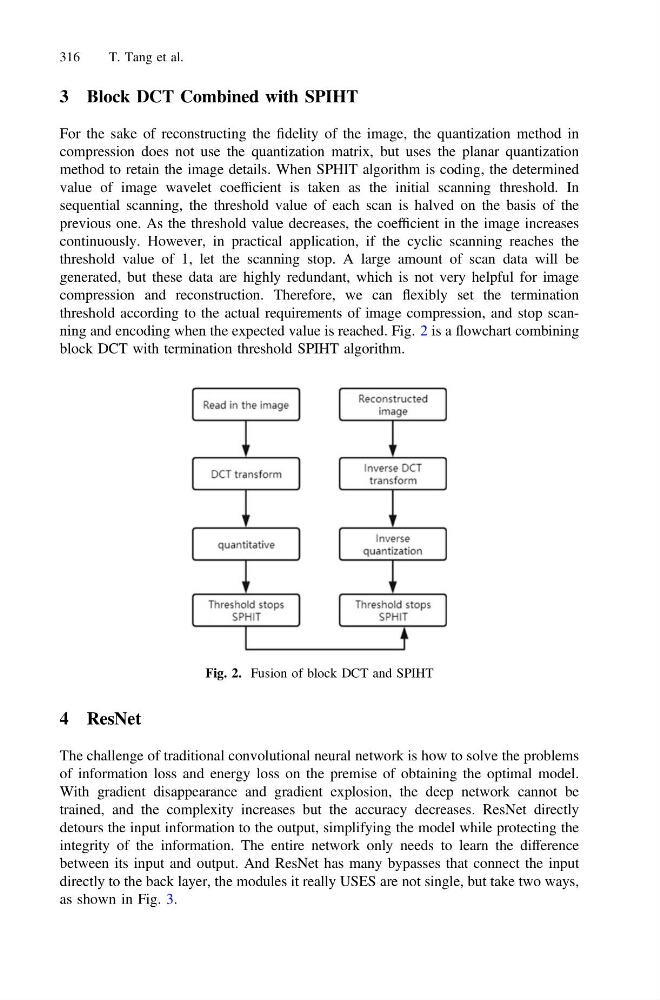
threshold according to the actual requirements of image compression, and stop scanning and encoding when the expected value is reached. Fig. 2 is a flowchart combining
block DCT with termination threshold SPIHT algorithm.
4 ResNet
The challenge of traditional convolutional neural network is how to solve the problems
of information loss and energy loss on the premise of obtaining the optimal model.
With gradient disappearance and gradient explosion, the deep network cannot be
trained, and the complexity increases but the accuracy decreases. ResNet directly
detours the input information to the output, simplifying the model while protecting the
integrity of the information. The entire network only needs to learn the difference
between its input and output. And ResNet has many bypasses that connect the input
directly to the back layer, the modules it really USES are not single, but take two ways,
as shown in Fig. 3.
Fig. 2. Fusion of block DCT and SPIHT
316
T. Tang et al.
For the sake of reconstructing the fidelity of the image, the quantization method in
compression does not use the quantization matrix, but uses the planar quantization
method to retain the image details. When SPHIT algorithm is coding, the determined
value of image wavelet coefficient is taken as the initial scanning threshold. In
sequential scanning, the threshold value of each scan is halved on the basis of the
previous one. As the threshold value decreases, the coefficient in the image increases
continuously. However, in practical application, if the cyclic scanning reaches the
threshold value of 1, let the scanning stop. A large amount of scan data will be
generated, but these data are highly redundant, which is not very helpful for image
compression and reconstruction. Therefore, we can flexibly set the termination
threshold according to the actual requirements of image compression, and stop scanning and encoding when the expected value is reached. Fig. 2 is a flowchart combining
block DCT with termination threshold SPIHT algorithm.
4 ResNet
The challenge of traditional convolutional neural network is how to solve the problems
of information loss and energy loss on the premise of obtaining the optimal model.
With gradient disappearance and gradient explosion, the deep network cannot be
trained, and the complexity increases but the accuracy decreases. ResNet directly
detours the input information to the output, simplifying the model while protecting the
integrity of the information. The entire network only needs to learn the difference
between its input and output. And ResNet has many bypasses that connect the input
directly to the back layer, the modules it really USES are not single, but take two ways,
as shown in Fig. 3.
Fig. 2. Fusion of block DCT and SPIHT
316
T. Tang et al.