

The residual element decomposes a problem into multi-scale linear residual, which
is very useful for optimization training. The input and output of the block are overlapped by the elements through short interception. Simple addition will not increase the
additional parameters and calculation of the network, but can greatly improve the
training speed of the model, improve the training effect; degradation is handled well as
the network deepens.
The innovation of this paper lies in the combination of image compression algorithm and convolutional neural network. The improvement of block DCT is combined
with SPIHT algorithm. The image information is retained to the greatest extent and the
number of training samples is reduced to concentrate the image energy. Change the
block size and step size of DCT image to ensure the image compression speed and
feature retention integrity; the ResNet model is used to classify the preprocessed
images accurately, which improves the accuracy of ancient building crack
identification.
2 Block DCT
The image is kaleidoscopic in the spatial domain, and it is difficult to be processed in a
unified range. Therefore, we consider transforming the image in the frequency domain
and making the main frequency coefficients of the image relatively concentrated.
Because the information in the low-frequency part of the image is much more than the
information in the high-frequency part, DCT is a good way to do that. If the whole
image is transformed by DCT, the complexity is very high. Therefore, DCT transformation and inverse transformation are implemented in parallel for each block to
improve the efficiency of transformation.
In general, most of the images are divided into 8 Â 8 blocks. The larger the block
size is, the fewer blocks the image is divided into, the more obvious the boundary of
the image block is, and the number of edges reflected by the block increases sharply.
The more serious the quantization error is, the better the image will be visually.
However, too small block size will increase the computational complexity and reduce
the computational speed. In this paper, we divide each image into 10 Â 10 blocks,
which increases the speed compared with 8 Â 8. The processing step size of each subblock is segmented from 1 to 0.8. In the image of a single sub-block, the step size of
each processing becomes smaller, which can retain image feature information to a
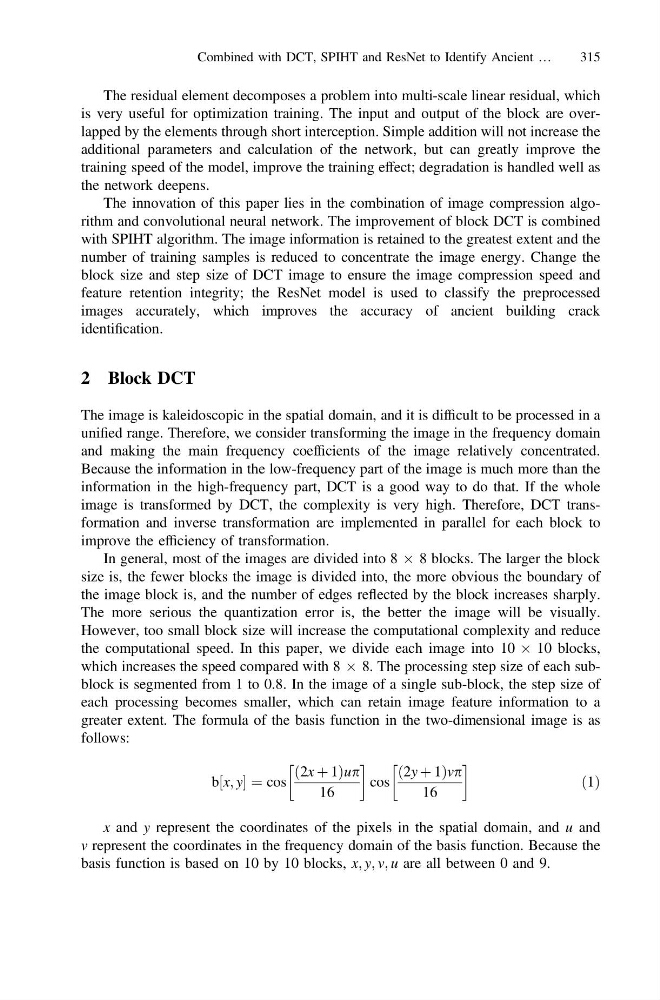
greater extent. The formula of the basis function in the two-dimensional image is as
follows:
b x; y
½ ¼ cos
2x þ 1
ð
Þup
16
cos
2y þ 1
ð
Þvp
16
ð1Þ
x and y represent the coordinates of the pixels in the spatial domain, and u and
v represent the coordinates in the frequency domain of the basis function. Because the
basis function is based on 10 by 10 blocks, x; y; v; u are all between 0 and 9.
Combined with DCT, SPIHT and ResNet to Identify Ancient …
315
is very useful for optimization training. The input and output of the block are overlapped by the elements through short interception. Simple addition will not increase the
additional parameters and calculation of the network, but can greatly improve the
training speed of the model, improve the training effect; degradation is handled well as
the network deepens.
The innovation of this paper lies in the combination of image compression algorithm and convolutional neural network. The improvement of block DCT is combined
with SPIHT algorithm. The image information is retained to the greatest extent and the
number of training samples is reduced to concentrate the image energy. Change the
block size and step size of DCT image to ensure the image compression speed and
feature retention integrity; the ResNet model is used to classify the preprocessed
images accurately, which improves the accuracy of ancient building crack
identification.
2 Block DCT
The image is kaleidoscopic in the spatial domain, and it is difficult to be processed in a
unified range. Therefore, we consider transforming the image in the frequency domain
and making the main frequency coefficients of the image relatively concentrated.
Because the information in the low-frequency part of the image is much more than the
information in the high-frequency part, DCT is a good way to do that. If the whole
image is transformed by DCT, the complexity is very high. Therefore, DCT transformation and inverse transformation are implemented in parallel for each block to
improve the efficiency of transformation.
In general, most of the images are divided into 8 Â 8 blocks. The larger the block
size is, the fewer blocks the image is divided into, the more obvious the boundary of
the image block is, and the number of edges reflected by the block increases sharply.
The more serious the quantization error is, the better the image will be visually.
However, too small block size will increase the computational complexity and reduce
the computational speed. In this paper, we divide each image into 10 Â 10 blocks,
which increases the speed compared with 8 Â 8. The processing step size of each subblock is segmented from 1 to 0.8. In the image of a single sub-block, the step size of
each processing becomes smaller, which can retain image feature information to a
greater extent. The formula of the basis function in the two-dimensional image is as
follows:
b x; y
½ ¼ cos
2x þ 1
ð
Þup
16
cos
2y þ 1
ð
Þvp
16
ð1Þ
x and y represent the coordinates of the pixels in the spatial domain, and u and
v represent the coordinates in the frequency domain of the basis function. Because the
basis function is based on 10 by 10 blocks, x; y; v; u are all between 0 and 9.
Combined with DCT, SPIHT and ResNet to Identify Ancient …
315