

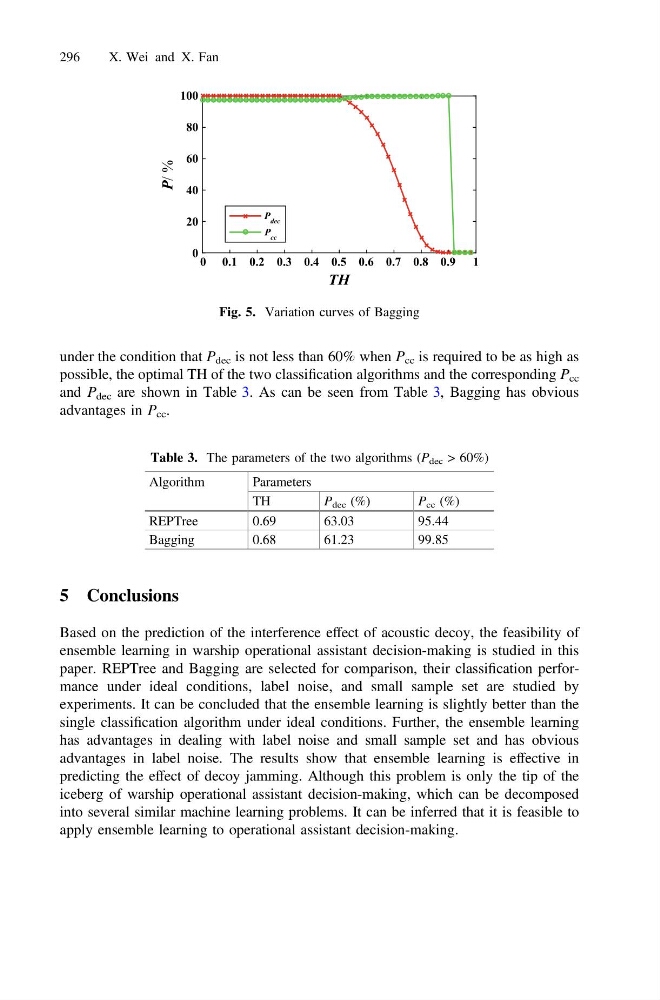
under the condition that P dec is not less than 60% when P cc is required to be as high as
possible, the optimal TH of the two classification algorithms and the corresponding P cc
and P dec are shown in Table 3. As can be seen from Table 3, Bagging has obvious
advantages in P cc .
5 Conclusions
Based on the prediction of the interference effect of acoustic decoy, the feasibility of
ensemble learning in warship operational assistant decision-making is studied in this
paper. REPTree and Bagging are selected for comparison, their classification performance under ideal conditions, label noise, and small sample set are studied by
experiments. It can be concluded that the ensemble learning is slightly better than the
single classification algorithm under ideal conditions. Further, the ensemble learning
has advantages in dealing with label noise and small sample set and has obvious
advantages in label noise. The results show that ensemble learning is effective in
predicting the effect of decoy jamming. Although this problem is only the tip of the
iceberg of warship operational assistant decision-making, which can be decomposed
into several similar machine learning problems. It can be inferred that it is feasible to
apply ensemble learning to operational assistant decision-making.
P/ %
0 0.1 0.2 0.3 0.4 0.5 0.6 0.7 0.8 0.9 1
TH
0
20
40
60
80
100
P dec
P cc
Fig. 5. Variation curves of Bagging
Table 3. The parameters of the two algorithms (P dec > 60%)
Algorithm
Parameters
TH
P dec (%)
P cc (%)
REPTree
0.69
63.03
95.44
Bagging
0.68
61.23
99.85
296
X. Wei and X. Fan
possible, the optimal TH of the two classification algorithms and the corresponding P cc
and P dec are shown in Table 3. As can be seen from Table 3, Bagging has obvious
advantages in P cc .
5 Conclusions
Based on the prediction of the interference effect of acoustic decoy, the feasibility of
ensemble learning in warship operational assistant decision-making is studied in this
paper. REPTree and Bagging are selected for comparison, their classification performance under ideal conditions, label noise, and small sample set are studied by
experiments. It can be concluded that the ensemble learning is slightly better than the
single classification algorithm under ideal conditions. Further, the ensemble learning
has advantages in dealing with label noise and small sample set and has obvious
advantages in label noise. The results show that ensemble learning is effective in
predicting the effect of decoy jamming. Although this problem is only the tip of the
iceberg of warship operational assistant decision-making, which can be decomposed
into several similar machine learning problems. It can be inferred that it is feasible to
apply ensemble learning to operational assistant decision-making.
P/ %
0 0.1 0.2 0.3 0.4 0.5 0.6 0.7 0.8 0.9 1
TH
0
20
40
60
80
100
P dec
P cc
Fig. 5. Variation curves of Bagging
Table 3. The parameters of the two algorithms (P dec > 60%)
Algorithm
Parameters
TH
P dec (%)
P cc (%)
REPTree
0.69
63.03
95.44
Bagging
0.68
61.23
99.85
296
X. Wei and X. Fan