

Not all the data can be used for training. In the experiment, the overexposed images
are generated due to the randomness of the parameters, which directly covered the
features of texture and contour. The model could not extract useful features, so the
accuracy is not high. The overexposed images should be deleted.
6.4 Conclusion
In this paper, the PlantVillage dataset and extended dataset are selected, and the
binarized model is used to identify plant diseases. The experiment shows that the fullprecision model and the binarized model both have the best performance under the
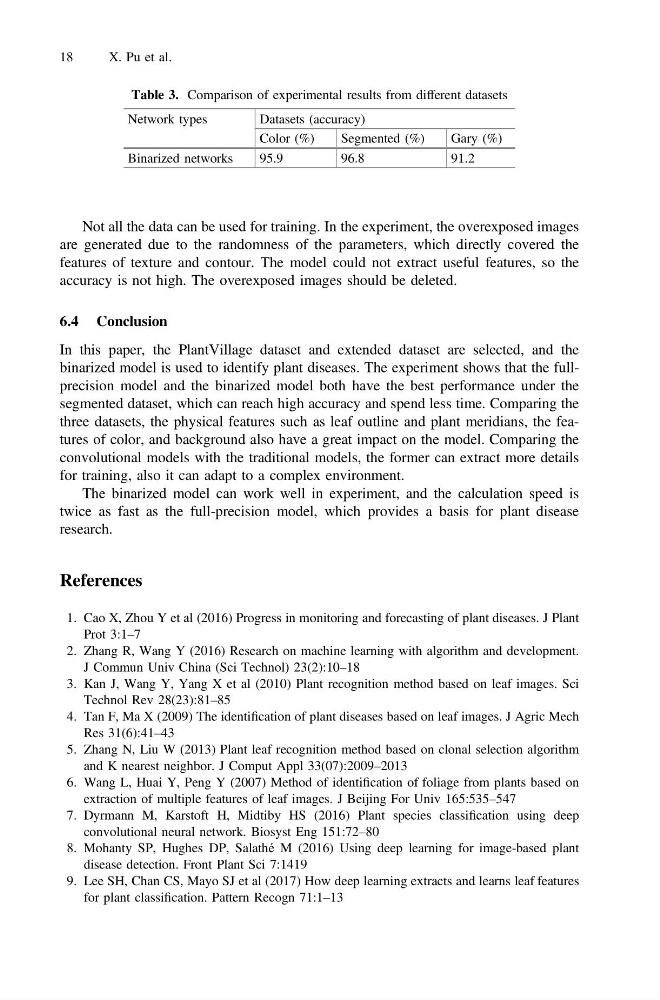
segmented dataset, which can reach high accuracy and spend less time. Comparing the
three datasets, the physical features such as leaf outline and plant meridians, the features of color, and background also have a great impact on the model. Comparing the
convolutional models with the traditional models, the former can extract more details
for training, also it can adapt to a complex environment.
The binarized model can work well in experiment, and the calculation speed is
twice as fast as the full-precision model, which provides a basis for plant disease
research.
References
1. Cao X, Zhou Y et al (2016) Progress in monitoring and forecasting of plant diseases. J Plant
Prot 3:1–7
2. Zhang R, Wang Y (2016) Research on machine learning with algorithm and development.
J Commun Univ China (Sci Technol) 23(2):10–18
3. Kan J, Wang Y, Yang X et al (2010) Plant recognition method based on leaf images. Sci
Technol Rev 28(23):81–85
4. Tan F, Ma X (2009) The identification of plant diseases based on leaf images. J Agric Mech
Res 31(6):41–43
5. Zhang N, Liu W (2013) Plant leaf recognition method based on clonal selection algorithm
and K nearest neighbor. J Comput Appl 33(07):2009–2013
6. Wang L, Huai Y, Peng Y (2007) Method of identification of foliage from plants based on
extraction of multiple features of leaf images. J Beijing For Univ 165:535–547
7. Dyrmann M, Karstoft H, Midtiby HS (2016) Plant species classification using deep
convolutional neural network. Biosyst Eng 151:72–80
8. Mohanty SP, Hughes DP, Salathé M (2016) Using deep learning for image-based plant
disease detection. Front Plant Sci 7:1419
9. Lee SH, Chan CS, Mayo SJ et al (2017) How deep learning extracts and learns leaf features
for plant classification. Pattern Recogn 71:1–13
Table 3. Comparison of experimental results from different datasets
Network types
Datasets (accuracy)
Color (%)
Segmented (%)
Gary (%)
Binarized networks
95.9
96.8
91.2
18
X. Pu et al.
are generated due to the randomness of the parameters, which directly covered the
features of texture and contour. The model could not extract useful features, so the
accuracy is not high. The overexposed images should be deleted.
6.4 Conclusion
In this paper, the PlantVillage dataset and extended dataset are selected, and the
binarized model is used to identify plant diseases. The experiment shows that the fullprecision model and the binarized model both have the best performance under the
segmented dataset, which can reach high accuracy and spend less time. Comparing the
three datasets, the physical features such as leaf outline and plant meridians, the features of color, and background also have a great impact on the model. Comparing the
convolutional models with the traditional models, the former can extract more details
for training, also it can adapt to a complex environment.
The binarized model can work well in experiment, and the calculation speed is
twice as fast as the full-precision model, which provides a basis for plant disease
research.
References
1. Cao X, Zhou Y et al (2016) Progress in monitoring and forecasting of plant diseases. J Plant
Prot 3:1–7
2. Zhang R, Wang Y (2016) Research on machine learning with algorithm and development.
J Commun Univ China (Sci Technol) 23(2):10–18
3. Kan J, Wang Y, Yang X et al (2010) Plant recognition method based on leaf images. Sci
Technol Rev 28(23):81–85
4. Tan F, Ma X (2009) The identification of plant diseases based on leaf images. J Agric Mech
Res 31(6):41–43
5. Zhang N, Liu W (2013) Plant leaf recognition method based on clonal selection algorithm
and K nearest neighbor. J Comput Appl 33(07):2009–2013
6. Wang L, Huai Y, Peng Y (2007) Method of identification of foliage from plants based on
extraction of multiple features of leaf images. J Beijing For Univ 165:535–547
7. Dyrmann M, Karstoft H, Midtiby HS (2016) Plant species classification using deep
convolutional neural network. Biosyst Eng 151:72–80
8. Mohanty SP, Hughes DP, Salathé M (2016) Using deep learning for image-based plant
disease detection. Front Plant Sci 7:1419
9. Lee SH, Chan CS, Mayo SJ et al (2017) How deep learning extracts and learns leaf features
for plant classification. Pattern Recogn 71:1–13
Table 3. Comparison of experimental results from different datasets
Network types
Datasets (accuracy)
Color (%)
Segmented (%)
Gary (%)
Binarized networks
95.9
96.8
91.2
18
X. Pu et al.