

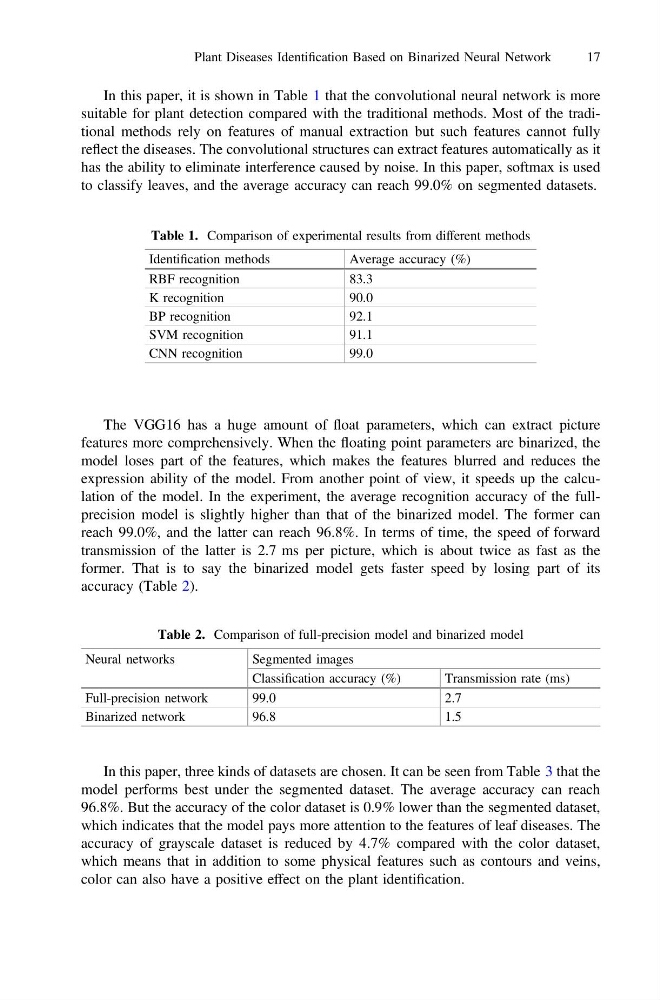
In this paper, it is shown in Table 1 that the convolutional neural network is more
suitable for plant detection compared with the traditional methods. Most of the traditional methods rely on features of manual extraction but such features cannot fully
reflect the diseases. The convolutional structures can extract features automatically as it
has the ability to eliminate interference caused by noise. In this paper, softmax is used
to classify leaves, and the average accuracy can reach 99.0% on segmented datasets.
The VGG16 has a huge amount of float parameters, which can extract picture
features more comprehensively. When the floating point parameters are binarized, the
model loses part of the features, which makes the features blurred and reduces the
expression ability of the model. From another point of view, it speeds up the calculation of the model. In the experiment, the average recognition accuracy of the fullprecision model is slightly higher than that of the binarized model. The former can
reach 99.0%, and the latter can reach 96.8%. In terms of time, the speed of forward
transmission of the latter is 2.7 ms per picture, which is about twice as fast as the
former. That is to say the binarized model gets faster speed by losing part of its
accuracy (Table 2).
In this paper, three kinds of datasets are chosen. It can be seen from Table 3 that the
model performs best under the segmented dataset. The average accuracy can reach
96.8%. But the accuracy of the color dataset is 0.9% lower than the segmented dataset,
which indicates that the model pays more attention to the features of leaf diseases. The
accuracy of grayscale dataset is reduced by 4.7% compared with the color dataset,
which means that in addition to some physical features such as contours and veins,
color can also have a positive effect on the plant identification.
Table 1. Comparison of experimental results from different methods
Identification methods
Average accuracy (%)
RBF recognition
83.3
K recognition
90.0
BP recognition
92.1
SVM recognition
91.1
CNN recognition
99.0
Table 2. Comparison of full-precision model and binarized model
Neural networks
Segmented images
Classification accuracy (%)
Transmission rate (ms)
Full-precision network
99.0
2.7
Binarized network
96.8
1.5
Plant Diseases Identification Based on Binarized Neural Network
17
suitable for plant detection compared with the traditional methods. Most of the traditional methods rely on features of manual extraction but such features cannot fully
reflect the diseases. The convolutional structures can extract features automatically as it
has the ability to eliminate interference caused by noise. In this paper, softmax is used
to classify leaves, and the average accuracy can reach 99.0% on segmented datasets.
The VGG16 has a huge amount of float parameters, which can extract picture
features more comprehensively. When the floating point parameters are binarized, the
model loses part of the features, which makes the features blurred and reduces the
expression ability of the model. From another point of view, it speeds up the calculation of the model. In the experiment, the average recognition accuracy of the fullprecision model is slightly higher than that of the binarized model. The former can
reach 99.0%, and the latter can reach 96.8%. In terms of time, the speed of forward
transmission of the latter is 2.7 ms per picture, which is about twice as fast as the
former. That is to say the binarized model gets faster speed by losing part of its
accuracy (Table 2).
In this paper, three kinds of datasets are chosen. It can be seen from Table 3 that the
model performs best under the segmented dataset. The average accuracy can reach
96.8%. But the accuracy of the color dataset is 0.9% lower than the segmented dataset,
which indicates that the model pays more attention to the features of leaf diseases. The
accuracy of grayscale dataset is reduced by 4.7% compared with the color dataset,
which means that in addition to some physical features such as contours and veins,
color can also have a positive effect on the plant identification.
Table 1. Comparison of experimental results from different methods
Identification methods
Average accuracy (%)
RBF recognition
83.3
K recognition
90.0
BP recognition
92.1
SVM recognition
91.1
CNN recognition
99.0
Table 2. Comparison of full-precision model and binarized model
Neural networks
Segmented images
Classification accuracy (%)
Transmission rate (ms)
Full-precision network
99.0
2.7
Binarized network
96.8
1.5
Plant Diseases Identification Based on Binarized Neural Network
17