

3.1 Data Processing
The MIMIC dataset contains several different kinds of physiological information for
volunteers, such as HR, PPG, and BP signals. However, the types of physiological
information contained in each sample are slightly different, and only those samples that
contain both the PPG signal and the BP signal are used. Due to the fact that there are
some time periods that no information was collected in the original data, which are of
no value to the experiment. So, the first step is to eliminate it. After discarding the data
segments that do not contain information, the original data is cut off, eventually
resulting in several consecutive signal segments of varying length. Then, a single
waveform cut is made for the successive signal fragments. As the segmentation is done,
the single waveform is finally normalized to 100 points by an interpolation method.
The raw data is given as a blood pressure waveform, and what needed is the blood
pressure value, that is SBP and DBP in a single corresponding waveform period. SBP
refers to the maximum blood pressure value in systole and DBP refers to the blood
pressure value in end-diastole. After cutting the single pulse waveform, the corresponding blood pressure waveform can be obtained which represents a complete blood
pressure cycle. The peak point value of blood pressure wave is the ground-truth of
SBP, and the end point of blood pressure wave is the ground-truth of DBP.
3.2 Model Structure
This section introduces the module and structure of the model. A convolutional neural
network (CNN) is a feed-forward neural network which uses a variation of multilayer
perceptrons designed to require minimal preprocessing. Its artificial neurons can
respond to a part of the surrounding cells in the coverage area and have excellent
performance for large-scale image processing [11–13]. A CNN includes input and
output layer, and a plurality of hidden layers. The hidden layer of CNN generally
includes convolutional layers, pooling layers, fully connected layers, and normalization
layers. The convolutional layer is the core building block of a CNN. The parameters of
this layer consist of a set of learnable filters that have a small receive field but extend
through the entire depth of the input volume. During the forward pass, each filter is
convolved over the width and height of the input volume, a dot product is calculated
between the input and the items of the filter, and a two-dimensional activation map of
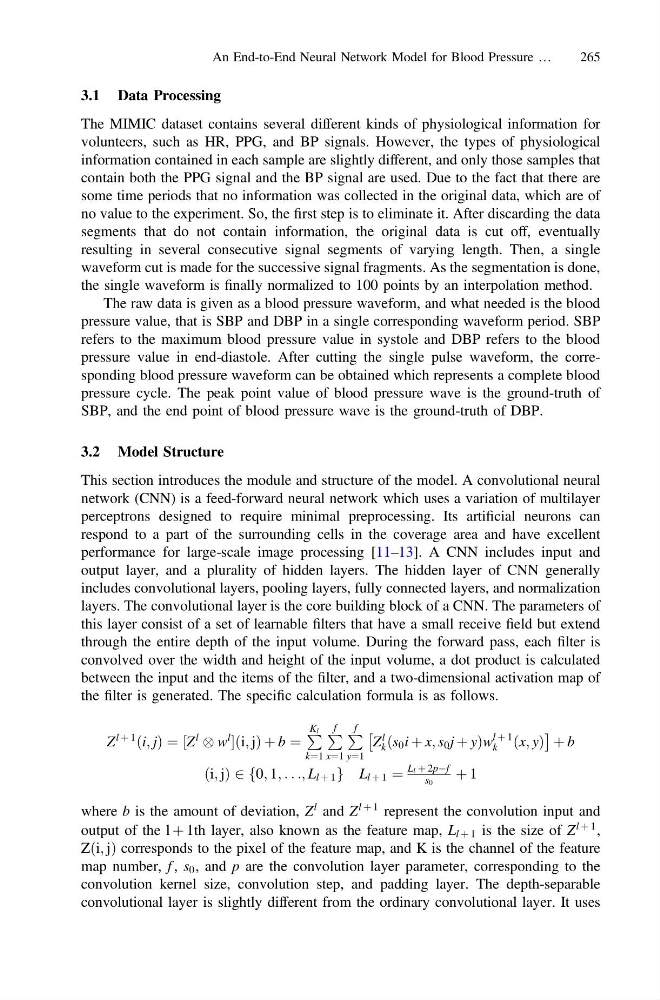
the filter is generated. The specific calculation formula is as follows.
Z
l þ 1
ði; jÞ ¼ ½Z
l
w
l
ði; jÞ þ b ¼
P K l
k¼1
P f
x¼1
P f
y¼1
Z
l
k s 0 i þ x; s 0 j þ y
ð
Þ w
l þ 1
k
x; y
ð Þ
Â
à þ b
i; j
ð Þ 2 0; 1; . . .; L l þ 1
f
g L l þ 1 ¼
L l þ 2pÀf
s 0
þ 1
where b is the amount of deviation, Z
l and Z
l þ 1 represent the convolution input and
output of the l þ 1th layer, also known as the feature map, L l þ 1 is the size of Z
l þ 1 ,
Z i; j
ð Þ corresponds to the pixel of the feature map, and K is the channel of the feature
map number, f , s 0 , and p are the convolution layer parameter, corresponding to the
convolution kernel size, convolution step, and padding layer. The depth-separable
convolutional layer is slightly different from the ordinary convolutional layer. It uses
An End-to-End Neural Network Model for Blood Pressure …
265
The MIMIC dataset contains several different kinds of physiological information for
volunteers, such as HR, PPG, and BP signals. However, the types of physiological
information contained in each sample are slightly different, and only those samples that
contain both the PPG signal and the BP signal are used. Due to the fact that there are
some time periods that no information was collected in the original data, which are of
no value to the experiment. So, the first step is to eliminate it. After discarding the data
segments that do not contain information, the original data is cut off, eventually
resulting in several consecutive signal segments of varying length. Then, a single
waveform cut is made for the successive signal fragments. As the segmentation is done,
the single waveform is finally normalized to 100 points by an interpolation method.
The raw data is given as a blood pressure waveform, and what needed is the blood
pressure value, that is SBP and DBP in a single corresponding waveform period. SBP
refers to the maximum blood pressure value in systole and DBP refers to the blood
pressure value in end-diastole. After cutting the single pulse waveform, the corresponding blood pressure waveform can be obtained which represents a complete blood
pressure cycle. The peak point value of blood pressure wave is the ground-truth of
SBP, and the end point of blood pressure wave is the ground-truth of DBP.
3.2 Model Structure
This section introduces the module and structure of the model. A convolutional neural
network (CNN) is a feed-forward neural network which uses a variation of multilayer
perceptrons designed to require minimal preprocessing. Its artificial neurons can
respond to a part of the surrounding cells in the coverage area and have excellent
performance for large-scale image processing [11–13]. A CNN includes input and
output layer, and a plurality of hidden layers. The hidden layer of CNN generally
includes convolutional layers, pooling layers, fully connected layers, and normalization
layers. The convolutional layer is the core building block of a CNN. The parameters of
this layer consist of a set of learnable filters that have a small receive field but extend
through the entire depth of the input volume. During the forward pass, each filter is
convolved over the width and height of the input volume, a dot product is calculated
between the input and the items of the filter, and a two-dimensional activation map of
the filter is generated. The specific calculation formula is as follows.
Z
l þ 1
ði; jÞ ¼ ½Z
l
w
l
ði; jÞ þ b ¼
P K l
k¼1
P f
x¼1
P f
y¼1
Z
l
k s 0 i þ x; s 0 j þ y
ð
Þ w
l þ 1
k
x; y
ð Þ
Â
à þ b
i; j
ð Þ 2 0; 1; . . .; L l þ 1
f
g L l þ 1 ¼
L l þ 2pÀf
s 0
þ 1
where b is the amount of deviation, Z
l and Z
l þ 1 represent the convolution input and
output of the l þ 1th layer, also known as the feature map, L l þ 1 is the size of Z
l þ 1 ,
Z i; j
ð Þ corresponds to the pixel of the feature map, and K is the channel of the feature
map number, f , s 0 , and p are the convolution layer parameter, corresponding to the
convolution kernel size, convolution step, and padding layer. The depth-separable
convolutional layer is slightly different from the ordinary convolutional layer. It uses
An End-to-End Neural Network Model for Blood Pressure …
265