

4 Conclusion
Aiming at reconstruction characteristics of the restricted Boltzmann machine, this paper
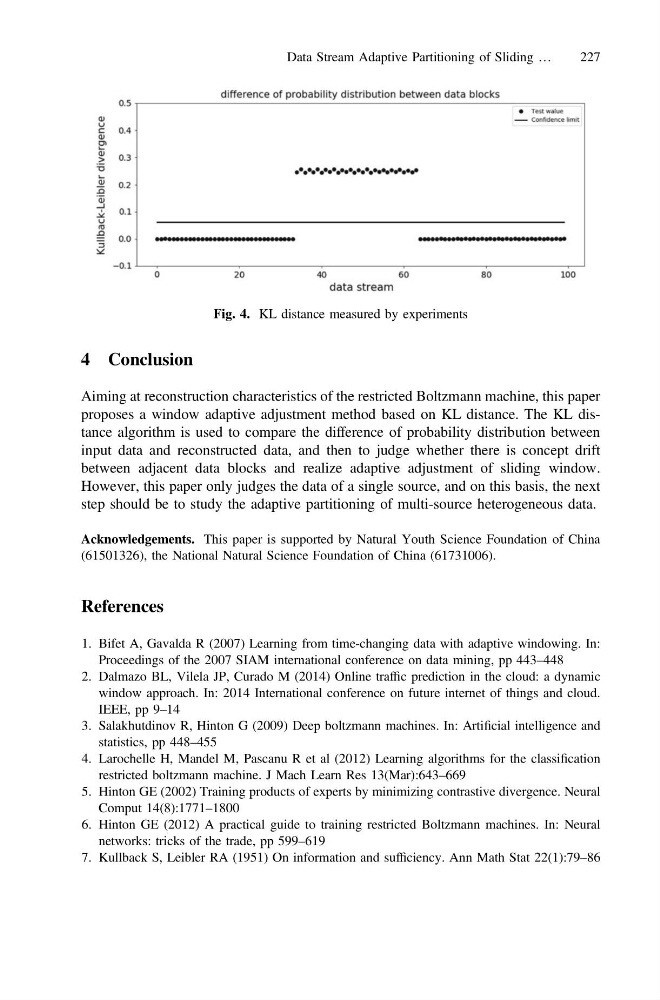
proposes a window adaptive adjustment method based on KL distance. The KL distance algorithm is used to compare the difference of probability distribution between
input data and reconstructed data, and then to judge whether there is concept drift
between adjacent data blocks and realize adaptive adjustment of sliding window.
However, this paper only judges the data of a single source, and on this basis, the next
step should be to study the adaptive partitioning of multi-source heterogeneous data.
Acknowledgements. This paper is supported by Natural Youth Science Foundation of China
(61501326), the National Natural Science Foundation of China (61731006).
References
1. Bifet A, Gavalda R (2007) Learning from time-changing data with adaptive windowing. In:
Proceedings of the 2007 SIAM international conference on data mining, pp 443–448
2. Dalmazo BL, Vilela JP, Curado M (2014) Online traffic prediction in the cloud: a dynamic
window approach. In: 2014 International conference on future internet of things and cloud.
IEEE, pp 9–14
3. Salakhutdinov R, Hinton G (2009) Deep boltzmann machines. In: Artificial intelligence and
statistics, pp 448–455
4. Larochelle H, Mandel M, Pascanu R et al (2012) Learning algorithms for the classification
restricted boltzmann machine. J Mach Learn Res 13(Mar):643–669
5. Hinton GE (2002) Training products of experts by minimizing contrastive divergence. Neural
Comput 14(8):1771–1800
6. Hinton GE (2012) A practical guide to training restricted Boltzmann machines. In: Neural
networks: tricks of the trade, pp 599–619
7. Kullback S, Leibler RA (1951) On information and sufficiency. Ann Math Stat 22(1):79–86
Fig. 4. KL distance measured by experiments
Data Stream Adaptive Partitioning of Sliding …
227
Aiming at reconstruction characteristics of the restricted Boltzmann machine, this paper
proposes a window adaptive adjustment method based on KL distance. The KL distance algorithm is used to compare the difference of probability distribution between
input data and reconstructed data, and then to judge whether there is concept drift
between adjacent data blocks and realize adaptive adjustment of sliding window.
However, this paper only judges the data of a single source, and on this basis, the next
step should be to study the adaptive partitioning of multi-source heterogeneous data.
Acknowledgements. This paper is supported by Natural Youth Science Foundation of China
(61501326), the National Natural Science Foundation of China (61731006).
References
1. Bifet A, Gavalda R (2007) Learning from time-changing data with adaptive windowing. In:
Proceedings of the 2007 SIAM international conference on data mining, pp 443–448
2. Dalmazo BL, Vilela JP, Curado M (2014) Online traffic prediction in the cloud: a dynamic
window approach. In: 2014 International conference on future internet of things and cloud.
IEEE, pp 9–14
3. Salakhutdinov R, Hinton G (2009) Deep boltzmann machines. In: Artificial intelligence and
statistics, pp 448–455
4. Larochelle H, Mandel M, Pascanu R et al (2012) Learning algorithms for the classification
restricted boltzmann machine. J Mach Learn Res 13(Mar):643–669
5. Hinton GE (2002) Training products of experts by minimizing contrastive divergence. Neural
Comput 14(8):1771–1800
6. Hinton GE (2012) A practical guide to training restricted Boltzmann machines. In: Neural
networks: tricks of the trade, pp 599–619
7. Kullback S, Leibler RA (1951) On information and sufficiency. Ann Math Stat 22(1):79–86
Fig. 4. KL distance measured by experiments
Data Stream Adaptive Partitioning of Sliding …
227