

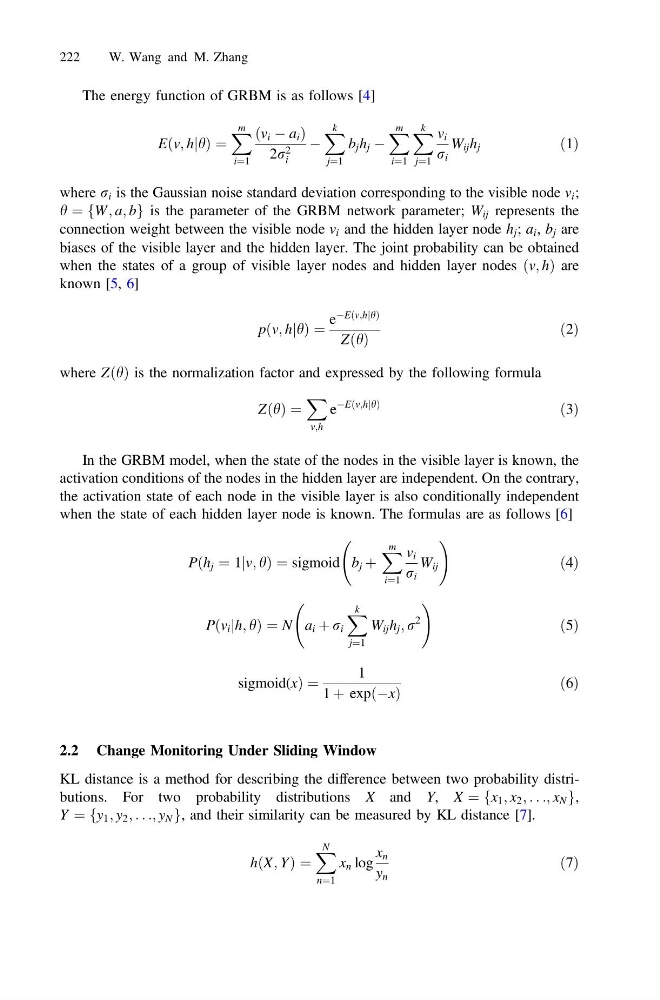
The energy function of GRBM is as follows [4]
Eðv; h h
j Þ ¼
X m
i¼1
ðv i À a i Þ
2r 2
i
À
X k
j¼1
b j h j À
X m
i¼1
X k
j¼1
v i
r i
W ij h j
ð1Þ
where r i is the Gaussian noise standard deviation corresponding to the visible node v i ;
h ¼ fW; a; bg is the parameter of the GRBM network parameter; W ij represents the
connection weight between the visible node v i and the hidden layer node h j ; a i , b j are
biases of the visible layer and the hidden layer. The joint probability can be obtained
when the states of a group of visible layer nodes and hidden layer nodes ðv; hÞ are
known [5, 6]
pðv; h h
j Þ ¼
e
ÀEðv;h h
j Þ
ZðhÞ
ð2Þ
where ZðhÞ is the normalization factor and expressed by the following formula
ZðhÞ ¼
X
v;h
e
ÀEðv;h h
j Þ
ð3Þ
In the GRBM model, when the state of the nodes in the visible layer is known, the
activation conditions of the nodes in the hidden layer are independent. On the contrary,
the activation state of each node in the visible layer is also conditionally independent
when the state of each hidden layer node is known. The formulas are as follows [6]
Pðh j ¼ 1 v; h
j Þ ¼ sigmoid b j þ
X m
i¼1
v i
r i
W ij
!
ð4Þ
Pðv i h; h
j Þ ¼ N a i þ r i
X k
j¼1
W ij h j ; r
2
!
ð5Þ
sigmoid(xÞ ¼
1
1 þ expðÀxÞ
ð6Þ
2.2 Change Monitoring Under Sliding Window
KL distance is a method for describing the difference between two probability distributions. For two probability distributions X and Y, X ¼ fx 1 ; x 2 ; . . .; x N g,
Y ¼ fy 1 ; y 2 ; . . .; y N g, and their similarity can be measured by KL distance [7].
hðX; YÞ ¼
X N
n¼1
x n log
x n
y n
ð7Þ
222
W. Wang and M. Zhang
Eðv; h h
j Þ ¼
X m
i¼1
ðv i À a i Þ
2r 2
i
À
X k
j¼1
b j h j À
X m
i¼1
X k
j¼1
v i
r i
W ij h j
ð1Þ
where r i is the Gaussian noise standard deviation corresponding to the visible node v i ;
h ¼ fW; a; bg is the parameter of the GRBM network parameter; W ij represents the
connection weight between the visible node v i and the hidden layer node h j ; a i , b j are
biases of the visible layer and the hidden layer. The joint probability can be obtained
when the states of a group of visible layer nodes and hidden layer nodes ðv; hÞ are
known [5, 6]
pðv; h h
j Þ ¼
e
ÀEðv;h h
j Þ
ZðhÞ
ð2Þ
where ZðhÞ is the normalization factor and expressed by the following formula
ZðhÞ ¼
X
v;h
e
ÀEðv;h h
j Þ
ð3Þ
In the GRBM model, when the state of the nodes in the visible layer is known, the
activation conditions of the nodes in the hidden layer are independent. On the contrary,
the activation state of each node in the visible layer is also conditionally independent
when the state of each hidden layer node is known. The formulas are as follows [6]
Pðh j ¼ 1 v; h
j Þ ¼ sigmoid b j þ
X m
i¼1
v i
r i
W ij
!
ð4Þ
Pðv i h; h
j Þ ¼ N a i þ r i
X k
j¼1
W ij h j ; r
2
!
ð5Þ
sigmoid(xÞ ¼
1
1 þ expðÀxÞ
ð6Þ
2.2 Change Monitoring Under Sliding Window
KL distance is a method for describing the difference between two probability distributions. For two probability distributions X and Y, X ¼ fx 1 ; x 2 ; . . .; x N g,
Y ¼ fy 1 ; y 2 ; . . .; y N g, and their similarity can be measured by KL distance [7].
hðX; YÞ ¼
X N
n¼1
x n log
x n
y n
ð7Þ
222
W. Wang and M. Zhang