

In this article, Gaussian–Bernoulli restricted Boltzmann machine model (GRBM)
and Kullback–Leibler divergence are presented for adaptive window adjustment.
GRBM is an extended model based on RBM, which is a recursive neural network
proposed by Salakhutdinov, and can solve some difficult tasks through the intrinsic
characteristics of data [3]. By comparing the probability distribution of reconstructed
data from a trained GRBM and input data, it can judge whether the model trained with
the previous data block is applicable to the current data block; furthermore, it is judged
whether there is a significant difference between the adjacent two data blocks, that is,
whether the sliding window needs to be adjusted. Kullback–Leibler divergence can be
introduced to judge whether the probability distribution is consistent or not. In addition,
the concept of confidence interval is used as a criterion of judgment, the adjustment
instruction will issue to the window when the KL distance value is greater than the
confidence upper limit.
This paper is mainly divided into four parts. In Sect. 1, the relevant research
background and the research content of this paper are introduced briefly. In Sect. 2, the
basic model and a sliding window adjustment algorithm based on KL distance are
proposed. Section 3 carries out relevant experiments and analyzes the results. Section 4
summarizes the entire article and establishes the future research direction.
2 Data Flow Blocking in Adaptive Window
A trained GRBM model, which can reconstruct the test data, is used as a benchmark to
judge whether there is an obvious change between the adjacent data block. The
Kullback–Leibler divergence and the confidence interval are introduced to measure this
change. By comparing if the probability distribution difference between test data and
reconstructed data is within the confidence interval, generate adjustment instructions of
the sliding window.
2.1 Gaussian Restricted Boltzmann Machines
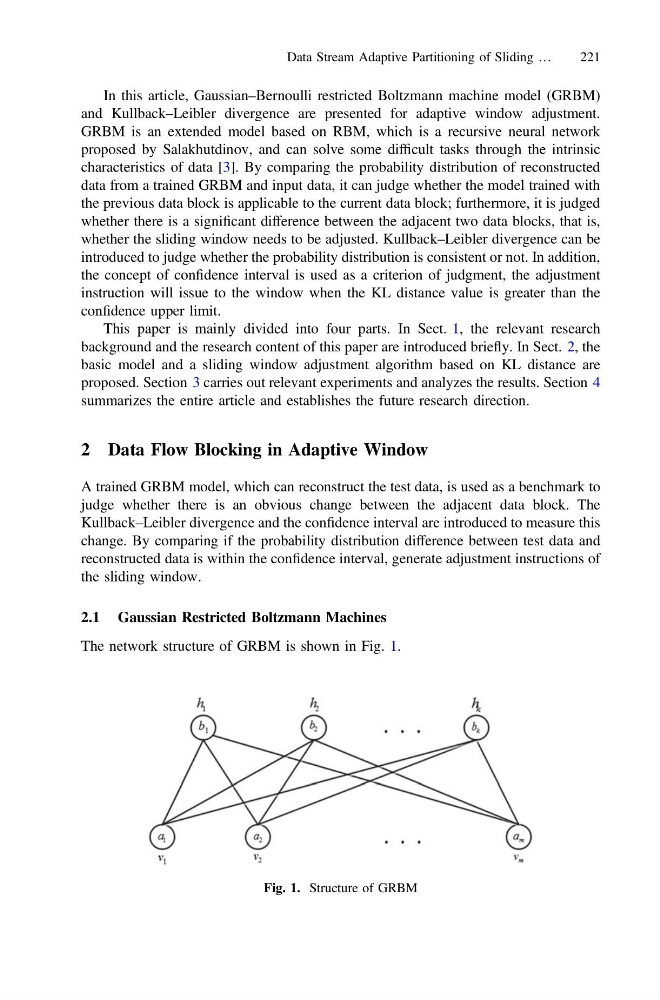
The network structure of GRBM is shown in Fig. 1.
Fig. 1. Structure of GRBM
Data Stream Adaptive Partitioning of Sliding …
221
and Kullback–Leibler divergence are presented for adaptive window adjustment.
GRBM is an extended model based on RBM, which is a recursive neural network
proposed by Salakhutdinov, and can solve some difficult tasks through the intrinsic
characteristics of data [3]. By comparing the probability distribution of reconstructed
data from a trained GRBM and input data, it can judge whether the model trained with
the previous data block is applicable to the current data block; furthermore, it is judged
whether there is a significant difference between the adjacent two data blocks, that is,
whether the sliding window needs to be adjusted. Kullback–Leibler divergence can be
introduced to judge whether the probability distribution is consistent or not. In addition,
the concept of confidence interval is used as a criterion of judgment, the adjustment
instruction will issue to the window when the KL distance value is greater than the
confidence upper limit.
This paper is mainly divided into four parts. In Sect. 1, the relevant research
background and the research content of this paper are introduced briefly. In Sect. 2, the
basic model and a sliding window adjustment algorithm based on KL distance are
proposed. Section 3 carries out relevant experiments and analyzes the results. Section 4
summarizes the entire article and establishes the future research direction.
2 Data Flow Blocking in Adaptive Window
A trained GRBM model, which can reconstruct the test data, is used as a benchmark to
judge whether there is an obvious change between the adjacent data block. The
Kullback–Leibler divergence and the confidence interval are introduced to measure this
change. By comparing if the probability distribution difference between test data and
reconstructed data is within the confidence interval, generate adjustment instructions of
the sliding window.
2.1 Gaussian Restricted Boltzmann Machines
The network structure of GRBM is shown in Fig. 1.
Fig. 1. Structure of GRBM
Data Stream Adaptive Partitioning of Sliding …
221