

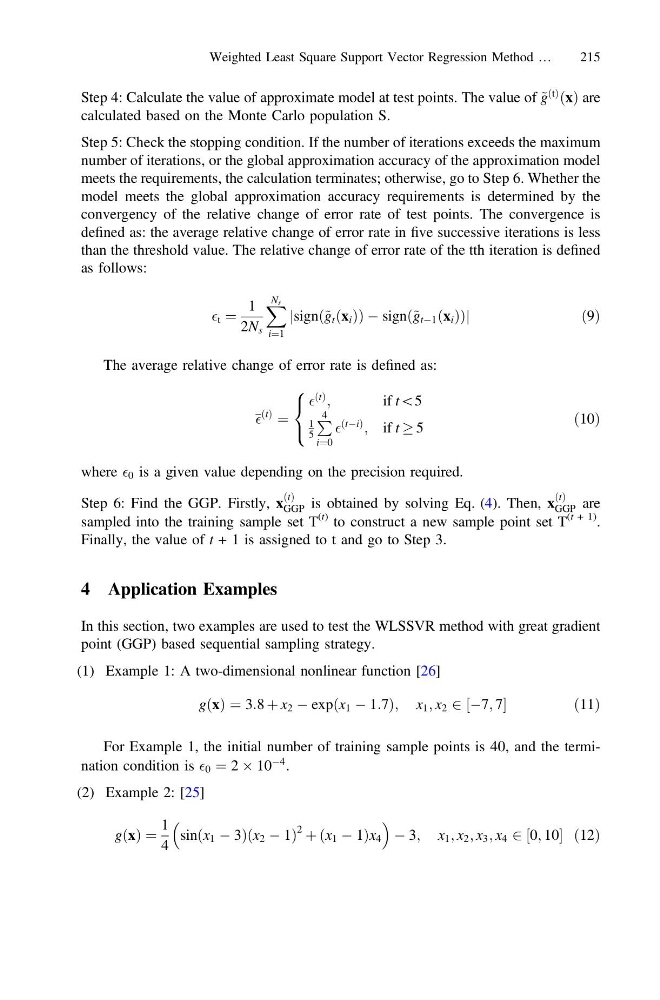
Step 4: Calculate the value of approximate model at test points. The value of ~ g
ðtÞ
ðxÞ are
calculated based on the Monte Carlo population S.
Step 5: Check the stopping condition. If the number of iterations exceeds the maximum
number of iterations, or the global approximation accuracy of the approximation model
meets the requirements, the calculation terminates; otherwise, go to Step 6. Whether the
model meets the global approximation accuracy requirements is determined by the
convergency of the relative change of error rate of test points. The convergence is
defined as: the average relative change of error rate in five successive iterations is less
than the threshold value. The relative change of error rate of the tth iteration is defined
as follows:
t ¼
1
2N s
X N s
i¼1
signð~ g t ðx i ÞÞ À signð~ g tÀ1 ðx i ÞÞ
j
j
ð9Þ
The average relative change of error rate is defined as:
ðtÞ
¼
ðtÞ
;
if t\5
1
5
P 4
i¼0
ðtÀiÞ
; if t ! 5
8
<
:
ð10Þ
where 0 is a given value depending on the precision required.
Step 6: Find the GGP. Firstly, x
ðtÞ
GGP is obtained by solving Eq. (4). Then, x
ðtÞ
GGP are
sampled into the training sample set T
(t) to construct a new sample point set T
(t + 1) .
Finally, the value of t + 1 is assigned to t and go to Step 3.
4 Application Examples
In this section, two examples are used to test the WLSSVR method with great gradient
point (GGP) based sequential sampling strategy.
(1) Example 1: A two-dimensional nonlinear function [26]
gðxÞ ¼ 3:8 þ x 2 À expðx 1 À 1:7Þ; x 1 ; x 2 2 ½À7; 7
ð 11Þ
For Example 1, the initial number of training sample points is 40, and the termination condition is 0 ¼ 2 Â 10
À4 .
(2) Example 2: [25]
gðxÞ ¼
1
4
sinðx 1 À 3Þðx 2 À 1Þ
2 þ ðx 1 À 1Þx 4
À 3; x 1 ; x 2 ; x 3 ; x 4 2 ½0; 10 ð12Þ
Weighted Least Square Support Vector Regression Method …
215
ðtÞ
ðxÞ are
calculated based on the Monte Carlo population S.
Step 5: Check the stopping condition. If the number of iterations exceeds the maximum
number of iterations, or the global approximation accuracy of the approximation model
meets the requirements, the calculation terminates; otherwise, go to Step 6. Whether the
model meets the global approximation accuracy requirements is determined by the
convergency of the relative change of error rate of test points. The convergence is
defined as: the average relative change of error rate in five successive iterations is less
than the threshold value. The relative change of error rate of the tth iteration is defined
as follows:
t ¼
1
2N s
X N s
i¼1
signð~ g t ðx i ÞÞ À signð~ g tÀ1 ðx i ÞÞ
j
j
ð9Þ
The average relative change of error rate is defined as:
ðtÞ
¼
ðtÞ
;
if t\5
1
5
P 4
i¼0
ðtÀiÞ
; if t ! 5
8
<
:
ð10Þ
where 0 is a given value depending on the precision required.
Step 6: Find the GGP. Firstly, x
ðtÞ
GGP is obtained by solving Eq. (4). Then, x
ðtÞ
GGP are
sampled into the training sample set T
(t) to construct a new sample point set T
(t + 1) .
Finally, the value of t + 1 is assigned to t and go to Step 3.
4 Application Examples
In this section, two examples are used to test the WLSSVR method with great gradient
point (GGP) based sequential sampling strategy.
(1) Example 1: A two-dimensional nonlinear function [26]
gðxÞ ¼ 3:8 þ x 2 À expðx 1 À 1:7Þ; x 1 ; x 2 2 ½À7; 7
ð 11Þ
For Example 1, the initial number of training sample points is 40, and the termination condition is 0 ¼ 2 Â 10
À4 .
(2) Example 2: [25]
gðxÞ ¼
1
4
sinðx 1 À 3Þðx 2 À 1Þ
2 þ ðx 1 À 1Þx 4
À 3; x 1 ; x 2 ; x 3 ; x 4 2 ½0; 10 ð12Þ
Weighted Least Square Support Vector Regression Method …
215