

Machine Learning for RF Fingerprinting Extraction . . .
197
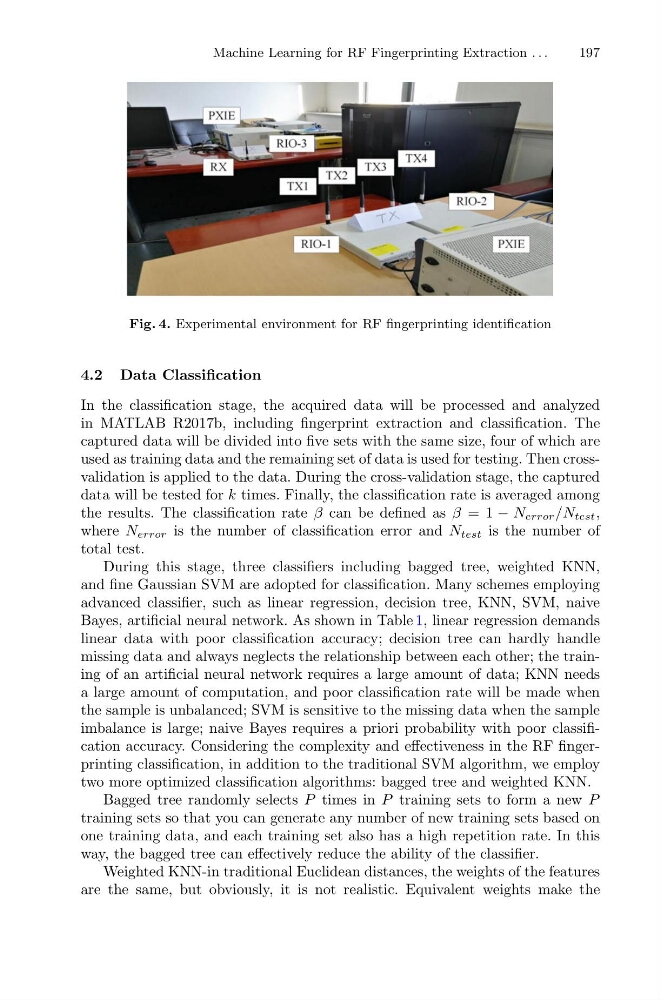
Fig. 4. Experimental environment for RF fingerprinting identification
4.2 Data Classification
In the classification stage, the acquired data will be processed and analyzed
in MATLAB R2017b, including fingerprint extraction and classification. The
captured data will be divided into five sets with the same size, four of which are
used as training data and the remaining set of data is used for testing. Then crossvalidation is applied to the data. During the cross-validation stage, the captured
data will be tested for k times. Finally, the classification rate is averaged among
the results. The classification rate β can be defined as β = 1 − N error /N test ,
where N error is the number of classification error and N test is the number of
total test.
During this stage, three classifiers including bagged tree, weighted KNN,
and fine Gaussian SVM are adopted for classification. Many schemes employing
advanced classifier, such as linear regression, decision tree, KNN, SVM, naive
Bayes, artificial neural network. As shown in Table 1, linear regression demands
linear data with poor classification accuracy; decision tree can hardly handle
missing data and always neglects the relationship between each other; the training of an artificial neural network requires a large amount of data; KNN needs
a large amount of computation, and poor classification rate will be made when
the sample is unbalanced; SVM is sensitive to the missing data when the sample
imbalance is large; naive Bayes requires a priori probability with poor classification accuracy. Considering the complexity and effectiveness in the RF fingerprinting classification, in addition to the traditional SVM algorithm, we employ
two more optimized classification algorithms: bagged tree and weighted KNN.
Bagged tree randomly selects P times in P training sets to form a new P
training sets so that you can generate any number of new training sets based on
one training data, and each training set also has a high repetition rate. In this
way, the bagged tree can effectively reduce the ability of the classifier.
Weighted KNN-in traditional Euclidean distances, the weights of the features
are the same, but obviously, it is not realistic. Equivalent weights make the
197
Fig. 4. Experimental environment for RF fingerprinting identification
4.2 Data Classification
In the classification stage, the acquired data will be processed and analyzed
in MATLAB R2017b, including fingerprint extraction and classification. The
captured data will be divided into five sets with the same size, four of which are
used as training data and the remaining set of data is used for testing. Then crossvalidation is applied to the data. During the cross-validation stage, the captured
data will be tested for k times. Finally, the classification rate is averaged among
the results. The classification rate β can be defined as β = 1 − N error /N test ,
where N error is the number of classification error and N test is the number of
total test.
During this stage, three classifiers including bagged tree, weighted KNN,
and fine Gaussian SVM are adopted for classification. Many schemes employing
advanced classifier, such as linear regression, decision tree, KNN, SVM, naive
Bayes, artificial neural network. As shown in Table 1, linear regression demands
linear data with poor classification accuracy; decision tree can hardly handle
missing data and always neglects the relationship between each other; the training of an artificial neural network requires a large amount of data; KNN needs
a large amount of computation, and poor classification rate will be made when
the sample is unbalanced; SVM is sensitive to the missing data when the sample
imbalance is large; naive Bayes requires a priori probability with poor classification accuracy. Considering the complexity and effectiveness in the RF fingerprinting classification, in addition to the traditional SVM algorithm, we employ
two more optimized classification algorithms: bagged tree and weighted KNN.
Bagged tree randomly selects P times in P training sets to form a new P
training sets so that you can generate any number of new training sets based on
one training data, and each training set also has a high repetition rate. In this
way, the bagged tree can effectively reduce the ability of the classifier.
Weighted KNN-in traditional Euclidean distances, the weights of the features
are the same, but obviously, it is not realistic. Equivalent weights make the