

196
S. Hu et al.
For a narrowband signal s (t) interfered by additive white Gaussian noise
n (t), the received signal can be expressed as
f (t) = s (t) + n (t) ,
(12)
where s (t) = [s I (t) + js Q (t)] e
jω0t n (t) = [n I (t) + jn Q (t)] e
jω0t . The second
moment and the forth moment of f (t) are defined as
m 2 = E [f
∗ (t) f (t)] , m 4 = E
[f
∗ (t) f (t)]
2
.
(13)
According to the narrowband random signal theory, if P s P n denote the power
of the signal and noise, then
E
s
∗2 (t) s
2 (t)
= {E [s
∗ (t) s (t)]}
2 = P s
2
E
n
∗2 (t) n
2 (t)
= {E [n
∗ (t) n (t)]}
2 = P n
2 .
(14)
After that the second moment and the forth moment of f (t) can be rewritten
as
m 2 = P s + P n , m 4 = P s
2 + 4P s P n + 2P n
2 .
(15)
Based on Eqs. (14–15), SNR is obtained by
SN R = 10 lg
P s
P n
= 10 lg
√
2m 2
2 − m 4
m 2 −
√
2m 2
2 − m 4
.
(16)
4 Experimental Environment Construction and Data
Collection Classification
4.1 Experimental Environment Construction and Data Collection
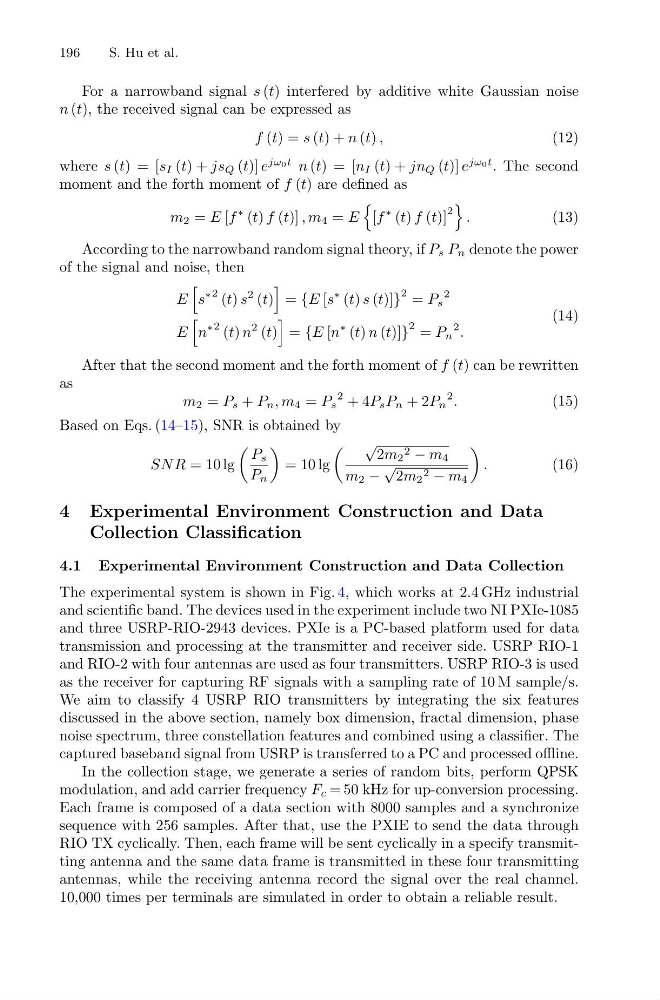
The experimental system is shown in Fig. 4, which works at 2.4 GHz industrial
and scientific band. The devices used in the experiment include two NI PXIe-1085
and three USRP-RIO-2943 devices. PXIe is a PC-based platform used for data
transmission and processing at the transmitter and receiver side. USRP RIO-1
and RIO-2 with four antennas are used as four transmitters. USRP RIO-3 is used
as the receiver for capturing RF signals with a sampling rate of 10 M sample/s.
We aim to classify 4 USRP RIO transmitters by integrating the six features
discussed in the above section, namely box dimension, fractal dimension, phase
noise spectrum, three constellation features and combined using a classifier. The
captured baseband signal from USRP is transferred to a PC and processed offline.
In the collection stage, we generate a series of random bits, perform QPSK
modulation, and add carrier frequency F c = 50 kHz for up-conversion processing.
Each frame is composed of a data section with 8000 samples and a synchronize
sequence with 256 samples. After that, use the PXIE to send the data through
RIO TX cyclically. Then, each frame will be sent cyclically in a specify transmitting antenna and the same data frame is transmitted in these four transmitting
antennas, while the receiving antenna record the signal over the real channel.
10,000 times per terminals are simulated in order to obtain a reliable result.
S. Hu et al.
For a narrowband signal s (t) interfered by additive white Gaussian noise
n (t), the received signal can be expressed as
f (t) = s (t) + n (t) ,
(12)
where s (t) = [s I (t) + js Q (t)] e
jω0t n (t) = [n I (t) + jn Q (t)] e
jω0t . The second
moment and the forth moment of f (t) are defined as
m 2 = E [f
∗ (t) f (t)] , m 4 = E
[f
∗ (t) f (t)]
2
.
(13)
According to the narrowband random signal theory, if P s P n denote the power
of the signal and noise, then
E
s
∗2 (t) s
2 (t)
= {E [s
∗ (t) s (t)]}
2 = P s
2
E
n
∗2 (t) n
2 (t)
= {E [n
∗ (t) n (t)]}
2 = P n
2 .
(14)
After that the second moment and the forth moment of f (t) can be rewritten
as
m 2 = P s + P n , m 4 = P s
2 + 4P s P n + 2P n
2 .
(15)
Based on Eqs. (14–15), SNR is obtained by
SN R = 10 lg
P s
P n
= 10 lg
√
2m 2
2 − m 4
m 2 −
√
2m 2
2 − m 4
.
(16)
4 Experimental Environment Construction and Data
Collection Classification
4.1 Experimental Environment Construction and Data Collection
The experimental system is shown in Fig. 4, which works at 2.4 GHz industrial
and scientific band. The devices used in the experiment include two NI PXIe-1085
and three USRP-RIO-2943 devices. PXIe is a PC-based platform used for data
transmission and processing at the transmitter and receiver side. USRP RIO-1
and RIO-2 with four antennas are used as four transmitters. USRP RIO-3 is used
as the receiver for capturing RF signals with a sampling rate of 10 M sample/s.
We aim to classify 4 USRP RIO transmitters by integrating the six features
discussed in the above section, namely box dimension, fractal dimension, phase
noise spectrum, three constellation features and combined using a classifier. The
captured baseband signal from USRP is transferred to a PC and processed offline.
In the collection stage, we generate a series of random bits, perform QPSK
modulation, and add carrier frequency F c = 50 kHz for up-conversion processing.
Each frame is composed of a data section with 8000 samples and a synchronize
sequence with 256 samples. After that, use the PXIE to send the data through
RIO TX cyclically. Then, each frame will be sent cyclically in a specify transmitting antenna and the same data frame is transmitted in these four transmitting
antennas, while the receiving antenna record the signal over the real channel.
10,000 times per terminals are simulated in order to obtain a reliable result.