

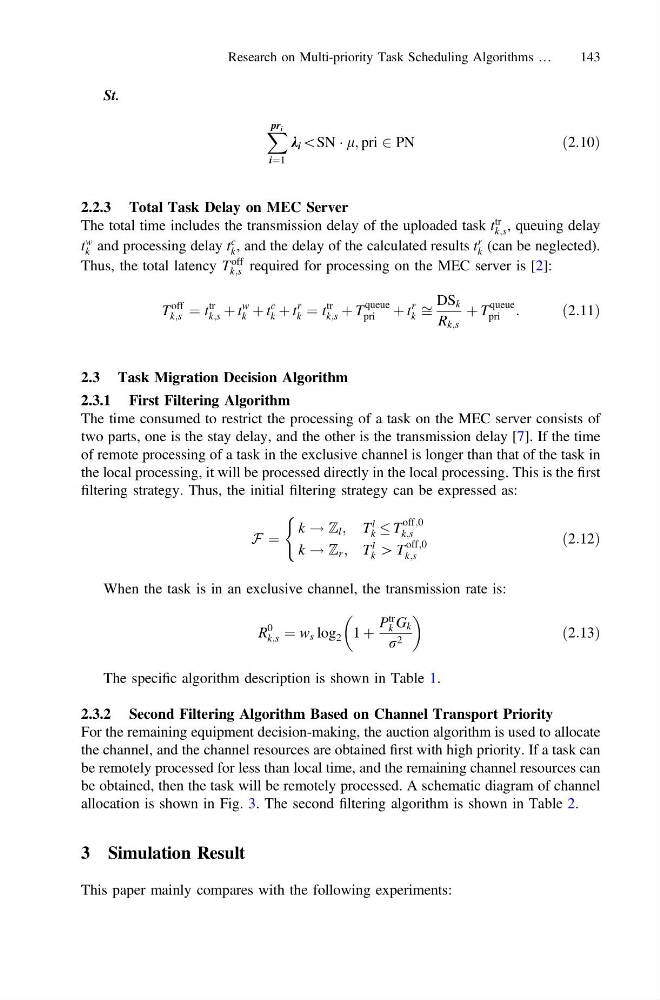
St.
X pr i
i¼1
k i \SN Á l; pri 2 PN
ð2:10Þ
2.2.3 Total Task Delay on MEC Server
The total time includes the transmission delay of the uploaded task t
tr
k;s , queuing delay
t
w
k and processing delay t
c
k , and the delay of the calculated results t
r
k (can be neglected).
Thus, the total latency T
off
k;s required for processing on the MEC server is [2]:
T
off
k;s ¼ t
tr
k;s þ t
w
k þ t
c
k þ t
r
k ¼ t
tr
k;s þ T
queue
pri
þ t
r
k ffi
DS k
R k;s
þ T
queue
pri :
ð2:11Þ
2.3 Task Migration Decision Algorithm
2.3.1 First Filtering Algorithm
The time consumed to restrict the processing of a task on the MEC server consists of
two parts, one is the stay delay, and the other is the transmission delay [7]. If the time
of remote processing of a task in the exclusive channel is longer than that of the task in
the local processing, it will be processed directly in the local processing. This is the first
filtering strategy. Thus, the initial filtering strategy can be expressed as:
F ¼
k ! Z l ; T
l
k
T
off;0
k;s
k ! Z r ; T
l
k [ T
off;0
k;s
(
ð2:12Þ
When the task is in an exclusive channel, the transmission rate is:
R
0
k;s ¼ w s log 2 1 þ
P
tr
k G k
r 2
ð2:13Þ
The specific algorithm description is shown in Table 1.
2.3.2 Second Filtering Algorithm Based on Channel Transport Priority
For the remaining equipment decision-making, the auction algorithm is used to allocate
the channel, and the channel resources are obtained first with high priority. If a task can
be remotely processed for less than local time, and the remaining channel resources can
be obtained, then the task will be remotely processed. A schematic diagram of channel
allocation is shown in Fig. 3. The second filtering algorithm is shown in Table 2.
3 Simulation Result
This paper mainly compares with the following experiments:
Research on Multi-priority Task Scheduling Algorithms …
143
X pr i
i¼1
k i \SN Á l; pri 2 PN
ð2:10Þ
2.2.3 Total Task Delay on MEC Server
The total time includes the transmission delay of the uploaded task t
tr
k;s , queuing delay
t
w
k and processing delay t
c
k , and the delay of the calculated results t
r
k (can be neglected).
Thus, the total latency T
off
k;s required for processing on the MEC server is [2]:
T
off
k;s ¼ t
tr
k;s þ t
w
k þ t
c
k þ t
r
k ¼ t
tr
k;s þ T
queue
pri
þ t
r
k ffi
DS k
R k;s
þ T
queue
pri :
ð2:11Þ
2.3 Task Migration Decision Algorithm
2.3.1 First Filtering Algorithm
The time consumed to restrict the processing of a task on the MEC server consists of
two parts, one is the stay delay, and the other is the transmission delay [7]. If the time
of remote processing of a task in the exclusive channel is longer than that of the task in
the local processing, it will be processed directly in the local processing. This is the first
filtering strategy. Thus, the initial filtering strategy can be expressed as:
F ¼
k ! Z l ; T
l
k
T
off;0
k;s
k ! Z r ; T
l
k [ T
off;0
k;s
(
ð2:12Þ
When the task is in an exclusive channel, the transmission rate is:
R
0
k;s ¼ w s log 2 1 þ
P
tr
k G k
r 2
ð2:13Þ
The specific algorithm description is shown in Table 1.
2.3.2 Second Filtering Algorithm Based on Channel Transport Priority
For the remaining equipment decision-making, the auction algorithm is used to allocate
the channel, and the channel resources are obtained first with high priority. If a task can
be remotely processed for less than local time, and the remaining channel resources can
be obtained, then the task will be remotely processed. A schematic diagram of channel
allocation is shown in Fig. 3. The second filtering algorithm is shown in Table 2.
3 Simulation Result
This paper mainly compares with the following experiments:
Research on Multi-priority Task Scheduling Algorithms …
143