

2.2.2 Task Stay Time on MEC Server
When task k is transmitted to MEC server through channel s for processing, queuing
will begin when the number of tasks is increasing. Therefore, the duration of a task on
the MEC server is the sum of queuing delay and processing delay.
T
queue
k
¼ t
w
k þ t
c
k
ð2:5Þ
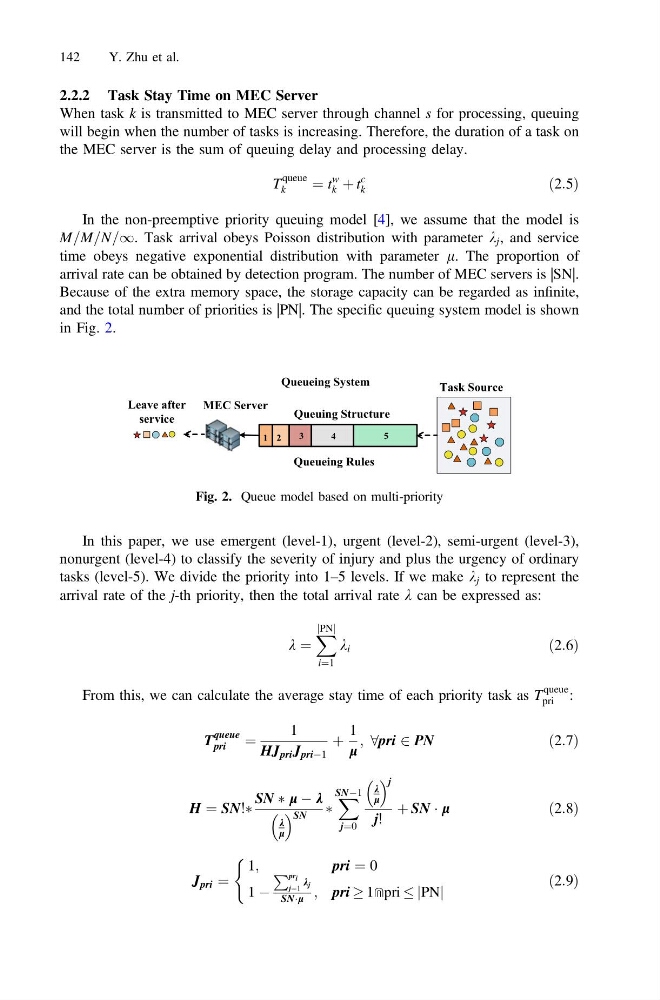
In the non-preemptive priority queuing model [4], we assume that the model is
M=M=N=1. Task arrival obeys Poisson distribution with parameter k j , and service
time obeys negative exponential distribution with parameter l. The proportion of
arrival rate can be obtained by detection program. The number of MEC servers is |SN|.
Because of the extra memory space, the storage capacity can be regarded as infinite,
and the total number of priorities is |PN|. The specific queuing system model is shown
in Fig. 2.
In this paper, we use emergent (level-1), urgent (level-2), semi-urgent (level-3),
nonurgent (level-4) to classify the severity of injury and plus the urgency of ordinary
tasks (level-5). We divide the priority into 1–5 levels. If we make k j to represent the
arrival rate of the j-th priority, then the total arrival rate k can be expressed as:
k ¼
X PN
j j
i¼1
k i
ð2:6Þ
From this, we can calculate the average stay time of each priority task as T
queue
pri :
T
queue
pri
¼
1
HJ pri J priÀ1
þ
1
l
; 8pri 2 PN
ð2:7Þ
H ¼ SN!Ã
SN Ã l À k
k
l
SN Ã
X
SNÀ1
j¼0
k
l
j
j!
þ SN Á l
ð2:8Þ
J pri ¼
1;
pri ¼ 0
1 À
P pr i
j¼1
k j
SNÁl ; pri ! 1epri PN
j j
(
ð2:9Þ
1 2
3
4
5
Queueing System
Queuing Structure
Queueing Rules
MEC Server
Leave after
service
Task Source
Fig. 2. Queue model based on multi-priority
142
Y. Zhu et al.
When task k is transmitted to MEC server through channel s for processing, queuing
will begin when the number of tasks is increasing. Therefore, the duration of a task on
the MEC server is the sum of queuing delay and processing delay.
T
queue
k
¼ t
w
k þ t
c
k
ð2:5Þ
In the non-preemptive priority queuing model [4], we assume that the model is
M=M=N=1. Task arrival obeys Poisson distribution with parameter k j , and service
time obeys negative exponential distribution with parameter l. The proportion of
arrival rate can be obtained by detection program. The number of MEC servers is |SN|.
Because of the extra memory space, the storage capacity can be regarded as infinite,
and the total number of priorities is |PN|. The specific queuing system model is shown
in Fig. 2.
In this paper, we use emergent (level-1), urgent (level-2), semi-urgent (level-3),
nonurgent (level-4) to classify the severity of injury and plus the urgency of ordinary
tasks (level-5). We divide the priority into 1–5 levels. If we make k j to represent the
arrival rate of the j-th priority, then the total arrival rate k can be expressed as:
k ¼
X PN
j j
i¼1
k i
ð2:6Þ
From this, we can calculate the average stay time of each priority task as T
queue
pri :
T
queue
pri
¼
1
HJ pri J priÀ1
þ
1
l
; 8pri 2 PN
ð2:7Þ
H ¼ SN!Ã
SN Ã l À k
k
l
SN Ã
X
SNÀ1
j¼0
k
l
j
j!
þ SN Á l
ð2:8Þ
J pri ¼
1;
pri ¼ 0
1 À
P pr i
j¼1
k j
SNÁl ; pri ! 1epri PN
j j
(
ð2:9Þ
1 2
3
4
5
Queueing System
Queuing Structure
Queueing Rules
MEC Server
Leave after
service
Task Source
Fig. 2. Queue model based on multi-priority
142
Y. Zhu et al.