

According to this method, a total of 6000 data were obtained, including 2000 for
emergencies and 4000 for non-emergency events. All data must first be segmented,
then the stop words are removed in the article, and finally, the words are converted into
word vectors as algorithm input.
4.2 Evaluation Criterion
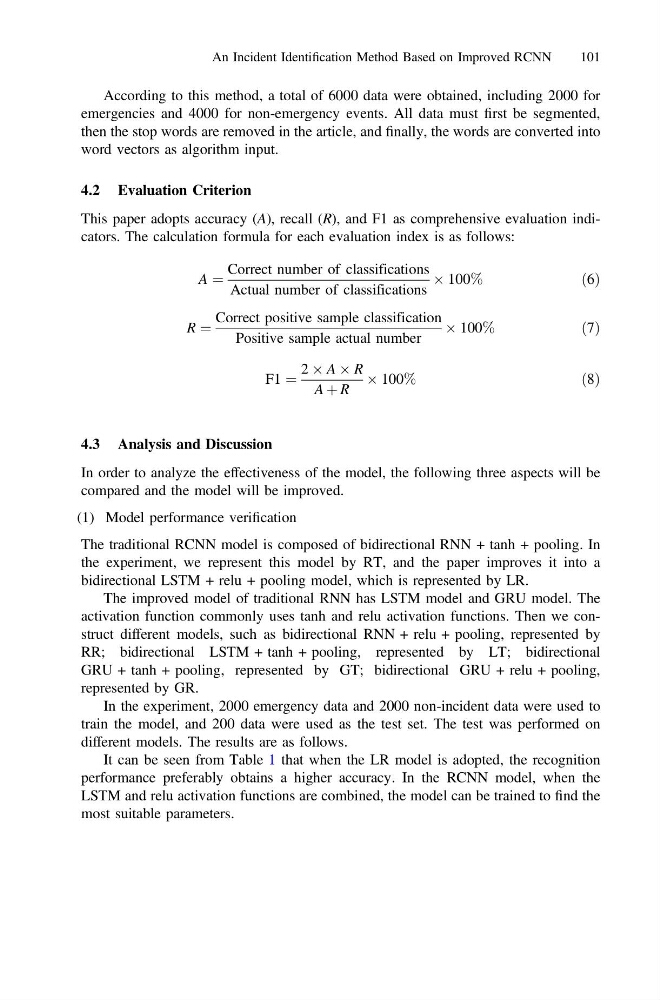
This paper adopts accuracy (A), recall (R), and F1 as comprehensive evaluation indicators. The calculation formula for each evaluation index is as follows:
A ¼
Correct number of classifications
Actual number of classifications
 100%
ð6Þ
R ¼
Correct positive sample classification
Positive sample actual number
 100%
ð7Þ
F1 ¼
2 Â A Â R
A þ R
 100%
ð8Þ
4.3 Analysis and Discussion
In order to analyze the effectiveness of the model, the following three aspects will be
compared and the model will be improved.
(1) Model performance verification
The traditional RCNN model is composed of bidirectional RNN + tanh + pooling. In
the experiment, we represent this model by RT, and the paper improves it into a
bidirectional LSTM + relu + pooling model, which is represented by LR.
The improved model of traditional RNN has LSTM model and GRU model. The
activation function commonly uses tanh and relu activation functions. Then we construct different models, such as bidirectional RNN + relu + pooling, represented by
RR; bidirectional LSTM + tanh + pooling, represented by LT; bidirectional
GRU + tanh + pooling, represented by GT; bidirectional GRU + relu + pooling,
represented by GR.
In the experiment, 2000 emergency data and 2000 non-incident data were used to
train the model, and 200 data were used as the test set. The test was performed on
different models. The results are as follows.
It can be seen from Table 1 that when the LR model is adopted, the recognition
performance preferably obtains a higher accuracy. In the RCNN model, when the
LSTM and relu activation functions are combined, the model can be trained to find the
most suitable parameters.
An Incident Identification Method Based on Improved RCNN
101
emergencies and 4000 for non-emergency events. All data must first be segmented,
then the stop words are removed in the article, and finally, the words are converted into
word vectors as algorithm input.
4.2 Evaluation Criterion
This paper adopts accuracy (A), recall (R), and F1 as comprehensive evaluation indicators. The calculation formula for each evaluation index is as follows:
A ¼
Correct number of classifications
Actual number of classifications
 100%
ð6Þ
R ¼
Correct positive sample classification
Positive sample actual number
 100%
ð7Þ
F1 ¼
2 Â A Â R
A þ R
 100%
ð8Þ
4.3 Analysis and Discussion
In order to analyze the effectiveness of the model, the following three aspects will be
compared and the model will be improved.
(1) Model performance verification
The traditional RCNN model is composed of bidirectional RNN + tanh + pooling. In
the experiment, we represent this model by RT, and the paper improves it into a
bidirectional LSTM + relu + pooling model, which is represented by LR.
The improved model of traditional RNN has LSTM model and GRU model. The
activation function commonly uses tanh and relu activation functions. Then we construct different models, such as bidirectional RNN + relu + pooling, represented by
RR; bidirectional LSTM + tanh + pooling, represented by LT; bidirectional
GRU + tanh + pooling, represented by GT; bidirectional GRU + relu + pooling,
represented by GR.
In the experiment, 2000 emergency data and 2000 non-incident data were used to
train the model, and 200 data were used as the test set. The test was performed on
different models. The results are as follows.
It can be seen from Table 1 that when the LR model is adopted, the recognition
performance preferably obtains a higher accuracy. In the RCNN model, when the
LSTM and relu activation functions are combined, the model can be trained to find the
most suitable parameters.
An Incident Identification Method Based on Improved RCNN
101