

Therefore, this paper converts the bidirectional RNN of the traditional RCNN into a
bidirectional LSTM, and constructs a structure of bidirectional LSTM + tanh activation
function + pooling layer, but the accuracy of the model test is only 57%.
In order to solve this situation, this paper observes the model training through
tensorboard.
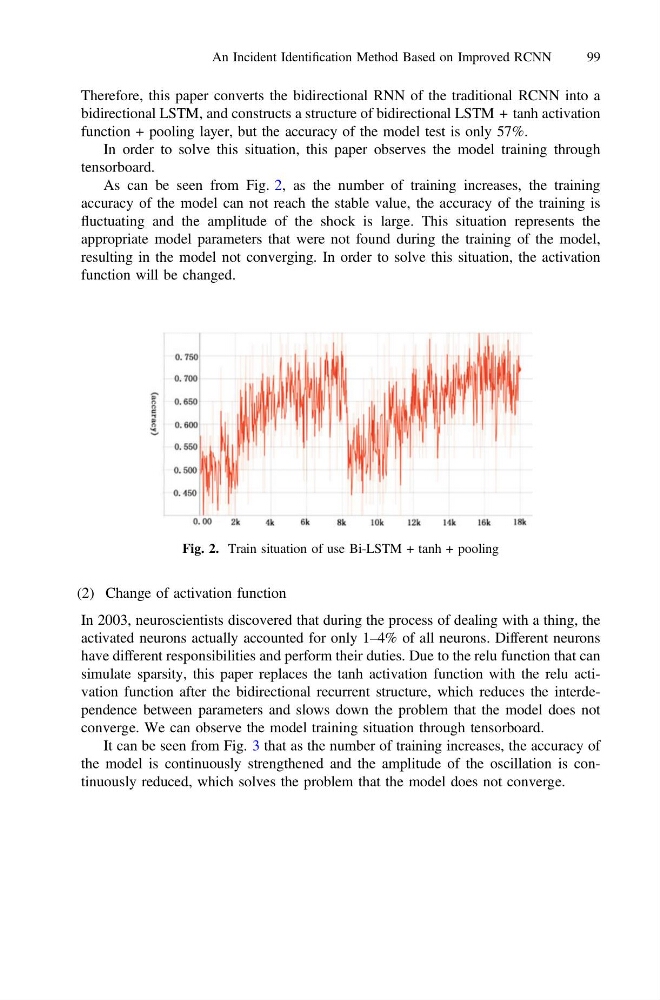
As can be seen from Fig. 2, as the number of training increases, the training
accuracy of the model can not reach the stable value, the accuracy of the training is
fluctuating and the amplitude of the shock is large. This situation represents the
appropriate model parameters that were not found during the training of the model,
resulting in the model not converging. In order to solve this situation, the activation
function will be changed.
(2) Change of activation function
In 2003, neuroscientists discovered that during the process of dealing with a thing, the
activated neurons actually accounted for only 1–4% of all neurons. Different neurons
have different responsibilities and perform their duties. Due to the relu function that can
simulate sparsity, this paper replaces the tanh activation function with the relu activation function after the bidirectional recurrent structure, which reduces the interdependence between parameters and slows down the problem that the model does not
converge. We can observe the model training situation through tensorboard.
It can be seen from Fig. 3 that as the number of training increases, the accuracy of
the model is continuously strengthened and the amplitude of the oscillation is continuously reduced, which solves the problem that the model does not converge.
Fig. 2. Train situation of use Bi-LSTM + tanh + pooling
An Incident Identification Method Based on Improved RCNN
99
bidirectional LSTM, and constructs a structure of bidirectional LSTM + tanh activation
function + pooling layer, but the accuracy of the model test is only 57%.
In order to solve this situation, this paper observes the model training through
tensorboard.
As can be seen from Fig. 2, as the number of training increases, the training
accuracy of the model can not reach the stable value, the accuracy of the training is
fluctuating and the amplitude of the shock is large. This situation represents the
appropriate model parameters that were not found during the training of the model,
resulting in the model not converging. In order to solve this situation, the activation
function will be changed.
(2) Change of activation function
In 2003, neuroscientists discovered that during the process of dealing with a thing, the
activated neurons actually accounted for only 1–4% of all neurons. Different neurons
have different responsibilities and perform their duties. Due to the relu function that can
simulate sparsity, this paper replaces the tanh activation function with the relu activation function after the bidirectional recurrent structure, which reduces the interdependence between parameters and slows down the problem that the model does not
converge. We can observe the model training situation through tensorboard.
It can be seen from Fig. 3 that as the number of training increases, the accuracy of
the model is continuously strengthened and the amplitude of the oscillation is continuously reduced, which solves the problem that the model does not converge.
Fig. 2. Train situation of use Bi-LSTM + tanh + pooling
An Incident Identification Method Based on Improved RCNN
99