

3.4 Algorithm Results Comparison
In order to evaluate the classification efficiency of the DSVM algorithm on the
imbalanced datasets, we performed five classification evaluations in each set of
instances on each dataset. Finally, the average result is taken as the classification
accuracy of the target. The classification recognition rate is compared with SAE and
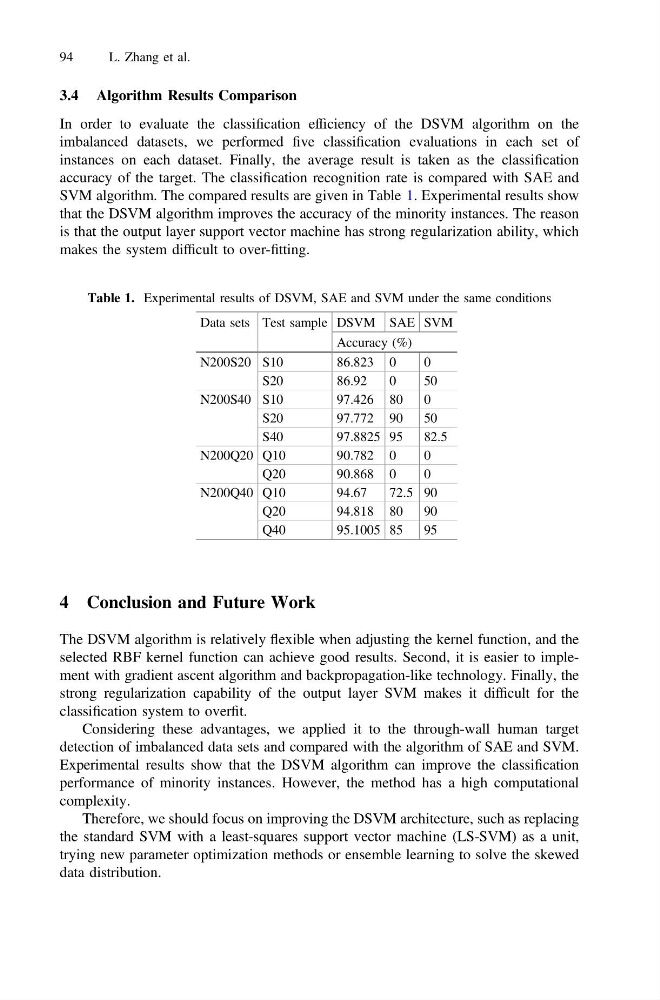
SVM algorithm. The compared results are given in Table 1. Experimental results show
that the DSVM algorithm improves the accuracy of the minority instances. The reason
is that the output layer support vector machine has strong regularization ability, which
makes the system difficult to over-fitting.
4 Conclusion and Future Work
The DSVM algorithm is relatively flexible when adjusting the kernel function, and the
selected RBF kernel function can achieve good results. Second, it is easier to implement with gradient ascent algorithm and backpropagation-like technology. Finally, the
strong regularization capability of the output layer SVM makes it difficult for the
classification system to overfit.
Considering these advantages, we applied it to the through-wall human target
detection of imbalanced data sets and compared with the algorithm of SAE and SVM.
Experimental results show that the DSVM algorithm can improve the classification
performance of minority instances. However, the method has a high computational
complexity.
Therefore, we should focus on improving the DSVM architecture, such as replacing
the standard SVM with a least-squares support vector machine (LS-SVM) as a unit,
trying new parameter optimization methods or ensemble learning to solve the skewed
data distribution.
Table 1. Experimental results of DSVM, SAE and SVM under the same conditions
Data sets Test sample DSVM SAE SVM
Accuracy (%)
N200S20 S10
86.823 0
0
S20
86.92
0
50
N200S40 S10
97.426 80
0
S20
97.772 90
50
S40
97.8825 95
82.5
N200Q20 Q10
90.782 0
0
Q20
90.868 0
0
N200Q40 Q10
94.67
72.5 90
Q20
94.818 80
90
Q40
95.1005 85
95
94
L. Zhang et al.
In order to evaluate the classification efficiency of the DSVM algorithm on the
imbalanced datasets, we performed five classification evaluations in each set of
instances on each dataset. Finally, the average result is taken as the classification
accuracy of the target. The classification recognition rate is compared with SAE and
SVM algorithm. The compared results are given in Table 1. Experimental results show
that the DSVM algorithm improves the accuracy of the minority instances. The reason
is that the output layer support vector machine has strong regularization ability, which
makes the system difficult to over-fitting.
4 Conclusion and Future Work
The DSVM algorithm is relatively flexible when adjusting the kernel function, and the
selected RBF kernel function can achieve good results. Second, it is easier to implement with gradient ascent algorithm and backpropagation-like technology. Finally, the
strong regularization capability of the output layer SVM makes it difficult for the
classification system to overfit.
Considering these advantages, we applied it to the through-wall human target
detection of imbalanced data sets and compared with the algorithm of SAE and SVM.
Experimental results show that the DSVM algorithm can improve the classification
performance of minority instances. However, the method has a high computational
complexity.
Therefore, we should focus on improving the DSVM architecture, such as replacing
the standard SVM with a least-squares support vector machine (LS-SVM) as a unit,
trying new parameter optimization methods or ensemble learning to solve the skewed
data distribution.
Table 1. Experimental results of DSVM, SAE and SVM under the same conditions
Data sets Test sample DSVM SAE SVM
Accuracy (%)
N200S20 S10
86.823 0
0
S20
86.92
0
50
N200S40 S10
97.426 80
0
S20
97.772 90
50
S40
97.8825 95
82.5
N200Q20 Q10
90.782 0
0
Q20
90.868 0
0
N200Q40 Q10
94.67
72.5 90
Q20
94.818 80
90
Q40
95.1005 85
95
94
L. Zhang et al.