

ground. And the wall thickness is 24 cm. To ensure that the electromagnetic wave can
be injected vertically into the wall, the receiving antenna and the transmitting antenna
are set to face the wall.
In this case, experimental analysis of multistate human targets is carried out. The
first group of experiments was unmanned state and the one-person rapid breathing state
after the wall. The second group of experiments was the unmanned state and the twoperson slowly walking state behind the wall. All human targets are required to face the
radar system behind the wall.
3.2 Human Target Detection Dataset Descriptions
By constructing the experimental platform described above, we collected three groups
data samples. In order to evaluate the performance of the DSVM algorithm for human
target detection through the wall, we combined four groups of datasets, namely
N200S20, N200Q20, N200S40 and N200Q40. Among them, the letter N represents
unmanned behind the brick ball. The letter S stands for two-person slowly walking
state behind the wall. The letter Q represents one-person rapid breathing state after the
wall.
Specifically, the N200S20 dataset contains 220 samples where 200 samples are
with nobody behind the brick wall and 20 samples are with two persons keeping the
status of slow moving. The N200Q20 dataset contains 220 samples where 200 samples
are with nobody behind the brick wall and 20 samples are with one-person rapid
breathing state behind the wall. The N200S40 dataset and the N200Q40 dataset are
similar to the above expression, except that the number of human states is changed to
40. After feature extraction, the number of feature attribute values for these four
datasets is 34.
In this paper, the experimental data is normalized to meet the requirements of the
experiment and reduce the amount of calculation. The training sample is a randomly
selected 90% in each type of dataset. The selection of test samples is determined
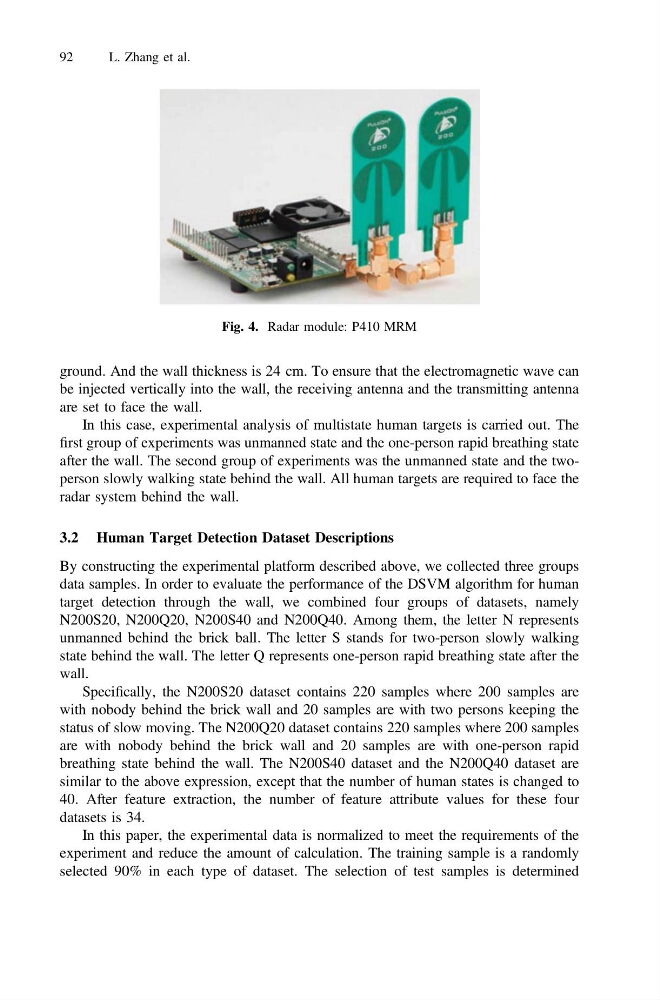
Fig. 4. Radar module: P410 MRM
92
L. Zhang et al.
be injected vertically into the wall, the receiving antenna and the transmitting antenna
are set to face the wall.
In this case, experimental analysis of multistate human targets is carried out. The
first group of experiments was unmanned state and the one-person rapid breathing state
after the wall. The second group of experiments was the unmanned state and the twoperson slowly walking state behind the wall. All human targets are required to face the
radar system behind the wall.
3.2 Human Target Detection Dataset Descriptions
By constructing the experimental platform described above, we collected three groups
data samples. In order to evaluate the performance of the DSVM algorithm for human
target detection through the wall, we combined four groups of datasets, namely
N200S20, N200Q20, N200S40 and N200Q40. Among them, the letter N represents
unmanned behind the brick ball. The letter S stands for two-person slowly walking
state behind the wall. The letter Q represents one-person rapid breathing state after the
wall.
Specifically, the N200S20 dataset contains 220 samples where 200 samples are
with nobody behind the brick wall and 20 samples are with two persons keeping the
status of slow moving. The N200Q20 dataset contains 220 samples where 200 samples
are with nobody behind the brick wall and 20 samples are with one-person rapid
breathing state behind the wall. The N200S40 dataset and the N200Q40 dataset are
similar to the above expression, except that the number of human states is changed to
40. After feature extraction, the number of feature attribute values for these four
datasets is 34.
In this paper, the experimental data is normalized to meet the requirements of the
experiment and reduce the amount of calculation. The training sample is a randomly
selected 90% in each type of dataset. The selection of test samples is determined
Fig. 4. Radar module: P410 MRM
92
L. Zhang et al.