

3.4 Associate Legendre Functions with Complex Indices
47
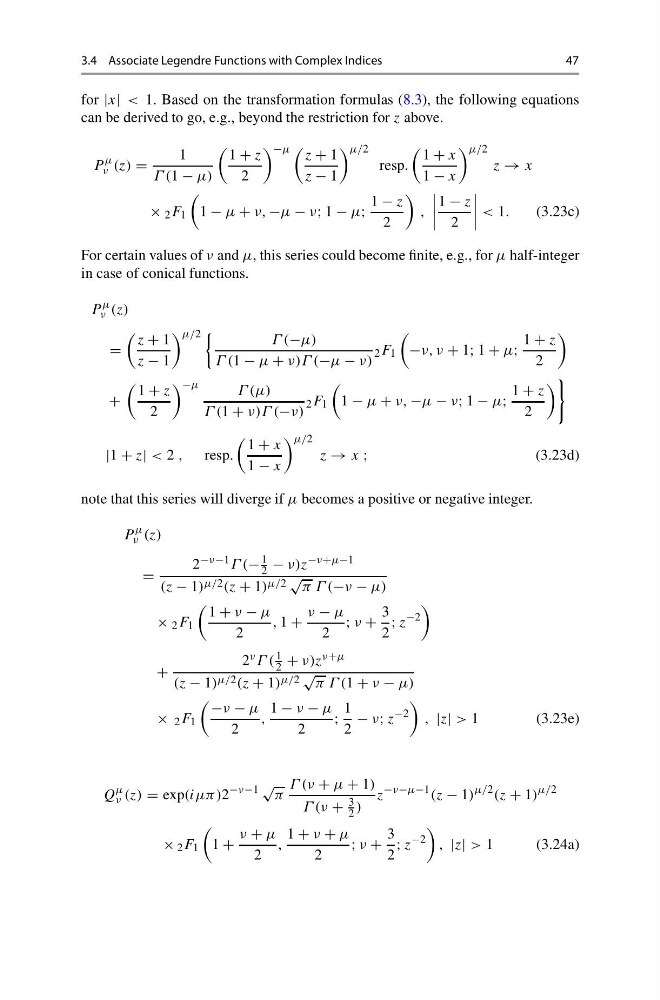
for |x| < 1. Based on the transformation formulas (8.3), the following equations
can be derived to go, e.g., beyond the restriction for z above.
P
μ
ν (z) =
1
Γ (1 − μ)
1 + z
2
−μ
z + 1
z − 1
μ/2
resp.
1 + x
1 − x
μ/2
z → x
× 2 F 1
1 − μ + ν, −μ − ν; 1 − μ;
1 − z
2
,
1 − z
2
< 1.
(3.23c)
For certain values of ν and μ, this series could become finite, e.g., for μ half-integer
in case of conical functions.
P
μ
ν (z)
=
z + 1
z − 1
μ/2
Γ (−μ)
Γ (1 − μ + ν)Γ (−μ − ν)
2 F 1
−ν, ν + 1; 1 + μ;
1 + z
2
+
1 + z
2
−μ
Γ (μ)
Γ (1 + ν)Γ (−ν)
2 F 1
1 − μ + ν, −μ − ν; 1 − μ;
1 + z
2
|1 + z| < 2 , resp.
1 + x
1 − x
μ/2
z → x ;
(3.23d)
note that this series will diverge if μ becomes a positive or negative integer.
P
μ
ν (z)
=
2 −ν−1 Γ (−
1
2 − ν)z −ν+μ−1
(z − 1) μ/2 (z + 1) μ/2 √
π Γ (−ν − μ)
× 2 F 1
1 + ν − μ
2
, 1 +
ν − μ
2
; ν +
3
2
; z
−2
+
2 ν Γ (
1
2 + ν)z ν+μ
(z − 1) μ/2 (z + 1) μ/2 √
π Γ (1 + ν − μ)
× 2 F 1
−ν − μ
2
,
1 − ν − μ
2
;
1
2
− ν; z
−2
, |z| > 1
(3.23e)
Q
μ
ν (z) = exp(iμπ)2
−ν−1 √
π
Γ (ν + μ + 1)
Γ (ν +
3
2 )
z
−ν−μ−1 (z − 1)
μ/2 (z + 1)
μ/2
× 2 F 1
1 +
ν + μ
2
,
1 + ν + μ
2
; ν +
3
2
; z
−2
, |z| > 1
(3.24a)
47
for |x| < 1. Based on the transformation formulas (8.3), the following equations
can be derived to go, e.g., beyond the restriction for z above.
P
μ
ν (z) =
1
Γ (1 − μ)
1 + z
2
−μ
z + 1
z − 1
μ/2
resp.
1 + x
1 − x
μ/2
z → x
× 2 F 1
1 − μ + ν, −μ − ν; 1 − μ;
1 − z
2
,
1 − z
2
< 1.
(3.23c)
For certain values of ν and μ, this series could become finite, e.g., for μ half-integer
in case of conical functions.
P
μ
ν (z)
=
z + 1
z − 1
μ/2
Γ (−μ)
Γ (1 − μ + ν)Γ (−μ − ν)
2 F 1
−ν, ν + 1; 1 + μ;
1 + z
2
+
1 + z
2
−μ
Γ (μ)
Γ (1 + ν)Γ (−ν)
2 F 1
1 − μ + ν, −μ − ν; 1 − μ;
1 + z
2
|1 + z| < 2 , resp.
1 + x
1 − x
μ/2
z → x ;
(3.23d)
note that this series will diverge if μ becomes a positive or negative integer.
P
μ
ν (z)
=
2 −ν−1 Γ (−
1
2 − ν)z −ν+μ−1
(z − 1) μ/2 (z + 1) μ/2 √
π Γ (−ν − μ)
× 2 F 1
1 + ν − μ
2
, 1 +
ν − μ
2
; ν +
3
2
; z
−2
+
2 ν Γ (
1
2 + ν)z ν+μ
(z − 1) μ/2 (z + 1) μ/2 √
π Γ (1 + ν − μ)
× 2 F 1
−ν − μ
2
,
1 − ν − μ
2
;
1
2
− ν; z
−2
, |z| > 1
(3.23e)
Q
μ
ν (z) = exp(iμπ)2
−ν−1 √
π
Γ (ν + μ + 1)
Γ (ν +
3
2 )
z
−ν−μ−1 (z − 1)
μ/2 (z + 1)
μ/2
× 2 F 1
1 +
ν + μ
2
,
1 + ν + μ
2
; ν +
3
2
; z
−2
, |z| > 1
(3.24a)