

23.1 Separability in Three Dimensions
267
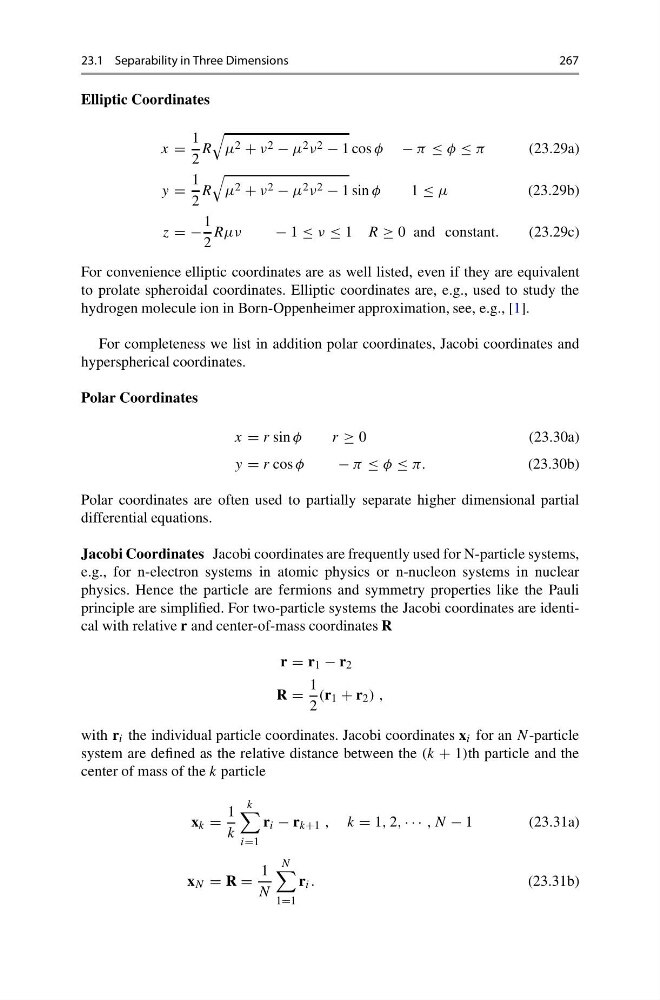
Elliptic Coordinates
x =
1
2
R
μ 2 + ν 2 − μ 2 ν 2 − 1 cos φ − π ≤ φ ≤ π
(23.29a)
y =
1
2
R
μ 2 + ν 2 − μ 2 ν 2 − 1 sin φ
1 ≤ μ
(23.29b)
z = −
1
2
Rμν
− 1 ≤ ν ≤ 1 R ≥ 0 and constant.
(23.29c)
For convenience elliptic coordinates are as well listed, even if they are equivalent
to prolate spheroidal coordinates. Elliptic coordinates are, e.g., used to study the
hydrogen molecule ion in Born-Oppenheimer approximation, see, e.g., [1].
For completeness we list in addition polar coordinates, Jacobi coordinates and
hyperspherical coordinates.
Polar Coordinates
x = r sin φ
r ≥ 0
(23.30a)
y = r cos φ
− π ≤ φ ≤ π.
(23.30b)
Polar coordinates are often used to partially separate higher dimensional partial
differential equations.
Jacobi Coordinates Jacobi coordinates are frequently used for N-particle systems,
e.g., for n-electron systems in atomic physics or n-nucleon systems in nuclear
physics. Hence the particle are fermions and symmetry properties like the Pauli
principle are simplified. For two-particle systems the Jacobi coordinates are identical with relative r and center-of-mass coordinates R
r = r 1 − r 2
R =
1
2
(r 1 + r 2 ) ,
with r i the individual particle coordinates. Jacobi coordinates x i for an N-particle
system are defined as the relative distance between the (k + 1)th particle and the
center of mass of the k particle
x k =
1
k
k
i=1
r i − r k+1 , k = 1, 2, · · · , N − 1
(23.31a)
x N = R =
1
N
N
1=1
r i .
(23.31b)
267
Elliptic Coordinates
x =
1
2
R
μ 2 + ν 2 − μ 2 ν 2 − 1 cos φ − π ≤ φ ≤ π
(23.29a)
y =
1
2
R
μ 2 + ν 2 − μ 2 ν 2 − 1 sin φ
1 ≤ μ
(23.29b)
z = −
1
2
Rμν
− 1 ≤ ν ≤ 1 R ≥ 0 and constant.
(23.29c)
For convenience elliptic coordinates are as well listed, even if they are equivalent
to prolate spheroidal coordinates. Elliptic coordinates are, e.g., used to study the
hydrogen molecule ion in Born-Oppenheimer approximation, see, e.g., [1].
For completeness we list in addition polar coordinates, Jacobi coordinates and
hyperspherical coordinates.
Polar Coordinates
x = r sin φ
r ≥ 0
(23.30a)
y = r cos φ
− π ≤ φ ≤ π.
(23.30b)
Polar coordinates are often used to partially separate higher dimensional partial
differential equations.
Jacobi Coordinates Jacobi coordinates are frequently used for N-particle systems,
e.g., for n-electron systems in atomic physics or n-nucleon systems in nuclear
physics. Hence the particle are fermions and symmetry properties like the Pauli
principle are simplified. For two-particle systems the Jacobi coordinates are identical with relative r and center-of-mass coordinates R
r = r 1 − r 2
R =
1
2
(r 1 + r 2 ) ,
with r i the individual particle coordinates. Jacobi coordinates x i for an N-particle
system are defined as the relative distance between the (k + 1)th particle and the
center of mass of the k particle
x k =
1
k
k
i=1
r i − r k+1 , k = 1, 2, · · · , N − 1
(23.31a)
x N = R =
1
N
N
1=1
r i .
(23.31b)