

254
22 Wigner- and Clebsch-Gordan Coefficients
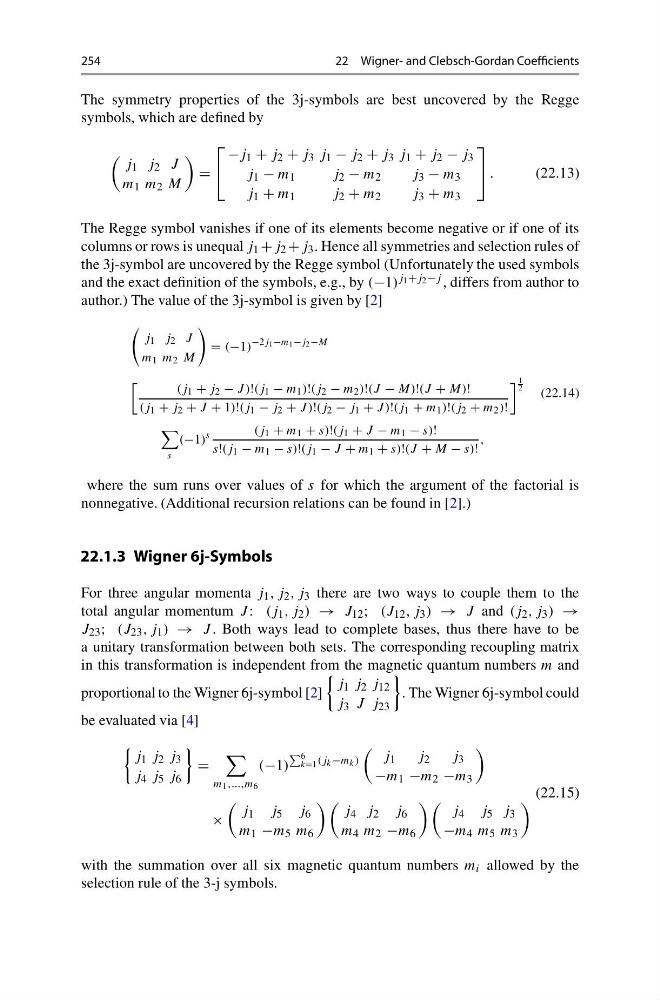
The symmetry properties of the 3j-symbols are best uncovered by the Regge
symbols, which are defined by
j 1 j 2 J
m 1 m 2 M
=
⎡
⎣
−j 1 + j 2 + j 3 j 1 − j 2 + j 3 j 1 + j 2 − j 3
j 1 − m 1
j 2 − m 2
j 3 − m 3
j 1 + m 1
j 2 + m 2
j 3 + m 3
⎤
⎦ .
(22.13)
The Regge symbol vanishes if one of its elements become negative or if one of its
columns or rows is unequal j 1 +j 2 +j 3 . Hence all symmetries and selection rules of
the 3j-symbol are uncovered by the Regge symbol (Unfortunately the used symbols
and the exact definition of the symbols, e.g., by (−1) j 1 +j 2 −j , differs from author to
author.) The value of the 3j-symbol is given by [2]
j 1 j 2 J
m 1 m 2 M
= (−1)
−2j 1 −m 1 −j 2 −M
(j 1 + j 2 − J )!(j 1 − m 1 )!(j 2 − m 2 )!(J − M)!(J + M)!
(j 1 + j 2 + J + 1)!(j 1 − j 2 + J )!(j 2 − j 1 + J )!(j 1 + m 1 )!(j 2 + m 2 )!
1
2
s
(−1)
s
(j 1 + m 1 + s)!(j 1 + J − m 1 − s)!
s!(j 1 − m 1 − s)!(j 1 − J + m 1 + s)!(J + M − s)!
,
(22.14)
where the sum runs over values of s for which the argument of the factorial is
nonnegative. (Additional recursion relations can be found in [2].)
22.1.3 Wigner 6j-Symbols
For three angular momenta j 1 , j 2 , j 3 there are two ways to couple them to the
total angular momentum J : (j 1 , j 2 ) → J 12 ; (J 12 , j 3 ) → J and (j 2 , j 3 ) →
J 23 ; (J 23 , j 1 ) → J . Both ways lead to complete bases, thus there have to be
a unitary transformation between both sets. The corresponding recoupling matrix
in this transformation is independent from the magnetic quantum numbers m and
proportional to the Wigner 6j-symbol [2]
j 1 j 2 j 12
j 3 J j 23
. The Wigner 6j-symbol could
be evaluated via [4]
j 1 j 2 j 3
j 4 j 5 j 6
=
m 1 ,...,m 6
(−1)
6
k=1 (j k −m k )
j 1 j 2 j 3
−m 1 −m 2 −m 3
×
j 1 j 5 j 6
m 1 −m 5 m 6
j 4 j 2 j 6
m 4 m 2 −m 6
j 4 j 5 j 3
−m 4 m 5 m 3
(22.15)
with the summation over all six magnetic quantum numbers m i allowed by the
selection rule of the 3-j symbols.
22 Wigner- and Clebsch-Gordan Coefficients
The symmetry properties of the 3j-symbols are best uncovered by the Regge
symbols, which are defined by
j 1 j 2 J
m 1 m 2 M
=
⎡
⎣
−j 1 + j 2 + j 3 j 1 − j 2 + j 3 j 1 + j 2 − j 3
j 1 − m 1
j 2 − m 2
j 3 − m 3
j 1 + m 1
j 2 + m 2
j 3 + m 3
⎤
⎦ .
(22.13)
The Regge symbol vanishes if one of its elements become negative or if one of its
columns or rows is unequal j 1 +j 2 +j 3 . Hence all symmetries and selection rules of
the 3j-symbol are uncovered by the Regge symbol (Unfortunately the used symbols
and the exact definition of the symbols, e.g., by (−1) j 1 +j 2 −j , differs from author to
author.) The value of the 3j-symbol is given by [2]
j 1 j 2 J
m 1 m 2 M
= (−1)
−2j 1 −m 1 −j 2 −M
(j 1 + j 2 − J )!(j 1 − m 1 )!(j 2 − m 2 )!(J − M)!(J + M)!
(j 1 + j 2 + J + 1)!(j 1 − j 2 + J )!(j 2 − j 1 + J )!(j 1 + m 1 )!(j 2 + m 2 )!
1
2
s
(−1)
s
(j 1 + m 1 + s)!(j 1 + J − m 1 − s)!
s!(j 1 − m 1 − s)!(j 1 − J + m 1 + s)!(J + M − s)!
,
(22.14)
where the sum runs over values of s for which the argument of the factorial is
nonnegative. (Additional recursion relations can be found in [2].)
22.1.3 Wigner 6j-Symbols
For three angular momenta j 1 , j 2 , j 3 there are two ways to couple them to the
total angular momentum J : (j 1 , j 2 ) → J 12 ; (J 12 , j 3 ) → J and (j 2 , j 3 ) →
J 23 ; (J 23 , j 1 ) → J . Both ways lead to complete bases, thus there have to be
a unitary transformation between both sets. The corresponding recoupling matrix
in this transformation is independent from the magnetic quantum numbers m and
proportional to the Wigner 6j-symbol [2]
j 1 j 2 j 12
j 3 J j 23
. The Wigner 6j-symbol could
be evaluated via [4]
j 1 j 2 j 3
j 4 j 5 j 6
=
m 1 ,...,m 6
(−1)
6
k=1 (j k −m k )
j 1 j 2 j 3
−m 1 −m 2 −m 3
×
j 1 j 5 j 6
m 1 −m 5 m 6
j 4 j 2 j 6
m 4 m 2 −m 6
j 4 j 5 j 3
−m 4 m 5 m 3
(22.15)
with the summation over all six magnetic quantum numbers m i allowed by the
selection rule of the 3-j symbols.