

22.1 Fundamental Equations and Computation
253
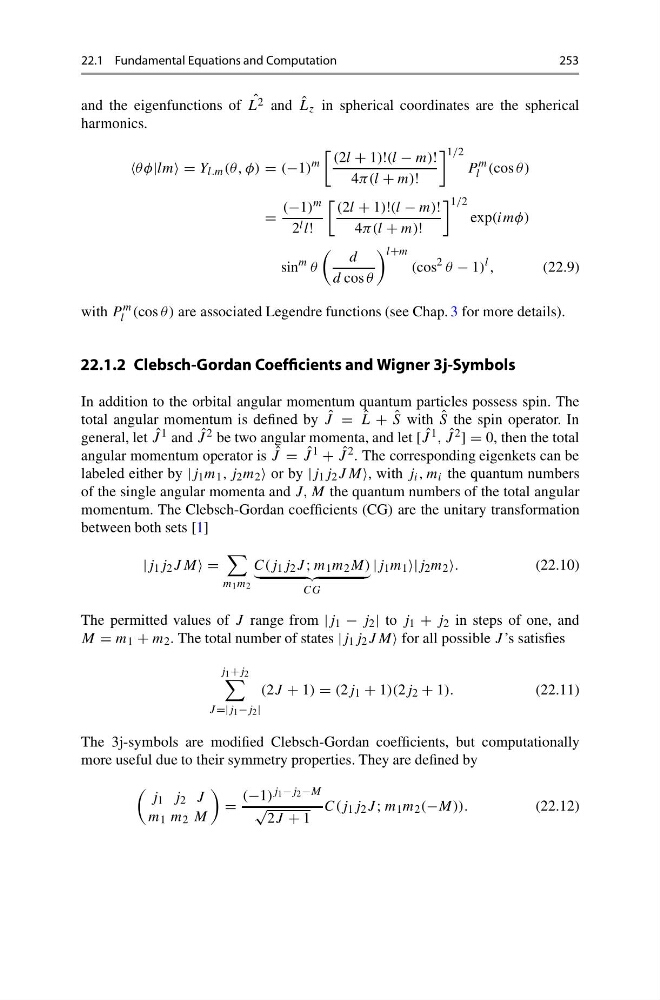
and the eigenfunctions of ˆ
L 2 and ˆ
L z in spherical coordinates are the spherical
harmonics.
θφ|lm = Y l.m (θ, φ) = (−1)
m
(2l + 1)!(l − m)!
4π(l + m)!
1/2
P
m
l (cos θ)
=
(−1) m
2 l l!
(2l + 1)!(l − m)!
4π(l + m)!
1/2
exp(imφ)
sin
m θ
d
d cos θ
l+m
(cos
2 θ − 1)
l ,
(22.9)
with P
m
l (cos θ) are associated Legendre functions (see Chap. 3 for more details).
22.1.2 Clebsch-Gordan Coefficients and Wigner 3j-Symbols
In addition to the orbital angular momentum quantum particles possess spin. The
total angular momentum is defined by ˆ
J = ˆ
L + ˆ
S with ˆ
S the spin operator. In
general, let ˆ
J 1 and ˆ
J 2 be two angular momenta, and let [ ˆ
J 1 , ˆ
J 2 ] = 0, then the total
angular momentum operator is ˆ
J = ˆ
J 1 + ˆ
J 2 . The corresponding eigenkets can be
labeled either by |j 1 m 1 , j 2 m 2 or by |j 1 j 2 J M, with j i , m i the quantum numbers
of the single angular momenta and J, M the quantum numbers of the total angular
momentum. The Clebsch-Gordan coefficients (CG) are the unitary transformation
between both sets [1]
|j 1 j 2 J M =
m 1 m 2
C(j 1 j 2 J ; m 1 m 2 M)
CG
|j 1 m 1 2 m 2
(22.10)
The permitted values of J range from |j 1 − j 2 | to j 1 + j 2 in steps of one, and
M = m 1 + m 2 . The total number of states |j 1 j 2 J M for all possible J ’s satisfies
j 1 +j 2
J =|j 1 −j 2 |
(2J + 1) = (2j 1 + 1)(2j 2 + 1).
(22.11)
The 3j-symbols are modified Clebsch-Gordan coefficients, but computationally
more useful due to their symmetry properties. They are defined by
j 1 j 2 J
m 1 m 2 M
=
(−1) j 1 −j 2 −M
√
2J + 1
C(j 1 j 2 J ; m 1 m 2 (−M)).
(22.12)
253
and the eigenfunctions of ˆ
L 2 and ˆ
L z in spherical coordinates are the spherical
harmonics.
θφ|lm = Y l.m (θ, φ) = (−1)
m
(2l + 1)!(l − m)!
4π(l + m)!
1/2
P
m
l (cos θ)
=
(−1) m
2 l l!
(2l + 1)!(l − m)!
4π(l + m)!
1/2
exp(imφ)
sin
m θ
d
d cos θ
l+m
(cos
2 θ − 1)
l ,
(22.9)
with P
m
l (cos θ) are associated Legendre functions (see Chap. 3 for more details).
22.1.2 Clebsch-Gordan Coefficients and Wigner 3j-Symbols
In addition to the orbital angular momentum quantum particles possess spin. The
total angular momentum is defined by ˆ
J = ˆ
L + ˆ
S with ˆ
S the spin operator. In
general, let ˆ
J 1 and ˆ
J 2 be two angular momenta, and let [ ˆ
J 1 , ˆ
J 2 ] = 0, then the total
angular momentum operator is ˆ
J = ˆ
J 1 + ˆ
J 2 . The corresponding eigenkets can be
labeled either by |j 1 m 1 , j 2 m 2 or by |j 1 j 2 J M, with j i , m i the quantum numbers
of the single angular momenta and J, M the quantum numbers of the total angular
momentum. The Clebsch-Gordan coefficients (CG) are the unitary transformation
between both sets [1]
|j 1 j 2 J M =
m 1 m 2
C(j 1 j 2 J ; m 1 m 2 M)
CG
|j 1 m 1 2 m 2
(22.10)
The permitted values of J range from |j 1 − j 2 | to j 1 + j 2 in steps of one, and
M = m 1 + m 2 . The total number of states |j 1 j 2 J M for all possible J ’s satisfies
j 1 +j 2
J =|j 1 −j 2 |
(2J + 1) = (2j 1 + 1)(2j 2 + 1).
(22.11)
The 3j-symbols are modified Clebsch-Gordan coefficients, but computationally
more useful due to their symmetry properties. They are defined by
j 1 j 2 J
m 1 m 2 M
=
(−1) j 1 −j 2 −M
√
2J + 1
C(j 1 j 2 J ; m 1 m 2 (−M)).
(22.12)