

15.5 Jacobi Polynomials
193
−2(n + α)(n + β)(2n + α + β + 2)P
(α,β)
n−1 (x) ,
with P
(α,β)
−1 (x) = 0, P
(α,β)
0
(x) = 1 , and P
(α,β)
1
(x) =
1
2
[α − β + (α + β + 2)x];
(15.22b)
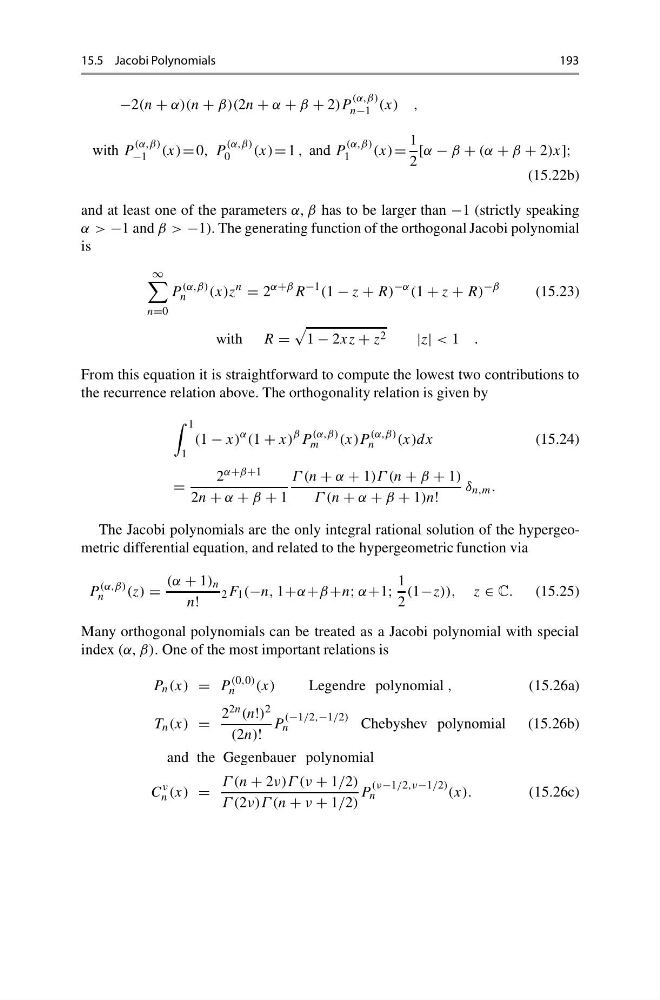
and at least one of the parameters α, β has to be larger than −1 (strictly speaking
α > −1 and β > −1). The generating function of the orthogonal Jacobi polynomial
is
∞
n=0
P
(α,β)
n
(x)z
n
= 2
α+β R
−1 (1 − z + R)
−α (1 + z + R)
−β
(15.23)
with R =
1 − 2xz + z 2
|z| < 1 .
From this equation it is straightforward to compute the lowest two contributions to
the recurrence relation above. The orthogonality relation is given by
1
1
(1 − x)
α (1 + x)
β P
(α,β)
m
(x)P
(α,β)
n
(x)dx
(15.24)
=
2 α+β+1
2n + α + β + 1
Γ (n + α + 1)Γ (n + β + 1)
Γ (n + α + β + 1)n!
δ n,m .
The Jacobi polynomials are the only integral rational solution of the hypergeometric differential equation, and related to the hypergeometric function via
P
(α,β)
n
(z) =
(α + 1) n
n!
2 F 1 (−n, 1+α+β +n; α+1;
1
2
(1−z)), z ∈ C.
(15.25)
Many orthogonal polynomials can be treated as a Jacobi polynomial with special
index (α, β). One of the most important relations is
P n (x) = P
(0,0)
n
(x)
Legendre polynomial ,
(15.26a)
T n (x) =
2 2n (n!) 2
(2n)!
P
(−1/2,−1/2)
n
Chebyshev polynomial (15.26b)
and the Gegenbauer polynomial
C
ν
n (x) =
Γ (n + 2ν)Γ (ν + 1/2)
Γ (2ν)Γ (n + ν + 1/2)
P
(ν−1/2,ν−1/2)
n
(x).
(15.26c)
193
−2(n + α)(n + β)(2n + α + β + 2)P
(α,β)
n−1 (x) ,
with P
(α,β)
−1 (x) = 0, P
(α,β)
0
(x) = 1 , and P
(α,β)
1
(x) =
1
2
[α − β + (α + β + 2)x];
(15.22b)
and at least one of the parameters α, β has to be larger than −1 (strictly speaking
α > −1 and β > −1). The generating function of the orthogonal Jacobi polynomial
is
∞
n=0
P
(α,β)
n
(x)z
n
= 2
α+β R
−1 (1 − z + R)
−α (1 + z + R)
−β
(15.23)
with R =
1 − 2xz + z 2
|z| < 1 .
From this equation it is straightforward to compute the lowest two contributions to
the recurrence relation above. The orthogonality relation is given by
1
1
(1 − x)
α (1 + x)
β P
(α,β)
m
(x)P
(α,β)
n
(x)dx
(15.24)
=
2 α+β+1
2n + α + β + 1
Γ (n + α + 1)Γ (n + β + 1)
Γ (n + α + β + 1)n!
δ n,m .
The Jacobi polynomials are the only integral rational solution of the hypergeometric differential equation, and related to the hypergeometric function via
P
(α,β)
n
(z) =
(α + 1) n
n!
2 F 1 (−n, 1+α+β +n; α+1;
1
2
(1−z)), z ∈ C.
(15.25)
Many orthogonal polynomials can be treated as a Jacobi polynomial with special
index (α, β). One of the most important relations is
P n (x) = P
(0,0)
n
(x)
Legendre polynomial ,
(15.26a)
T n (x) =
2 2n (n!) 2
(2n)!
P
(−1/2,−1/2)
n
Chebyshev polynomial (15.26b)
and the Gegenbauer polynomial
C
ν
n (x) =
Γ (n + 2ν)Γ (ν + 1/2)
Γ (2ν)Γ (n + ν + 1/2)
P
(ν−1/2,ν−1/2)
n
(x).
(15.26c)