

15.2 General Definitions
183
0, 1, 2 · · · n} of degree i are the orthonormal polynomials associated with the weight
function w(x) and the interval [a, b] if and only if
b
a
φ i (x)φ j (x)w(x)dx = δ ij i, j = 0, 1, 2, · · · .
(15.1)
The inner or scalar product between two function f, g on the interval [a, b] is
defined by
f, g =
b
a
f (x)g(x)w(x)dx .
(15.2)
Because φ n (x) is a polynomial of degree n, φ n has n roots ({x | φ(x) = 0}), which
are real, distinct, and elements of the interval [a,b]. Any polynomial f (x) of degree
n can be written as a linear combination {φ i (x), i = 0 · · · n},
f (x) =
n
i=0
a i φ i (x) with a i = =φ i |f i = 0 · · · n .
By writing the orthogonal polynomial in the following form:
φ n (x) =
n
i=0
k i x
i , k n > 0
(15.3)
a three-term recurrence relation can be derived:
xφ n−1 (x) =
k n−1
k n
φ n (x) +
k n−2
k n−1
φ n−2 (x) + β n−1 φ n−1 (x) .
(15.4)
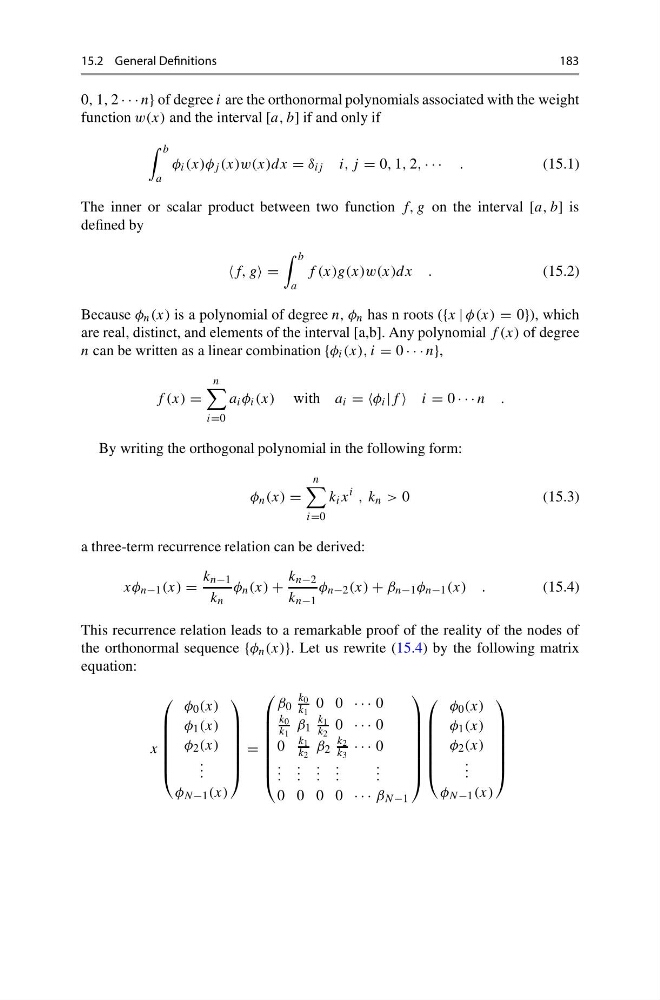
This recurrence relation leads to a remarkable proof of the reality of the nodes of
the orthonormal sequence {φ n (x)}. Let us rewrite (15.4) by the following matrix
equation:
x
⎛
⎜
⎜
⎜
⎜
⎜
⎝
φ 0 (x)
φ 1 (x)
φ 2 (x)
. . .
φ N−1 (x)
⎞
⎟
⎟
⎟
⎟
⎟
⎠
=
⎛
⎜
⎜
⎜
⎜
⎜
⎜
⎝
β 0
k 0
k 1
0 0 · · · 0
k 0
k 1
β 1
k 1
k 2
0 · · · 0
0
k 1
k 2
β 2
k 2
k 3
· · · 0
. . .
. . .
. . .
. . .
. . .
0 0 0 0 · · · β N−1
⎞
⎟
⎟
⎟
⎟
⎟
⎟
⎠
⎛
⎜
⎜
⎜
⎜
⎜
⎝
φ 0 (x)
φ 1 (x)
φ 2 (x)
. . .
φ N−1 (x)
⎞
⎟
⎟
⎟
⎟
⎟
⎠
183
0, 1, 2 · · · n} of degree i are the orthonormal polynomials associated with the weight
function w(x) and the interval [a, b] if and only if
b
a
φ i (x)φ j (x)w(x)dx = δ ij i, j = 0, 1, 2, · · · .
(15.1)
The inner or scalar product between two function f, g on the interval [a, b] is
defined by
f, g =
b
a
f (x)g(x)w(x)dx .
(15.2)
Because φ n (x) is a polynomial of degree n, φ n has n roots ({x | φ(x) = 0}), which
are real, distinct, and elements of the interval [a,b]. Any polynomial f (x) of degree
n can be written as a linear combination {φ i (x), i = 0 · · · n},
f (x) =
n
i=0
a i φ i (x) with a i = =φ i |f i = 0 · · · n .
By writing the orthogonal polynomial in the following form:
φ n (x) =
n
i=0
k i x
i , k n > 0
(15.3)
a three-term recurrence relation can be derived:
xφ n−1 (x) =
k n−1
k n
φ n (x) +
k n−2
k n−1
φ n−2 (x) + β n−1 φ n−1 (x) .
(15.4)
This recurrence relation leads to a remarkable proof of the reality of the nodes of
the orthonormal sequence {φ n (x)}. Let us rewrite (15.4) by the following matrix
equation:
x
⎛
⎜
⎜
⎜
⎜
⎜
⎝
φ 0 (x)
φ 1 (x)
φ 2 (x)
. . .
φ N−1 (x)
⎞
⎟
⎟
⎟
⎟
⎟
⎠
=
⎛
⎜
⎜
⎜
⎜
⎜
⎜
⎝
β 0
k 0
k 1
0 0 · · · 0
k 0
k 1
β 1
k 1
k 2
0 · · · 0
0
k 1
k 2
β 2
k 2
k 3
· · · 0
. . .
. . .
. . .
. . .
. . .
0 0 0 0 · · · β N−1
⎞
⎟
⎟
⎟
⎟
⎟
⎟
⎠
⎛
⎜
⎜
⎜
⎜
⎜
⎝
φ 0 (x)
φ 1 (x)
φ 2 (x)
. . .
φ N−1 (x)
⎞
⎟
⎟
⎟
⎟
⎟
⎠