

168
14 Mathieu Functions
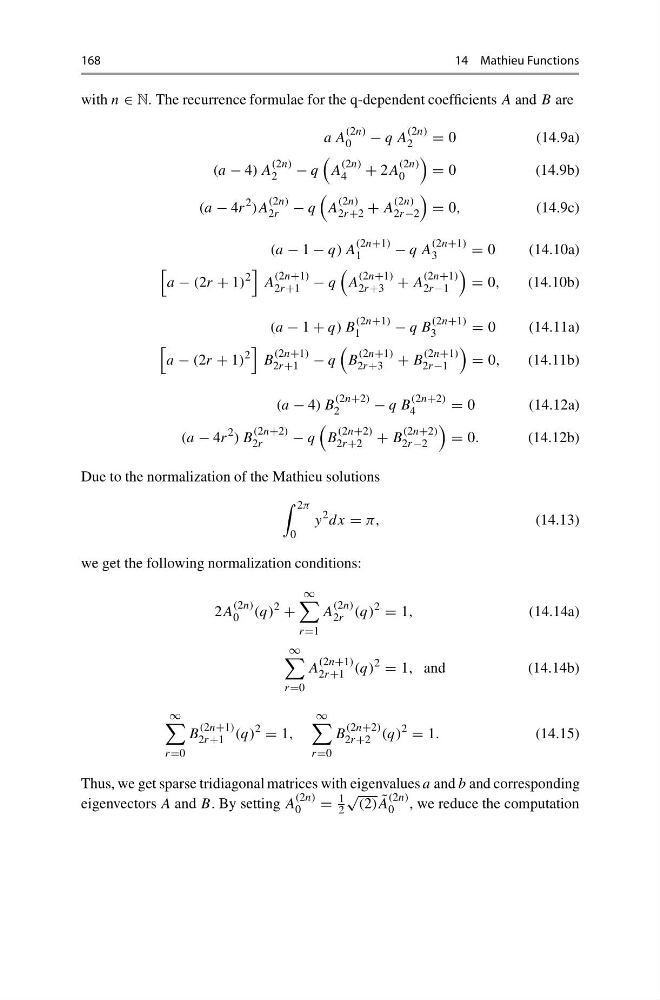
with n ∈ N. The recurrence formulae for the q-dependent coefficients A and B are
a A
(2n)
0
− q A
(2n)
2
= 0
(14.9a)
(a − 4) A
(2n)
2
− q
A
(2n)
4
+ 2A
(2n)
0
= 0
(14.9b)
(a − 4r
2 )A
(2n)
2r − q
A
(2n)
2r+2 + A
(2n)
2r−2
= 0,
(14.9c)
(a − 1 − q) A
(2n+1)
1
− q A
(2n+1)
3
= 0
(14.10a)
a − (2r + 1)
2
A
(2n+1)
2r+1 − q
A
(2n+1)
2r+3 + A
(2n+1)
2r−1
= 0,
(14.10b)
(a − 1 + q) B
(2n+1)
1
− q B
(2n+1)
3
= 0
(14.11a)
a − (2r + 1)
2
B
(2n+1)
2r+1 − q
B
(2n+1)
2r+3 + B
(2n+1)
2r−1
= 0,
(14.11b)
(a − 4) B
(2n+2)
2
− q B
(2n+2)
4
= 0
(14.12a)
(a − 4r
2 ) B
(2n+2)
2r
− q
B
(2n+2)
2r+2 + B
(2n+2)
2r−2
= 0.
(14.12b)
Due to the normalization of the Mathieu solutions
2π
0
y
2 dx = π,
(14.13)
we get the following normalization conditions:
2A
(2n)
0 (q)
2
+
∞
r=1
A
(2n)
2r (q)
2
= 1,
(14.14a)
∞
r=0
A
(2n+1)
2r+1 (q)
2
= 1, and
(14.14b)
∞
r=0
B
(2n+1)
2r+1 (q)
2
= 1,
∞
r=0
B
(2n+2)
2r+2 (q)
2
= 1.
(14.15)
Thus, we get sparse tridiagonal matrices with eigenvalues a and b and corresponding
eigenvectors A and B. By setting A
(2n)
0
=
1
2
√
(2) ˜
A
(2n)
0 , we reduce the computation
14 Mathieu Functions
with n ∈ N. The recurrence formulae for the q-dependent coefficients A and B are
a A
(2n)
0
− q A
(2n)
2
= 0
(14.9a)
(a − 4) A
(2n)
2
− q
A
(2n)
4
+ 2A
(2n)
0
= 0
(14.9b)
(a − 4r
2 )A
(2n)
2r − q
A
(2n)
2r+2 + A
(2n)
2r−2
= 0,
(14.9c)
(a − 1 − q) A
(2n+1)
1
− q A
(2n+1)
3
= 0
(14.10a)
a − (2r + 1)
2
A
(2n+1)
2r+1 − q
A
(2n+1)
2r+3 + A
(2n+1)
2r−1
= 0,
(14.10b)
(a − 1 + q) B
(2n+1)
1
− q B
(2n+1)
3
= 0
(14.11a)
a − (2r + 1)
2
B
(2n+1)
2r+1 − q
B
(2n+1)
2r+3 + B
(2n+1)
2r−1
= 0,
(14.11b)
(a − 4) B
(2n+2)
2
− q B
(2n+2)
4
= 0
(14.12a)
(a − 4r
2 ) B
(2n+2)
2r
− q
B
(2n+2)
2r+2 + B
(2n+2)
2r−2
= 0.
(14.12b)
Due to the normalization of the Mathieu solutions
2π
0
y
2 dx = π,
(14.13)
we get the following normalization conditions:
2A
(2n)
0 (q)
2
+
∞
r=1
A
(2n)
2r (q)
2
= 1,
(14.14a)
∞
r=0
A
(2n+1)
2r+1 (q)
2
= 1, and
(14.14b)
∞
r=0
B
(2n+1)
2r+1 (q)
2
= 1,
∞
r=0
B
(2n+2)
2r+2 (q)
2
= 1.
(14.15)
Thus, we get sparse tridiagonal matrices with eigenvalues a and b and corresponding
eigenvectors A and B. By setting A
(2n)
0
=
1
2
√
(2) ˜
A
(2n)
0 , we reduce the computation