

14.2 Fundamental Equations and Computation
167
Floquet’s theorem, it is always possible to choose y 1 in the form
y 1 (z) = exp(i ν (a,q) z) p(z)
(14.3)
with p(z) π-periodic and ν a constant depending on a and q. If ν is a real number,
y 1 (z) is bounded, otherwise unbounded. If ν is a rational number, y 1 (z) will be
periodic and for integer values π or 2π periodic and, respectively, π periodic or
π antiperiod, in all other real cases non-periodic. In addition, if ν is an integer, a
second solution exists of the form
y 2 (z) = c z y 1 (z) + f (z),
(14.4)
with f (z) the same periodicity properties as y 1 and c a constant [2].
Periodic Mathieu Eigenfunctions of Integer Order
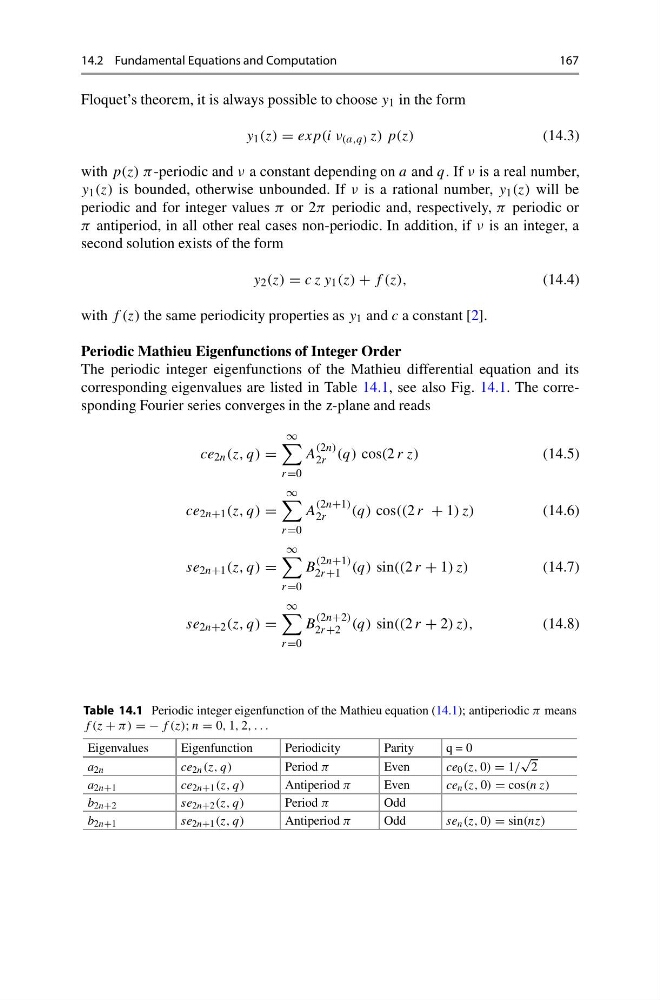
The periodic integer eigenfunctions of the Mathieu differential equation and its
corresponding eigenvalues are listed in Table 14.1, see also Fig. 14.1. The corresponding Fourier series converges in the z-plane and reads
ce 2n (z, q) =
∞
r=0
A
(2n)
2r (q) cos(2 r z)
(14.5)
ce 2n+1 (z, q) =
∞
r=0
A
(2n+1)
2r
(q) cos((2 r + 1) z)
(14.6)
se 2n+1 (z, q) =
∞
r=0
B
(2n+1)
2r+1 (q) sin((2 r + 1) z)
(14.7)
se 2n+2 (z, q) =
∞
r=0
B
(2n+2)
2r+2 (q) sin((2 r + 2) z),
(14.8)
Table 14.1 Periodic integer eigenfunction of the Mathieu equation (14.1); antiperiodic π means
f (z + π) = − f (z); n = 0, 1, 2, . . .
Eigenvalues
Eigenfunction
Periodicity
Parity
q = 0
a 2n
ce 2n (z, q)
Period π
Even
ce 0 (z, 0) = 1/
√
2
a 2n+1
ce 2n+1 (z, q)
Antiperiod π
Even
ce n (z, 0) = cos(n z)
b 2n+2
se 2n+2 (z, q)
Period π
Odd
b 2n+1
se 2n+1 (z, q)
Antiperiod π
Odd
se n (z, 0) = sin(nz)
167
Floquet’s theorem, it is always possible to choose y 1 in the form
y 1 (z) = exp(i ν (a,q) z) p(z)
(14.3)
with p(z) π-periodic and ν a constant depending on a and q. If ν is a real number,
y 1 (z) is bounded, otherwise unbounded. If ν is a rational number, y 1 (z) will be
periodic and for integer values π or 2π periodic and, respectively, π periodic or
π antiperiod, in all other real cases non-periodic. In addition, if ν is an integer, a
second solution exists of the form
y 2 (z) = c z y 1 (z) + f (z),
(14.4)
with f (z) the same periodicity properties as y 1 and c a constant [2].
Periodic Mathieu Eigenfunctions of Integer Order
The periodic integer eigenfunctions of the Mathieu differential equation and its
corresponding eigenvalues are listed in Table 14.1, see also Fig. 14.1. The corresponding Fourier series converges in the z-plane and reads
ce 2n (z, q) =
∞
r=0
A
(2n)
2r (q) cos(2 r z)
(14.5)
ce 2n+1 (z, q) =
∞
r=0
A
(2n+1)
2r
(q) cos((2 r + 1) z)
(14.6)
se 2n+1 (z, q) =
∞
r=0
B
(2n+1)
2r+1 (q) sin((2 r + 1) z)
(14.7)
se 2n+2 (z, q) =
∞
r=0
B
(2n+2)
2r+2 (q) sin((2 r + 2) z),
(14.8)
Table 14.1 Periodic integer eigenfunction of the Mathieu equation (14.1); antiperiodic π means
f (z + π) = − f (z); n = 0, 1, 2, . . .
Eigenvalues
Eigenfunction
Periodicity
Parity
q = 0
a 2n
ce 2n (z, q)
Period π
Even
ce 0 (z, 0) = 1/
√
2
a 2n+1
ce 2n+1 (z, q)
Antiperiod π
Even
ce n (z, 0) = cos(n z)
b 2n+2
se 2n+2 (z, q)
Period π
Odd
b 2n+1
se 2n+1 (z, q)
Antiperiod π
Odd
se n (z, 0) = sin(nz)