

13.1 Equations and the Class paracylFun
163
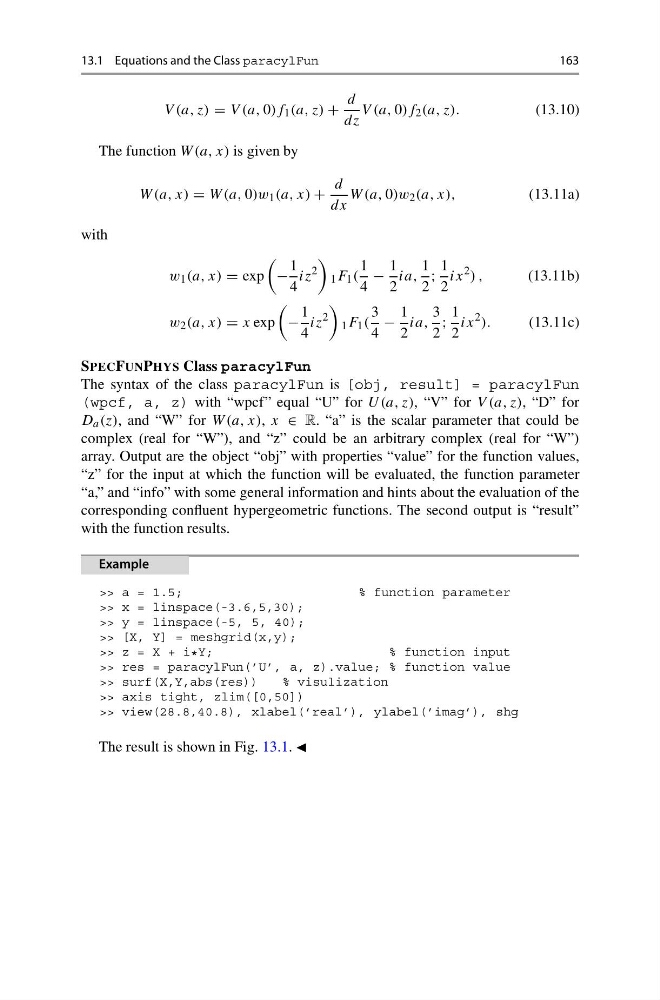
V (a, z) = V (a, 0)f 1 (a, z) +
d
dz
V (a, 0)f 2 (a, z).
(13.10)
The function W (a, x) is given by
W (a, x) = W (a, 0)w 1 (a, x) +
d
dx
W (a, 0)w 2 (a, x),
(13.11a)
with
w 1 (a, x) = exp
−
1
4
iz
2
1 F 1 (
1
4
−
1
2
ia,
1
2
;
1
2
ix
2 ) ,
(13.11b)
w 2 (a, x) = x exp
−
1
4
iz
2
1 F 1 (
3
4
−
1
2
ia,
3
2
;
1
2
ix
2 ).
(13.11c)
SPECFUNPHYS Class paracylFun
The syntax of the class paracylFun is [obj, result] = paracylFun
(wpcf, a, z) with “wpcf” equal “U” for U(a, z), “V” for V (a, z), “D” for
D a (z), and “W” for W (a, x), x ∈ R. “a” is the scalar parameter that could be
complex (real for “W”), and “z” could be an arbitrary complex (real for “W”)
array. Output are the object “obj” with properties “value” for the function values,
“z” for the input at which the function will be evaluated, the function parameter
“a,” and “info” with some general information and hints about the evaluation of the
corresponding confluent hypergeometric functions. The second output is “result”
with the function results.
Example
>> a = 1.5;
% function parameter
>> x = linspace(-3.6,5,30);
>> y = linspace(-5, 5, 40);
>> [X, Y] = meshgrid(x,y);
>> z = X + i * Y;
% function input
>> res = paracylFun(’U’, a, z).value; % function value
>> surf(X,Y,abs(res))
% visulization
>> axis tight, zlim([0,50])
>> view(28.8,40.8), xlabel(’real’), ylabel(’imag’), shg
The result is shown in Fig. 13.1.
163
V (a, z) = V (a, 0)f 1 (a, z) +
d
dz
V (a, 0)f 2 (a, z).
(13.10)
The function W (a, x) is given by
W (a, x) = W (a, 0)w 1 (a, x) +
d
dx
W (a, 0)w 2 (a, x),
(13.11a)
with
w 1 (a, x) = exp
−
1
4
iz
2
1 F 1 (
1
4
−
1
2
ia,
1
2
;
1
2
ix
2 ) ,
(13.11b)
w 2 (a, x) = x exp
−
1
4
iz
2
1 F 1 (
3
4
−
1
2
ia,
3
2
;
1
2
ix
2 ).
(13.11c)
SPECFUNPHYS Class paracylFun
The syntax of the class paracylFun is [obj, result] = paracylFun
(wpcf, a, z) with “wpcf” equal “U” for U(a, z), “V” for V (a, z), “D” for
D a (z), and “W” for W (a, x), x ∈ R. “a” is the scalar parameter that could be
complex (real for “W”), and “z” could be an arbitrary complex (real for “W”)
array. Output are the object “obj” with properties “value” for the function values,
“z” for the input at which the function will be evaluated, the function parameter
“a,” and “info” with some general information and hints about the evaluation of the
corresponding confluent hypergeometric functions. The second output is “result”
with the function results.
Example
>> a = 1.5;
% function parameter
>> x = linspace(-3.6,5,30);
>> y = linspace(-5, 5, 40);
>> [X, Y] = meshgrid(x,y);
>> z = X + i * Y;
% function input
>> res = paracylFun(’U’, a, z).value; % function value
>> surf(X,Y,abs(res))
% visulization
>> axis tight, zlim([0,50])
>> view(28.8,40.8), xlabel(’real’), ylabel(’imag’), shg
The result is shown in Fig. 13.1.