

162
13 Parabolic Cylinder Functions
13.1 Equations and the Class paracylFun
Function Overview
The SPECFUNPHYS class paracylFun allows the evaluation of the parabolic
cylinder functions U(a, z), V (a, z), D a (z), and W (a, z).
Equations
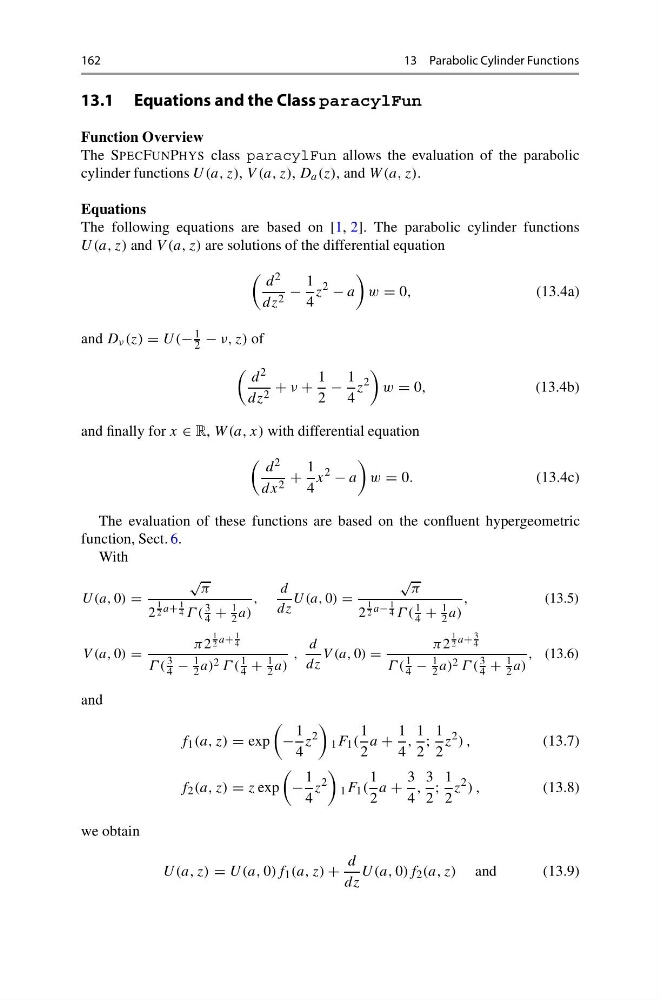
The following equations are based on [1, 2]. The parabolic cylinder functions
U(a, z) and V (a, z) are solutions of the differential equation
d 2
dz 2 −
1
4
z
2
− a
w = 0,
(13.4a)
and D ν (z) = U(−
1
2 − ν, z) of
d 2
dz 2 + ν +
1
2
−
1
4
z
2
w = 0,
(13.4b)
and finally for x ∈ R, W (a, x) with differential equation
d 2
dx 2 +
1
4
x
2
− a
w = 0.
(13.4c)
The evaluation of these functions are based on the confluent hypergeometric
function, Sect. 6.
With
U (a, 0) =
√
π
2
1
2 a+
1
4 Γ (
3
4 +
1
2 a)
,
d
dz
U (a, 0) =
√
π
2
1
2 a−
1
4 Γ (
1
4 +
1
2 a)
,
(13.5)
V (a, 0) =
π2
1
2 a+
1
4
Γ (
3
4 −
1
2 a) 2 Γ (
1
4 +
1
2 a)
,
d
dz
V (a, 0) =
π2
1
2 a+
3
4
Γ (
1
4 −
1
2 a) 2 Γ (
3
4 +
1
2 a)
, (13.6)
and
f 1 (a, z) = exp
−
1
4
z
2
1 F 1 (
1
2
a +
1
4
,
1
2
;
1
2
z
2 ) ,
(13.7)
f 2 (a, z) = z exp
−
1
4
z
2
1 F 1 (
1
2
a +
3
4
,
3
2
;
1
2
z
2 ) ,
(13.8)
we obtain
U(a, z) = U(a, 0)f 1 (a, z) +
d
dz
U(a, 0)f 2 (a, z) and
(13.9)
13 Parabolic Cylinder Functions
13.1 Equations and the Class paracylFun
Function Overview
The SPECFUNPHYS class paracylFun allows the evaluation of the parabolic
cylinder functions U(a, z), V (a, z), D a (z), and W (a, z).
Equations
The following equations are based on [1, 2]. The parabolic cylinder functions
U(a, z) and V (a, z) are solutions of the differential equation
d 2
dz 2 −
1
4
z
2
− a
w = 0,
(13.4a)
and D ν (z) = U(−
1
2 − ν, z) of
d 2
dz 2 + ν +
1
2
−
1
4
z
2
w = 0,
(13.4b)
and finally for x ∈ R, W (a, x) with differential equation
d 2
dx 2 +
1
4
x
2
− a
w = 0.
(13.4c)
The evaluation of these functions are based on the confluent hypergeometric
function, Sect. 6.
With
U (a, 0) =
√
π
2
1
2 a+
1
4 Γ (
3
4 +
1
2 a)
,
d
dz
U (a, 0) =
√
π
2
1
2 a−
1
4 Γ (
1
4 +
1
2 a)
,
(13.5)
V (a, 0) =
π2
1
2 a+
1
4
Γ (
3
4 −
1
2 a) 2 Γ (
1
4 +
1
2 a)
,
d
dz
V (a, 0) =
π2
1
2 a+
3
4
Γ (
1
4 −
1
2 a) 2 Γ (
3
4 +
1
2 a)
, (13.6)
and
f 1 (a, z) = exp
−
1
4
z
2
1 F 1 (
1
2
a +
1
4
,
1
2
;
1
2
z
2 ) ,
(13.7)
f 2 (a, z) = z exp
−
1
4
z
2
1 F 1 (
1
2
a +
3
4
,
3
2
;
1
2
z
2 ) ,
(13.8)
we obtain
U(a, z) = U(a, 0)f 1 (a, z) +
d
dz
U(a, 0)f 2 (a, z) and
(13.9)