

126
9 ϑ Functions
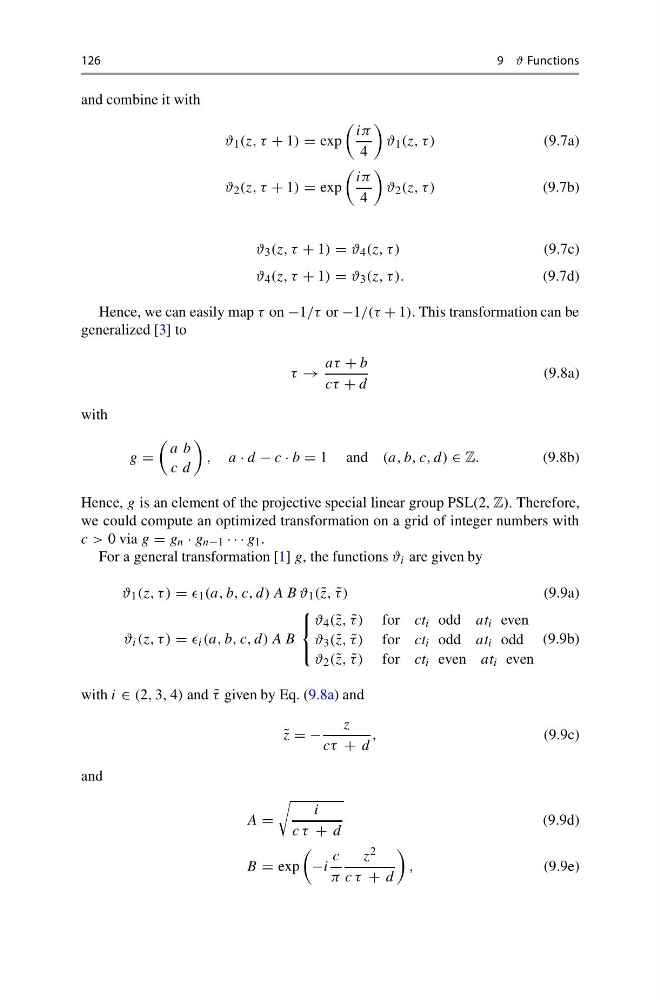
and combine it with
ϑ 1 (z, τ + 1) = exp
iπ
4
ϑ 1 (z, τ )
(9.7a)
ϑ 2 (z, τ + 1) = exp
iπ
4
ϑ 2 (z, τ )
(9.7b)
ϑ 3 (z, τ + 1) = ϑ 4 (z, τ )
(9.7c)
ϑ 4 (z, τ + 1) = ϑ 3 (z, τ ).
(9.7d)
Hence, we can easily map τ on −1/τ or −1/(τ + 1). This transformation can be
generalized [3] to
τ →
aτ + b
cτ + d
(9.8a)
with
g =
a b
c d
, a · d − c · b = 1 and (a, b, c, d) ∈ Z.
(9.8b)
Hence, g is an element of the projective special linear group PSL(2, Z). Therefore,
we could compute an optimized transformation on a grid of integer numbers with
c > 0 via g = g n · g n−1 · · · g 1 .
For a general transformation [1] g, the functions ϑ i are given by
ϑ 1 (z, τ ) = 1 (a, b, c, d) A B ϑ 1 (˜ z, ˜
τ )
(9.9a)
ϑ i (z, τ ) = i (a, b, c, d) A B
⎧
⎨
⎩
ϑ 4 (˜ z, ˜
τ ) for ct i odd at i even
ϑ 3 (˜ z, ˜
τ ) for ct i odd at i odd
ϑ 2 (˜ z, ˜
τ ) for ct i even at i even
(9.9b)
with i ∈ (2, 3, 4) and ˜
τ given by Eq. (9.8a) and
˜
z = −
z
cτ + d
,
(9.9c)
and
A =
i
c τ + d
(9.9d)
B = exp
−i
c
π
z 2
c τ + d
,
(9.9e)
9 ϑ Functions
and combine it with
ϑ 1 (z, τ + 1) = exp
iπ
4
ϑ 1 (z, τ )
(9.7a)
ϑ 2 (z, τ + 1) = exp
iπ
4
ϑ 2 (z, τ )
(9.7b)
ϑ 3 (z, τ + 1) = ϑ 4 (z, τ )
(9.7c)
ϑ 4 (z, τ + 1) = ϑ 3 (z, τ ).
(9.7d)
Hence, we can easily map τ on −1/τ or −1/(τ + 1). This transformation can be
generalized [3] to
τ →
aτ + b
cτ + d
(9.8a)
with
g =
a b
c d
, a · d − c · b = 1 and (a, b, c, d) ∈ Z.
(9.8b)
Hence, g is an element of the projective special linear group PSL(2, Z). Therefore,
we could compute an optimized transformation on a grid of integer numbers with
c > 0 via g = g n · g n−1 · · · g 1 .
For a general transformation [1] g, the functions ϑ i are given by
ϑ 1 (z, τ ) = 1 (a, b, c, d) A B ϑ 1 (˜ z, ˜
τ )
(9.9a)
ϑ i (z, τ ) = i (a, b, c, d) A B
⎧
⎨
⎩
ϑ 4 (˜ z, ˜
τ ) for ct i odd at i even
ϑ 3 (˜ z, ˜
τ ) for ct i odd at i odd
ϑ 2 (˜ z, ˜
τ ) for ct i even at i even
(9.9b)
with i ∈ (2, 3, 4) and ˜
τ given by Eq. (9.8a) and
˜
z = −
z
cτ + d
,
(9.9c)
and
A =
i
c τ + d
(9.9d)
B = exp
−i
c
π
z 2
c τ + d
,
(9.9e)