

9.2 Jacobi ϑ Functions
125
For fixed τ , the ϑ i functions are entire functions of z with period 2π and quasi
periodic on the lattice
z m,n = (m + nτ )π, with m, n ∈ Z.
(9.3)
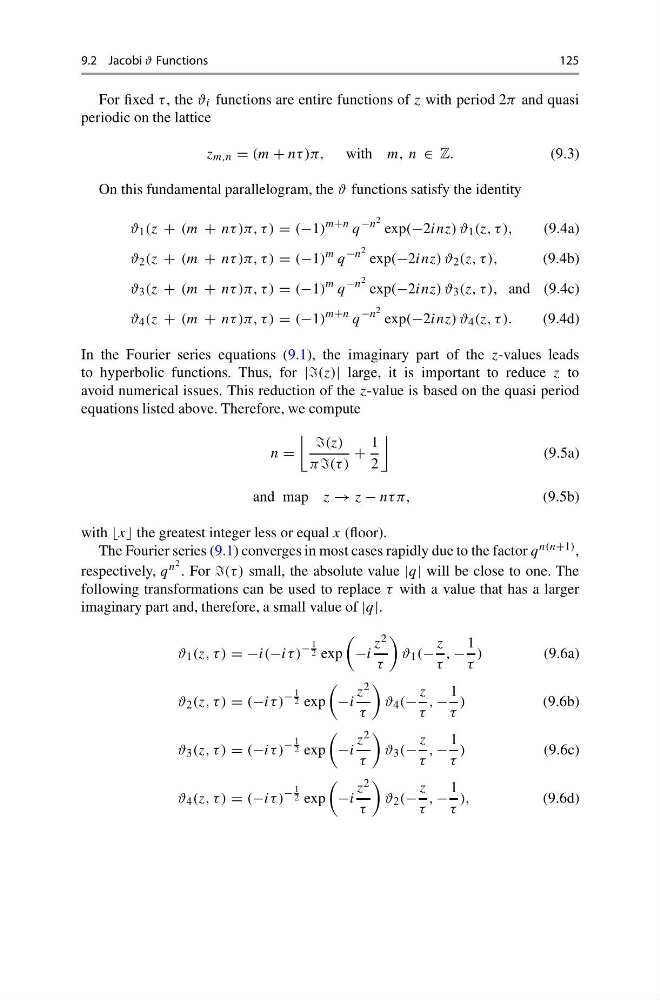
On this fundamental parallelogram, the ϑ functions satisfy the identity
ϑ 1 (z + (m + nτ )π, τ ) = (−1)
m+n q
−n 2 exp(−2inz) ϑ 1 (z, τ ),
(9.4a)
ϑ 2 (z + (m + nτ )π, τ ) = (−1)
m q
−n 2 exp(−2inz) ϑ 2 (z, τ ),
(9.4b)
ϑ 3 (z + (m + nτ )π, τ ) = (−1)
m q
−n 2 exp(−2inz) ϑ 3 (z, τ ), and (9.4c)
ϑ 4 (z + (m + nτ )π, τ ) = (−1)
m+n q
−n 2 exp(−2inz) ϑ 4 (z, τ ).
(9.4d)
In the Fourier series equations (9.1), the imaginary part of the z-values leads
to hyperbolic functions. Thus, for ||(z)| large, it is important to reduce z to
avoid numerical issues. This reduction of the z-value is based on the quasi period
equations listed above. Therefore, we compute
n =
(z)
π(τ )
+
1
2
(9.5a)
and map z → z − nτ π,
(9.5b)
with the greatest integer less or equal x (floor).
The Fourier series (9.1) converges in most cases rapidly due to the factor q n(n+1) ,
respectively, q n 2 . For (τ ) small, the absolute value |q| will be close to one. The
following transformations can be used to replace τ with a value that has a larger
imaginary part and, therefore, a small value of |q|.
ϑ 1 (z, τ ) = −i(−iτ )
−
1
2 exp
−i
z 2
τ
ϑ 1 (−
z
τ
, −
1
τ
)
(9.6a)
ϑ 2 (z, τ ) = (−iτ )
−
1
2 exp
−i
z 2
τ
ϑ 4 (−
z
τ
, −
1
τ
)
(9.6b)
ϑ 3 (z, τ ) = (−iτ )
−
1
2 exp
−i
z 2
τ
ϑ 3 (−
z
τ
, −
1
τ
)
(9.6c)
ϑ 4 (z, τ ) = (−iτ )
−
1
2 exp
−i
z 2
τ
ϑ 2 (−
z
τ
, −
1
τ
),
(9.6d)
125
For fixed τ , the ϑ i functions are entire functions of z with period 2π and quasi
periodic on the lattice
z m,n = (m + nτ )π, with m, n ∈ Z.
(9.3)
On this fundamental parallelogram, the ϑ functions satisfy the identity
ϑ 1 (z + (m + nτ )π, τ ) = (−1)
m+n q
−n 2 exp(−2inz) ϑ 1 (z, τ ),
(9.4a)
ϑ 2 (z + (m + nτ )π, τ ) = (−1)
m q
−n 2 exp(−2inz) ϑ 2 (z, τ ),
(9.4b)
ϑ 3 (z + (m + nτ )π, τ ) = (−1)
m q
−n 2 exp(−2inz) ϑ 3 (z, τ ), and (9.4c)
ϑ 4 (z + (m + nτ )π, τ ) = (−1)
m+n q
−n 2 exp(−2inz) ϑ 4 (z, τ ).
(9.4d)
In the Fourier series equations (9.1), the imaginary part of the z-values leads
to hyperbolic functions. Thus, for ||(z)| large, it is important to reduce z to
avoid numerical issues. This reduction of the z-value is based on the quasi period
equations listed above. Therefore, we compute
n =
(z)
π(τ )
+
1
2
(9.5a)
and map z → z − nτ π,
(9.5b)
with the greatest integer less or equal x (floor).
The Fourier series (9.1) converges in most cases rapidly due to the factor q n(n+1) ,
respectively, q n 2 . For (τ ) small, the absolute value |q| will be close to one. The
following transformations can be used to replace τ with a value that has a larger
imaginary part and, therefore, a small value of |q|.
ϑ 1 (z, τ ) = −i(−iτ )
−
1
2 exp
−i
z 2
τ
ϑ 1 (−
z
τ
, −
1
τ
)
(9.6a)
ϑ 2 (z, τ ) = (−iτ )
−
1
2 exp
−i
z 2
τ
ϑ 4 (−
z
τ
, −
1
τ
)
(9.6b)
ϑ 3 (z, τ ) = (−iτ )
−
1
2 exp
−i
z 2
τ
ϑ 3 (−
z
τ
, −
1
τ
)
(9.6c)
ϑ 4 (z, τ ) = (−iτ )
−
1
2 exp
−i
z 2
τ
ϑ 2 (−
z
τ
, −
1
τ
),
(9.6d)