

104
7 Coulomb Wave Functions
with the Whittaker function W a,b (z) and
H
±
l (γ , ρ) = G l (γ , ρ) ± iF l (γ , ρ).
(7.11b)
G l (γ , ρ) is a real and analytic function for ρ > 0 and γ ∈ R.
Spherical Coordinates: Parameterization (b)
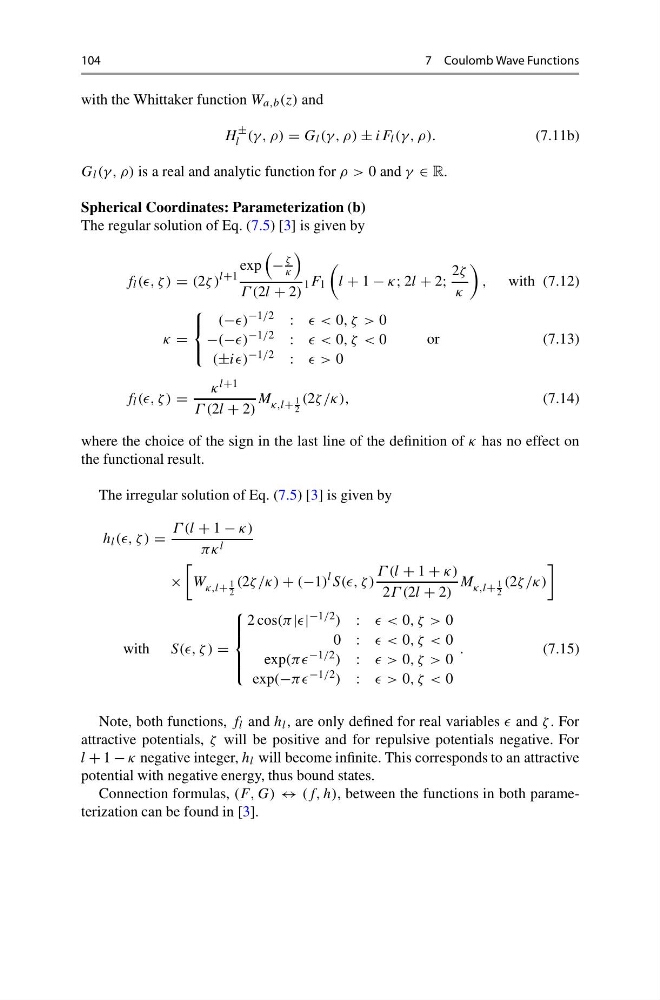
The regular solution of Eq. (7.5) [3] is given by
f l ((, ζ ) = (2ζ )
l+1
exp
−
ζ
κ
Γ (2l + 2)
1 F 1
l + 1 − κ; 2l + 2;
2ζ
κ
, with (7.12)
κ =
⎧
⎨
⎩
(− −1/2 : < 0, ζ > 0
−(− −1/2 : < 0, ζ < 0
(±ii) −1/2 : > 0
or
(7.13)
f l ((, ζ ) =
κ l+1
Γ (2l + 2)
M κ,l+
1
2
(2ζ /κ),
(7.14)
where the choice of the sign in the last line of the definition of κ has no effect on
the functional result.
The irregular solution of Eq. (7.5) [3] is given by
h l ((, ζ ) =
Γ (l + 1 − κ)
πκ l
×
W κ,l+
1
2
(2ζ /κ) + (−1)
l S((, ζ )
Γ (l + 1 + κ)
2Γ (2l + 2)
M κ,l+
1
2
(2ζ /κ)
with S((, ζ ) =
⎧
⎪ ⎪ ⎨
⎪ ⎪ ⎩
2 cos(π| −1/2 ) : < 0, ζ > 0
0 : < 0, ζ < 0
exp(ππ −1/2 ) : > 0, ζ > 0
exp(−ππ −1/2 ) : > 0, ζ < 0
.
(7.15)
Note, both functions, f l and h l , are only defined for real variables and ζ . For
attractive potentials, ζ will be positive and for repulsive potentials negative. For
l + 1 − κ negative integer, h l will become infinite. This corresponds to an attractive
potential with negative energy, thus bound states.
Connection formulas, (F, G) ↔ (f, h), between the functions in both parameterization can be found in [3].
7 Coulomb Wave Functions
with the Whittaker function W a,b (z) and
H
±
l (γ , ρ) = G l (γ , ρ) ± iF l (γ , ρ).
(7.11b)
G l (γ , ρ) is a real and analytic function for ρ > 0 and γ ∈ R.
Spherical Coordinates: Parameterization (b)
The regular solution of Eq. (7.5) [3] is given by
f l ((, ζ ) = (2ζ )
l+1
exp
−
ζ
κ
Γ (2l + 2)
1 F 1
l + 1 − κ; 2l + 2;
2ζ
κ
, with (7.12)
κ =
⎧
⎨
⎩
(− −1/2 : < 0, ζ > 0
−(− −1/2 : < 0, ζ < 0
(±ii) −1/2 : > 0
or
(7.13)
f l ((, ζ ) =
κ l+1
Γ (2l + 2)
M κ,l+
1
2
(2ζ /κ),
(7.14)
where the choice of the sign in the last line of the definition of κ has no effect on
the functional result.
The irregular solution of Eq. (7.5) [3] is given by
h l ((, ζ ) =
Γ (l + 1 − κ)
πκ l
×
W κ,l+
1
2
(2ζ /κ) + (−1)
l S((, ζ )
Γ (l + 1 + κ)
2Γ (2l + 2)
M κ,l+
1
2
(2ζ /κ)
with S((, ζ ) =
⎧
⎪ ⎪ ⎨
⎪ ⎪ ⎩
2 cos(π| −1/2 ) : < 0, ζ > 0
0 : < 0, ζ < 0
exp(ππ −1/2 ) : > 0, ζ > 0
exp(−ππ −1/2 ) : > 0, ζ < 0
.
(7.15)
Note, both functions, f l and h l , are only defined for real variables and ζ . For
attractive potentials, ζ will be positive and for repulsive potentials negative. For
l + 1 − κ negative integer, h l will become infinite. This corresponds to an attractive
potential with negative energy, thus bound states.
Connection formulas, (F, G) ↔ (f, h), between the functions in both parameterization can be found in [3].