

56
5 Ionization Counters
A
B
C
D
0 0 0 1
0 0 5
0
Voltage (V)
Number of ions collected per unit time
Recombination before collection
Proportional region
Ionization region
Region limited proportionality
Geiger region m
Continuous spark F
10
5
10
4
10
3
10
2
10
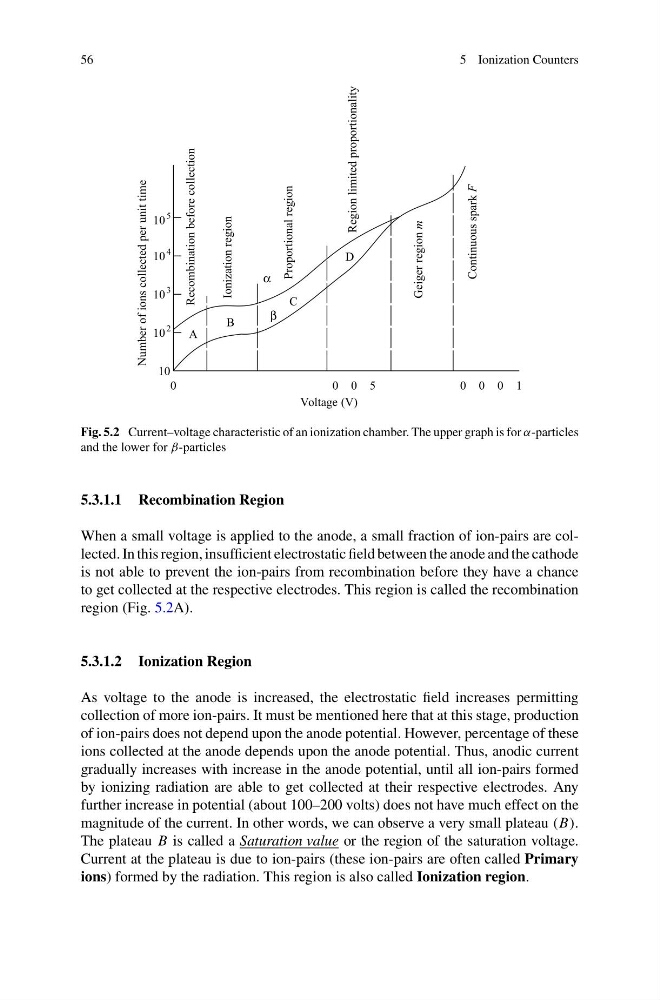
Fig. 5.2 Current–voltage characteristic of an ionization chamber. The upper graph is for α-particles
and the lower for β-particles
5.3.1.1 Recombination Region
When a small voltage is applied to the anode, a small fraction of ion-pairs are collected. In this region, insufficient electrostatic field between the anode and the cathode
is not able to prevent the ion-pairs from recombination before they have a chance
to get collected at the respective electrodes. This region is called the recombination
region (Fig. 5.2A).
5.3.1.2 Ionization Region
As voltage to the anode is increased, the electrostatic field increases permitting
collection of more ion-pairs. It must be mentioned here that at this stage, production
of ion-pairs does not depend upon the anode potential. However, percentage of these
ions collected at the anode depends upon the anode potential. Thus, anodic current
gradually increases with increase in the anode potential, until all ion-pairs formed
by ionizing radiation are able to get collected at their respective electrodes. Any
further increase in potential (about 100–200 volts) does not have much effect on the
magnitude of the current. In other words, we can observe a very small plateau (B).
The plateau B is called a Saturation value or the region of the saturation voltage.
Current at the plateau is due to ion-pairs (these ion-pairs are often called Primary
ions) formed by the radiation. This region is also called Ionization region.
5 Ionization Counters
A
B
C
D
0 0 0 1
0 0 5
0
Voltage (V)
Number of ions collected per unit time
Recombination before collection
Proportional region
Ionization region
Region limited proportionality
Geiger region m
Continuous spark F
10
5
10
4
10
3
10
2
10
Fig. 5.2 Current–voltage characteristic of an ionization chamber. The upper graph is for α-particles
and the lower for β-particles
5.3.1.1 Recombination Region
When a small voltage is applied to the anode, a small fraction of ion-pairs are collected. In this region, insufficient electrostatic field between the anode and the cathode
is not able to prevent the ion-pairs from recombination before they have a chance
to get collected at the respective electrodes. This region is called the recombination
region (Fig. 5.2A).
5.3.1.2 Ionization Region
As voltage to the anode is increased, the electrostatic field increases permitting
collection of more ion-pairs. It must be mentioned here that at this stage, production
of ion-pairs does not depend upon the anode potential. However, percentage of these
ions collected at the anode depends upon the anode potential. Thus, anodic current
gradually increases with increase in the anode potential, until all ion-pairs formed
by ionizing radiation are able to get collected at their respective electrodes. Any
further increase in potential (about 100–200 volts) does not have much effect on the
magnitude of the current. In other words, we can observe a very small plateau (B).
The plateau B is called a Saturation value or the region of the saturation voltage.
Current at the plateau is due to ion-pairs (these ion-pairs are often called Primary
ions) formed by the radiation. This region is also called Ionization region.