

3.8 Applications of Nuclear Reactions
43
232 Th(n, γ )
233 Th
233 Th
β
GGGGGGGA
24.2 min
233 Pa
β
GGGGGGA
27 days
239 U
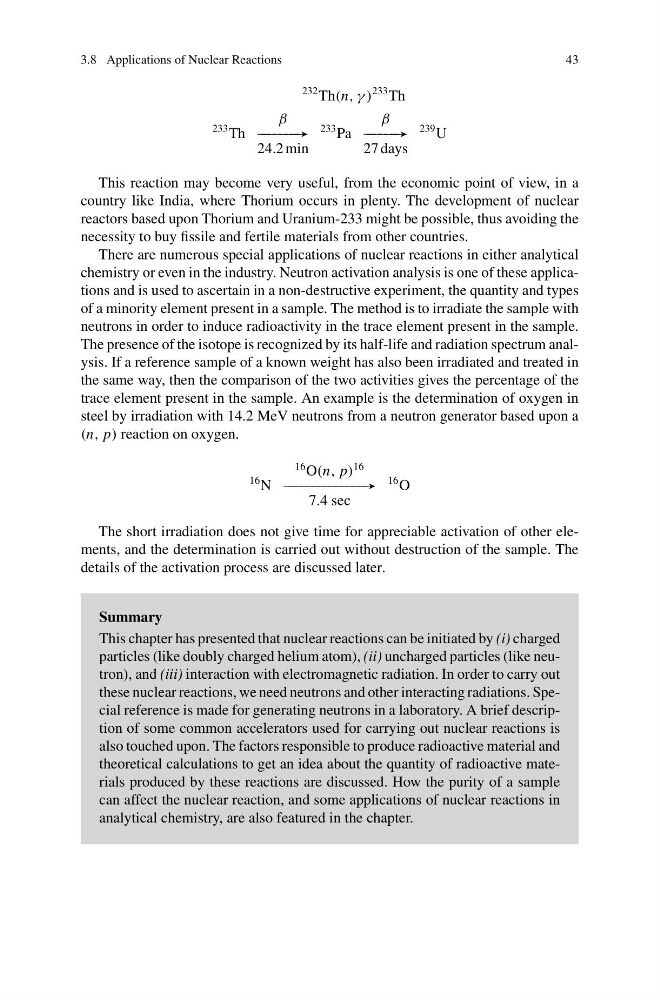
This reaction may become very useful, from the economic point of view, in a
country like India, where Thorium occurs in plenty. The development of nuclear
reactors based upon Thorium and Uranium-233 might be possible, thus avoiding the
necessity to buy fissile and fertile materials from other countries.
There are numerous special applications of nuclear reactions in either analytical
chemistry or even in the industry. Neutron activation analysis is one of these applications and is used to ascertain in a non-destructive experiment, the quantity and types
of a minority element present in a sample. The method is to irradiate the sample with
neutrons in order to induce radioactivity in the trace element present in the sample.
The presence of the isotope is recognized by its half-life and radiation spectrum analysis. If a reference sample of a known weight has also been irradiated and treated in
the same way, then the comparison of the two activities gives the percentage of the
trace element present in the sample. An example is the determination of oxygen in
steel by irradiation with 14.2 MeV neutrons from a neutron generator based upon a
(n, p) reaction on oxygen.
16 N
16 O(n, p)
16
GGGGGGGGGGGGGGA
7.4 sec
16 O
The short irradiation does not give time for appreciable activation of other elements, and the determination is carried out without destruction of the sample. The
details of the activation process are discussed later.
Summary
This chapter has presented that nuclear reactions can be initiated by (i) charged
particles (like doubly charged helium atom), (ii) uncharged particles (like neutron), and (iii) interaction with electromagnetic radiation. In order to carry out
these nuclear reactions, we need neutrons and other interacting radiations. Special reference is made for generating neutrons in a laboratory. A brief description of some common accelerators used for carrying out nuclear reactions is
also touched upon. The factors responsible to produce radioactive material and
theoretical calculations to get an idea about the quantity of radioactive materials produced by these reactions are discussed. How the purity of a sample
can affect the nuclear reaction, and some applications of nuclear reactions in
analytical chemistry, are also featured in the chapter.
43
232 Th(n, γ )
233 Th
233 Th
β
GGGGGGGA
24.2 min
233 Pa
β
GGGGGGA
27 days
239 U
This reaction may become very useful, from the economic point of view, in a
country like India, where Thorium occurs in plenty. The development of nuclear
reactors based upon Thorium and Uranium-233 might be possible, thus avoiding the
necessity to buy fissile and fertile materials from other countries.
There are numerous special applications of nuclear reactions in either analytical
chemistry or even in the industry. Neutron activation analysis is one of these applications and is used to ascertain in a non-destructive experiment, the quantity and types
of a minority element present in a sample. The method is to irradiate the sample with
neutrons in order to induce radioactivity in the trace element present in the sample.
The presence of the isotope is recognized by its half-life and radiation spectrum analysis. If a reference sample of a known weight has also been irradiated and treated in
the same way, then the comparison of the two activities gives the percentage of the
trace element present in the sample. An example is the determination of oxygen in
steel by irradiation with 14.2 MeV neutrons from a neutron generator based upon a
(n, p) reaction on oxygen.
16 N
16 O(n, p)
16
GGGGGGGGGGGGGGA
7.4 sec
16 O
The short irradiation does not give time for appreciable activation of other elements, and the determination is carried out without destruction of the sample. The
details of the activation process are discussed later.
Summary
This chapter has presented that nuclear reactions can be initiated by (i) charged
particles (like doubly charged helium atom), (ii) uncharged particles (like neutron), and (iii) interaction with electromagnetic radiation. In order to carry out
these nuclear reactions, we need neutrons and other interacting radiations. Special reference is made for generating neutrons in a laboratory. A brief description of some common accelerators used for carrying out nuclear reactions is
also touched upon. The factors responsible to produce radioactive material and
theoretical calculations to get an idea about the quantity of radioactive materials produced by these reactions are discussed. How the purity of a sample
can affect the nuclear reaction, and some applications of nuclear reactions in
analytical chemistry, are also featured in the chapter.