

42
3 Nuclear Reaction
product and reactant can indicate the minimum energy of incident particle required
for carrying out the nuclear reaction.
3.7.3 Nature of the Products
It would be advantageous to know the characteristic properties of the expected nuclei
(such as half-life and types of energy of radiation emitted). This helps in planning
the manipulation of the products and the selection of counting methods.
The chemical properties are of assistance in selecting a suitable separation method
of the products from the target material. If a nuclear reaction is to be carried out with
a new element, the chemical properties can be predicted from its expected position
in the periodic table. This may be helpful in planning the experiment.
3.8 Applications of Nuclear Reactions
It is unfortunate that the advents of nuclear science first burst on the world in an
explosion over Hiroshima and Nagasaki. Nevertheless, the fundamental scientific
principles involved in the release of energy in nuclear weapons are now being widely
applied for peaceful purposes. The nuclear reactor is coming into use for the generation of power, such as electricity. Useful by-products from the reactor operation are
radioisotopes, produced either in the fission process itself or by the introduction of
other materials into the neutron atmosphere of the reactor. It is rather fortunate that
some of the radioactive isotopes, which have suitable properties for use as tracers
or radiation sources, such as Strontium-90, Cesium-137, and Barium-140, are produced in the fission process. Another important aspect of reactor operation is that
while the energy is produced for mankind during the nuclear fission reaction, a new
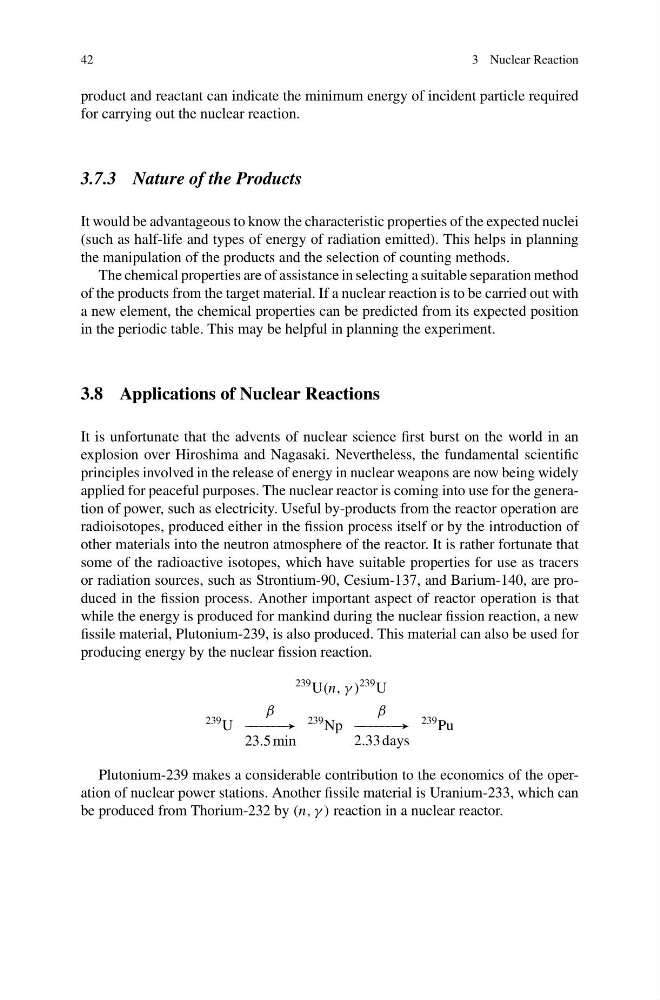
fissile material, Plutonium-239, is also produced. This material can also be used for
producing energy by the nuclear fission reaction.
239 U(n, γ )
239 U
239 U
β
GGGGGGGA
23.5 min
239 Np
β
GGGGGGGGA
2.33 days
239 Pu
Plutonium-239 makes a considerable contribution to the economics of the operation of nuclear power stations. Another fissile material is Uranium-233, which can
be produced from Thorium-232 by (n, γ ) reaction in a nuclear reactor.
3 Nuclear Reaction
product and reactant can indicate the minimum energy of incident particle required
for carrying out the nuclear reaction.
3.7.3 Nature of the Products
It would be advantageous to know the characteristic properties of the expected nuclei
(such as half-life and types of energy of radiation emitted). This helps in planning
the manipulation of the products and the selection of counting methods.
The chemical properties are of assistance in selecting a suitable separation method
of the products from the target material. If a nuclear reaction is to be carried out with
a new element, the chemical properties can be predicted from its expected position
in the periodic table. This may be helpful in planning the experiment.
3.8 Applications of Nuclear Reactions
It is unfortunate that the advents of nuclear science first burst on the world in an
explosion over Hiroshima and Nagasaki. Nevertheless, the fundamental scientific
principles involved in the release of energy in nuclear weapons are now being widely
applied for peaceful purposes. The nuclear reactor is coming into use for the generation of power, such as electricity. Useful by-products from the reactor operation are
radioisotopes, produced either in the fission process itself or by the introduction of
other materials into the neutron atmosphere of the reactor. It is rather fortunate that
some of the radioactive isotopes, which have suitable properties for use as tracers
or radiation sources, such as Strontium-90, Cesium-137, and Barium-140, are produced in the fission process. Another important aspect of reactor operation is that
while the energy is produced for mankind during the nuclear fission reaction, a new
fissile material, Plutonium-239, is also produced. This material can also be used for
producing energy by the nuclear fission reaction.
239 U(n, γ )
239 U
239 U
β
GGGGGGGA
23.5 min
239 Np
β
GGGGGGGGA
2.33 days
239 Pu
Plutonium-239 makes a considerable contribution to the economics of the operation of nuclear power stations. Another fissile material is Uranium-233, which can
be produced from Thorium-232 by (n, γ ) reaction in a nuclear reactor.