

2.6 Decay Scheme
27
d N A
dt
= −λ A × N A
(2.8)
Likewise, at time “t” the number of atoms of “B” being created per second from
“A” is λ A N A (i.e., number of atom A decaying into atom B) while the number of
atoms of “B” disintegrating, in turn, is λ B N B . The rate at which the number of
daughter atoms builds up is equal to the rate of their formation from the decaying
parent atoms less than the rate of their own decay. Therefore, at such times “t” can
be stated as
d N B
dt
= N A λ A − λ B N B
(2.9)
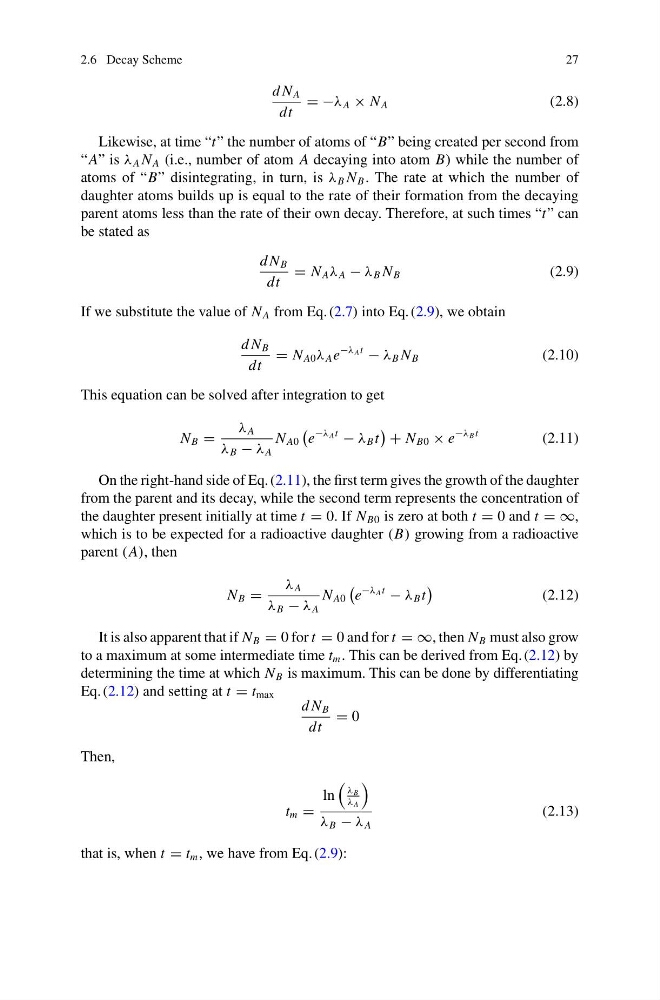
If we substitute the value of N A from Eq. (2.7) into Eq. (2.9), we obtain
d N B
dt
= N A0 λ A e
−λ A t
− λ B N B
(2.10)
This equation can be solved after integration to get
N B =
λ A
λ B − λ A
N A0
e
−λ A t
− λ B t
+ N B0 × e
−λ B t
(2.11)
On the right-hand side of Eq. (2.11), the first term gives the growth of the daughter
from the parent and its decay, while the second term represents the concentration of
the daughter present initially at time t = 0. If N B0 is zero at both t = 0 and t = ∞,
which is to be expected for a radioactive daughter (B) growing from a radioactive
parent (A), then
N B =
λ A
λ B − λ A
N A0
e
−λ A t
− λ B t
(2.12)
It is also apparent that if N B = 0 for t = 0 and for t = ∞, then N B must also grow
to a maximum at some intermediate time t m . This can be derived from Eq. (2.12) by
determining the time at which N B is maximum. This can be done by differentiating
Eq. (2.12) and setting at t = t max
d N B
dt
= 0
Then,
t m =
ln
λ B
λ A
λ B − λ A
(2.13)
that is, when t = t m , we have from Eq. (2.9):
27
d N A
dt
= −λ A × N A
(2.8)
Likewise, at time “t” the number of atoms of “B” being created per second from
“A” is λ A N A (i.e., number of atom A decaying into atom B) while the number of
atoms of “B” disintegrating, in turn, is λ B N B . The rate at which the number of
daughter atoms builds up is equal to the rate of their formation from the decaying
parent atoms less than the rate of their own decay. Therefore, at such times “t” can
be stated as
d N B
dt
= N A λ A − λ B N B
(2.9)
If we substitute the value of N A from Eq. (2.7) into Eq. (2.9), we obtain
d N B
dt
= N A0 λ A e
−λ A t
− λ B N B
(2.10)
This equation can be solved after integration to get
N B =
λ A
λ B − λ A
N A0
e
−λ A t
− λ B t
+ N B0 × e
−λ B t
(2.11)
On the right-hand side of Eq. (2.11), the first term gives the growth of the daughter
from the parent and its decay, while the second term represents the concentration of
the daughter present initially at time t = 0. If N B0 is zero at both t = 0 and t = ∞,
which is to be expected for a radioactive daughter (B) growing from a radioactive
parent (A), then
N B =
λ A
λ B − λ A
N A0
e
−λ A t
− λ B t
(2.12)
It is also apparent that if N B = 0 for t = 0 and for t = ∞, then N B must also grow
to a maximum at some intermediate time t m . This can be derived from Eq. (2.12) by
determining the time at which N B is maximum. This can be done by differentiating
Eq. (2.12) and setting at t = t max
d N B
dt
= 0
Then,
t m =
ln
λ B
λ A
λ B − λ A
(2.13)
that is, when t = t m , we have from Eq. (2.9):