

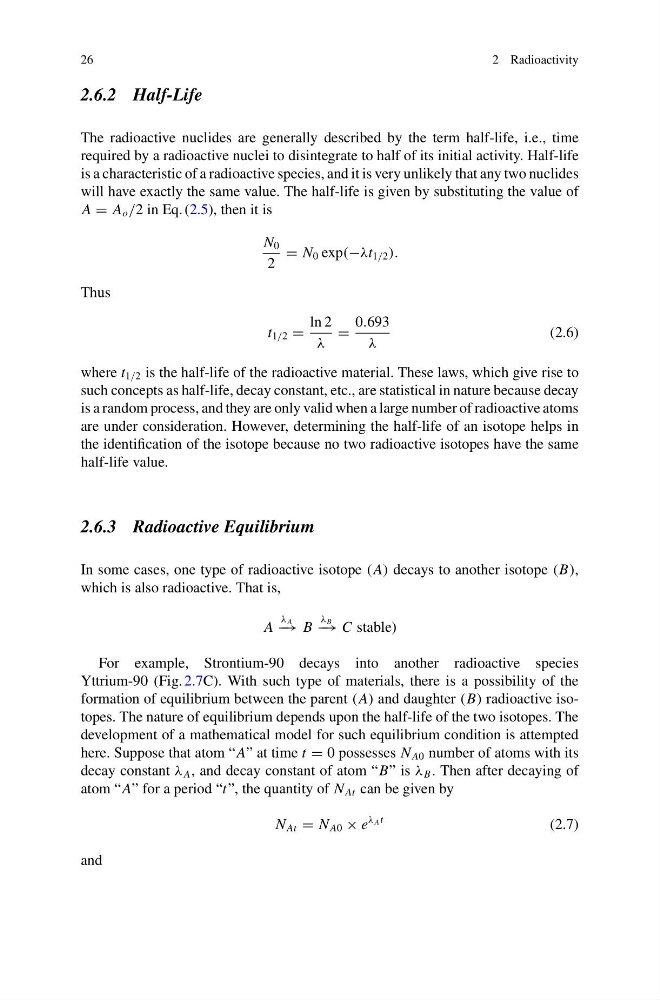
26
2 Radioactivity
2.6.2 Half-Life
The radioactive nuclides are generally described by the term half-life, i.e., time
required by a radioactive nuclei to disintegrate to half of its initial activity. Half-life
is a characteristic of a radioactive species, and it is very unlikely that any two nuclides
will have exactly the same value. The half-life is given by substituting the value of
A = A o /2 in Eq. (2.5), then it is
N 0
2
= N 0 exp(−λt 1/2 ).
Thus
t 1/2 =
ln 2
λ
=
0.693
λ
(2.6)
where t 1/2 is the half-life of the radioactive material. These laws, which give rise to
such concepts as half-life, decay constant, etc., are statistical in nature because decay
is a random process, and they are only valid when a large number of radioactive atoms
are under consideration. However, determining the half-life of an isotope helps in
the identification of the isotope because no two radioactive isotopes have the same
half-life value.
2.6.3 Radioactive Equilibrium
In some cases, one type of radioactive isotope (A) decays to another isotope (B),
which is also radioactive. That is,
A
λ A
− → B
λ B
− → C stable)
For example, Strontium-90 decays into another radioactive species
Yttrium-90 (Fig. 2.7C). With such type of materials, there is a possibility of the
formation of equilibrium between the parent (A) and daughter (B) radioactive isotopes. The nature of equilibrium depends upon the half-life of the two isotopes. The
development of a mathematical model for such equilibrium condition is attempted
here. Suppose that atom “A” at time t = 0 possesses N A0 number of atoms with its
decay constant λ A , and decay constant of atom “B” is λ B . Then after decaying of
atom “A” for a period “t”, the quantity of N At can be given by
N At = N A0 × e
λ A t
(2.7)
and
2 Radioactivity
2.6.2 Half-Life
The radioactive nuclides are generally described by the term half-life, i.e., time
required by a radioactive nuclei to disintegrate to half of its initial activity. Half-life
is a characteristic of a radioactive species, and it is very unlikely that any two nuclides
will have exactly the same value. The half-life is given by substituting the value of
A = A o /2 in Eq. (2.5), then it is
N 0
2
= N 0 exp(−λt 1/2 ).
Thus
t 1/2 =
ln 2
λ
=
0.693
λ
(2.6)
where t 1/2 is the half-life of the radioactive material. These laws, which give rise to
such concepts as half-life, decay constant, etc., are statistical in nature because decay
is a random process, and they are only valid when a large number of radioactive atoms
are under consideration. However, determining the half-life of an isotope helps in
the identification of the isotope because no two radioactive isotopes have the same
half-life value.
2.6.3 Radioactive Equilibrium
In some cases, one type of radioactive isotope (A) decays to another isotope (B),
which is also radioactive. That is,
A
λ A
− → B
λ B
− → C stable)
For example, Strontium-90 decays into another radioactive species
Yttrium-90 (Fig. 2.7C). With such type of materials, there is a possibility of the
formation of equilibrium between the parent (A) and daughter (B) radioactive isotopes. The nature of equilibrium depends upon the half-life of the two isotopes. The
development of a mathematical model for such equilibrium condition is attempted
here. Suppose that atom “A” at time t = 0 possesses N A0 number of atoms with its
decay constant λ A , and decay constant of atom “B” is λ B . Then after decaying of
atom “A” for a period “t”, the quantity of N At can be given by
N At = N A0 × e
λ A t
(2.7)
and