

16
2 Radioactivity
2.3 Interconversion of Nucleons Within the Nucleus
2.3.1 Conversion of Neutrons into Protons
An unstable nucleus that has excess neutron, but not enough to combine with proton in
pairs and emit α-particles and become stable; are made stable by converting a neutron
into a proton. Nuclear electron known as a β-particle (to maintain conservation of
electric charge) along with electromagnetic radiation known as a neutrino is emitted.
When a neutron is converted into a proton, some excess mass (i.e., the mass difference
between the parent and daughter + β-particle) may still be left. This excess mass
may not be large enough to allow another neutron to convert into a proton. Therefore,
this un-utilized excess mass is converted into electromagnetic radiation. This type of
electromagnetic radiation is called a neutrino. In other words, β-particles together
with a neutrino are emitted to conserve excess mass left in the nucleus after one
neutron has been converted into a proton.
The energy available for β-transition (i.e., mass excess) is, thus, shared between a
neutrino and a β-particle. In α-decay, there is no such sharing of excess mass, hence,
the α-particle is emitted from the nucleus with a specific kinetic energy whereas, in
β-decay, since the excess mass (i.e., the energy converted out of the excess mass) is
shared between a neutrino and a β-particle, emitted radiation does not possess fixed
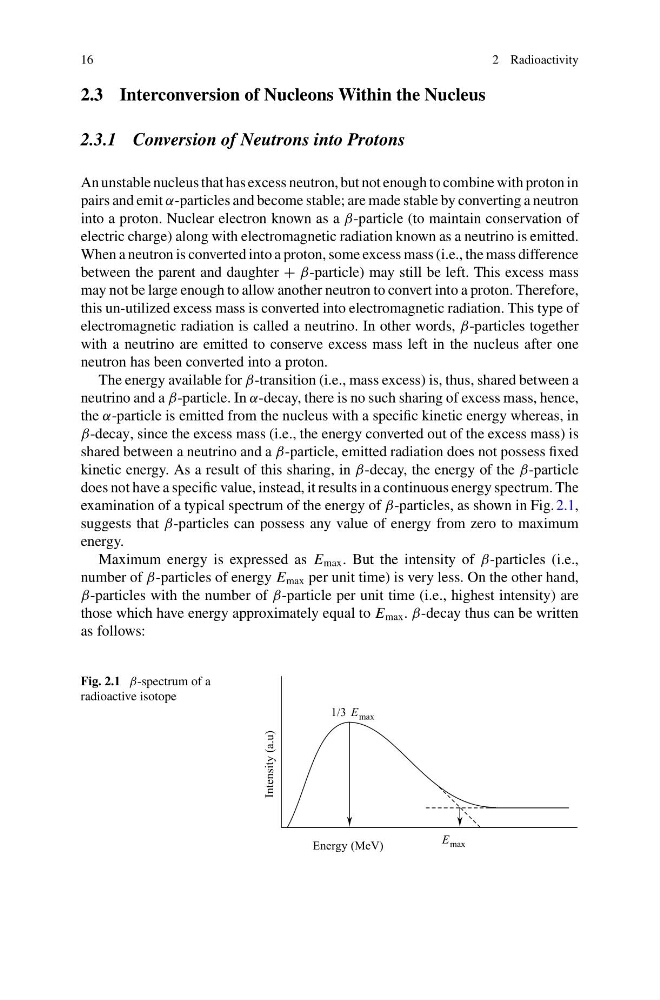
kinetic energy. As a result of this sharing, in β-decay, the energy of the β-particle
does not have a specific value, instead, it results in a continuous energy spectrum. The
examination of a typical spectrum of the energy of β-particles, as shown in Fig. 2.1,
suggests that β-particles can possess any value of energy from zero to maximum
energy.
Maximum energy is expressed as E max . But the intensity of β-particles (i.e.,
number of β-particles of energy E max per unit time) is very less. On the other hand,
β-particles with the number of β-particle per unit time (i.e., highest intensity) are
those which have energy approximately equal to E max . β-decay thus can be written
as follows:
Fig. 2.1 β-spectrum of a
radioactive isotope
1/3 E max
E max
Energy (MeV)
Intensity (a.u)
2 Radioactivity
2.3 Interconversion of Nucleons Within the Nucleus
2.3.1 Conversion of Neutrons into Protons
An unstable nucleus that has excess neutron, but not enough to combine with proton in
pairs and emit α-particles and become stable; are made stable by converting a neutron
into a proton. Nuclear electron known as a β-particle (to maintain conservation of
electric charge) along with electromagnetic radiation known as a neutrino is emitted.
When a neutron is converted into a proton, some excess mass (i.e., the mass difference
between the parent and daughter + β-particle) may still be left. This excess mass
may not be large enough to allow another neutron to convert into a proton. Therefore,
this un-utilized excess mass is converted into electromagnetic radiation. This type of
electromagnetic radiation is called a neutrino. In other words, β-particles together
with a neutrino are emitted to conserve excess mass left in the nucleus after one
neutron has been converted into a proton.
The energy available for β-transition (i.e., mass excess) is, thus, shared between a
neutrino and a β-particle. In α-decay, there is no such sharing of excess mass, hence,
the α-particle is emitted from the nucleus with a specific kinetic energy whereas, in
β-decay, since the excess mass (i.e., the energy converted out of the excess mass) is
shared between a neutrino and a β-particle, emitted radiation does not possess fixed
kinetic energy. As a result of this sharing, in β-decay, the energy of the β-particle
does not have a specific value, instead, it results in a continuous energy spectrum. The
examination of a typical spectrum of the energy of β-particles, as shown in Fig. 2.1,
suggests that β-particles can possess any value of energy from zero to maximum
energy.
Maximum energy is expressed as E max . But the intensity of β-particles (i.e.,
number of β-particles of energy E max per unit time) is very less. On the other hand,
β-particles with the number of β-particle per unit time (i.e., highest intensity) are
those which have energy approximately equal to E max . β-decay thus can be written
as follows:
Fig. 2.1 β-spectrum of a
radioactive isotope
1/3 E max
E max
Energy (MeV)
Intensity (a.u)