

2.2 Emission of Nuclear Particles
15
The daughter nuclei, i.e., the product nuclei are an isotope of the element with an
atomic number two units lower than that of the parent.
In these calculations, the shock experienced by the parent nuclei when an αparticle leaves the nucleus is not considered. Since an α-particle has a mass and it
leaves the nucleus with a velocity almost equal to the velocity of light, the parent
nuclei must also experience a recoil. The energy of α-particles emitted should, thus,
include the effect of recoil energy as well. Therefore, the actual energy of the αparticle is the difference between energy available for transition and recoil energy of
the daughter nucleus. When an α-particle having a mass of 4.002603 a.m.u. leaves
the nucleus, recoil is experienced by the nucleus. Hence, part of the energy is also
shared in conserving the recoil energy. Considering these factors, the energy of an
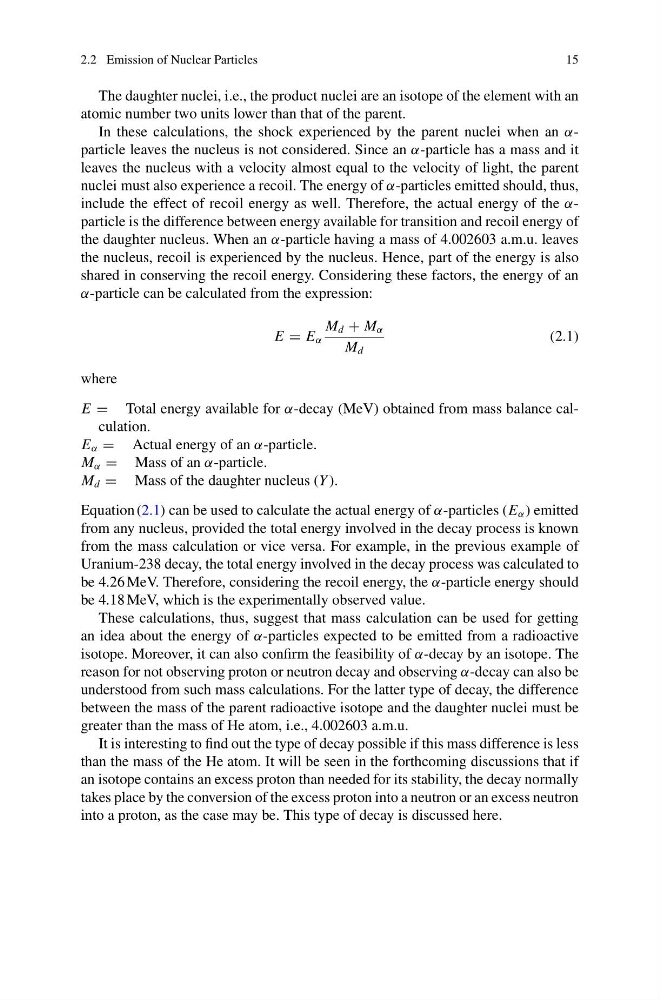
α-particle can be calculated from the expression:
E = E α
M d + M α
M d
(2.1)
where
E = Total energy available for α-decay (MeV) obtained from mass balance calculation.
E α = Actual energy of an α-particle.
M α = Mass of an α-particle.
M d = Mass of the daughter nucleus (Y ).
Equation (2.1) can be used to calculate the actual energy of α-particles (E α ) emitted
from any nucleus, provided the total energy involved in the decay process is known
from the mass calculation or vice versa. For example, in the previous example of
Uranium-238 decay, the total energy involved in the decay process was calculated to
be 4.26 MeV. Therefore, considering the recoil energy, the α-particle energy should
be 4.18 MeV, which is the experimentally observed value.
These calculations, thus, suggest that mass calculation can be used for getting
an idea about the energy of α-particles expected to be emitted from a radioactive
isotope. Moreover, it can also confirm the feasibility of α-decay by an isotope. The
reason for not observing proton or neutron decay and observing α-decay can also be
understood from such mass calculations. For the latter type of decay, the difference
between the mass of the parent radioactive isotope and the daughter nuclei must be
greater than the mass of He atom, i.e., 4.002603 a.m.u.
It is interesting to find out the type of decay possible if this mass difference is less
than the mass of the He atom. It will be seen in the forthcoming discussions that if
an isotope contains an excess proton than needed for its stability, the decay normally
takes place by the conversion of the excess proton into a neutron or an excess neutron
into a proton, as the case may be. This type of decay is discussed here.
15
The daughter nuclei, i.e., the product nuclei are an isotope of the element with an
atomic number two units lower than that of the parent.
In these calculations, the shock experienced by the parent nuclei when an αparticle leaves the nucleus is not considered. Since an α-particle has a mass and it
leaves the nucleus with a velocity almost equal to the velocity of light, the parent
nuclei must also experience a recoil. The energy of α-particles emitted should, thus,
include the effect of recoil energy as well. Therefore, the actual energy of the αparticle is the difference between energy available for transition and recoil energy of
the daughter nucleus. When an α-particle having a mass of 4.002603 a.m.u. leaves
the nucleus, recoil is experienced by the nucleus. Hence, part of the energy is also
shared in conserving the recoil energy. Considering these factors, the energy of an
α-particle can be calculated from the expression:
E = E α
M d + M α
M d
(2.1)
where
E = Total energy available for α-decay (MeV) obtained from mass balance calculation.
E α = Actual energy of an α-particle.
M α = Mass of an α-particle.
M d = Mass of the daughter nucleus (Y ).
Equation (2.1) can be used to calculate the actual energy of α-particles (E α ) emitted
from any nucleus, provided the total energy involved in the decay process is known
from the mass calculation or vice versa. For example, in the previous example of
Uranium-238 decay, the total energy involved in the decay process was calculated to
be 4.26 MeV. Therefore, considering the recoil energy, the α-particle energy should
be 4.18 MeV, which is the experimentally observed value.
These calculations, thus, suggest that mass calculation can be used for getting
an idea about the energy of α-particles expected to be emitted from a radioactive
isotope. Moreover, it can also confirm the feasibility of α-decay by an isotope. The
reason for not observing proton or neutron decay and observing α-decay can also be
understood from such mass calculations. For the latter type of decay, the difference
between the mass of the parent radioactive isotope and the daughter nuclei must be
greater than the mass of He atom, i.e., 4.002603 a.m.u.
It is interesting to find out the type of decay possible if this mass difference is less
than the mass of the He atom. It will be seen in the forthcoming discussions that if
an isotope contains an excess proton than needed for its stability, the decay normally
takes place by the conversion of the excess proton into a neutron or an excess neutron
into a proton, as the case may be. This type of decay is discussed here.