

6
1 Nuclear Chemistry
their binding energies lie near maxima of the curve, i.e., about 8 MeV), whereas
fission reaction products are mostly radioactive (because their binding energies lie
much below the maxima of the curve). We shall now discuss briefly the Fission and
Fusion processes.
1.6 Fission Reaction
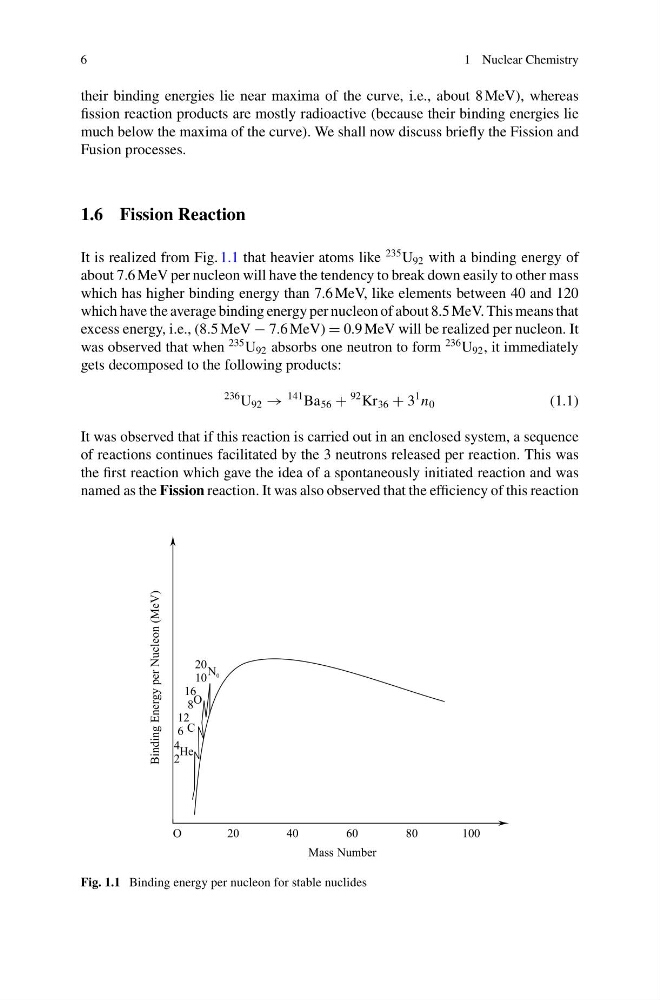
It is realized from Fig. 1.1 that heavier atoms like
235 U 92 with a binding energy of
about 7.6 MeV per nucleon will have the tendency to break down easily to other mass
which has higher binding energy than 7.6 MeV, like elements between 40 and 120
which have the average binding energy per nucleon of about 8.5 MeV. This means that
excess energy, i.e., (8.5 MeV − 7.6 MeV) = 0.9 MeV will be realized per nucleon. It
was observed that when
235 U 92 absorbs one neutron to form
236 U 92 , it immediately
gets decomposed to the following products:
236 U 92 →
141 Ba 56 +
92 Kr 36 + 3
1 n 0
(1.1)
It was observed that if this reaction is carried out in an enclosed system, a sequence
of reactions continues facilitated by the 3 neutrons released per reaction. This was
the first reaction which gave the idea of a spontaneously initiated reaction and was
named as the Fission reaction. It was also observed that the efficiency of this reaction
O
20
40
60
80
100
20
10
N 0
16
8 O
12
6 C
4
2
He
Mass Number
Binding Energy per Nucleon (MeV)
Fig. 1.1 Binding energy per nucleon for stable nuclides
1 Nuclear Chemistry
their binding energies lie near maxima of the curve, i.e., about 8 MeV), whereas
fission reaction products are mostly radioactive (because their binding energies lie
much below the maxima of the curve). We shall now discuss briefly the Fission and
Fusion processes.
1.6 Fission Reaction
It is realized from Fig. 1.1 that heavier atoms like
235 U 92 with a binding energy of
about 7.6 MeV per nucleon will have the tendency to break down easily to other mass
which has higher binding energy than 7.6 MeV, like elements between 40 and 120
which have the average binding energy per nucleon of about 8.5 MeV. This means that
excess energy, i.e., (8.5 MeV − 7.6 MeV) = 0.9 MeV will be realized per nucleon. It
was observed that when
235 U 92 absorbs one neutron to form
236 U 92 , it immediately
gets decomposed to the following products:
236 U 92 →
141 Ba 56 +
92 Kr 36 + 3
1 n 0
(1.1)
It was observed that if this reaction is carried out in an enclosed system, a sequence
of reactions continues facilitated by the 3 neutrons released per reaction. This was
the first reaction which gave the idea of a spontaneously initiated reaction and was
named as the Fission reaction. It was also observed that the efficiency of this reaction
O
20
40
60
80
100
20
10
N 0
16
8 O
12
6 C
4
2
He
Mass Number
Binding Energy per Nucleon (MeV)
Fig. 1.1 Binding energy per nucleon for stable nuclides